Dötsch Annika, Eisele Lewin, Rabeling Miriam, Rump Katharina, Walstein Kai, Bick Alexandra, Cox Linda, Engler Andrea, Bachmann Hagen S, Jöckel Karl-Heinz, Adamzik Michael, Peters Jürgen, Schäfer Simon T
Klinik für Anästhesiologie und Intensivmedizin, Universitätsklinikum Essen, Hufelandstraße 55, D-45122 Essen, Germany.
Institut für Medizinische Informatik, Biometrie und Epidemiologie, D-45122 Essen, Germany.
Int J Mol Sci. 2017 Jun 14;18(6):1266. doi: 10.3390/ijms18061266.
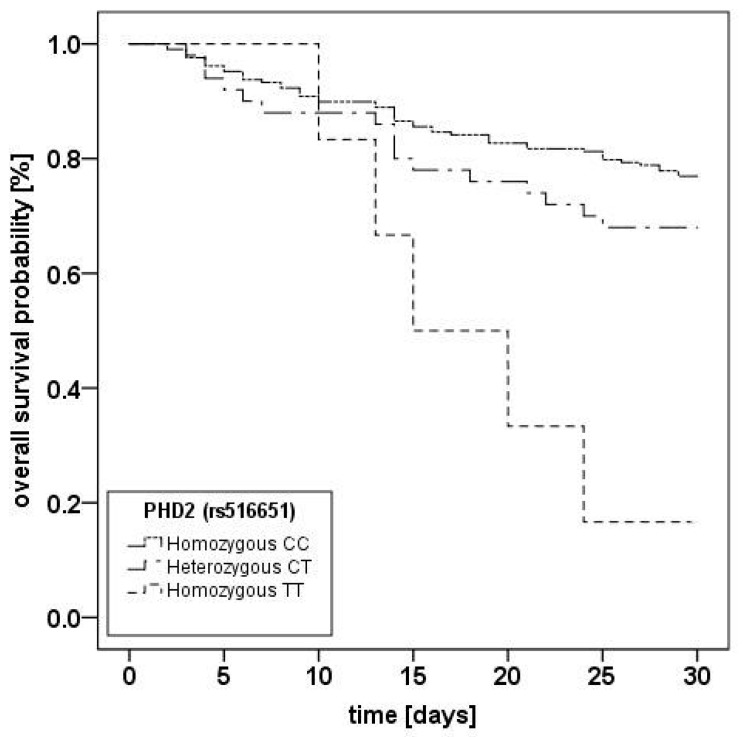
Hypoxia-inducible-factor-2α (HIF-2α) and HIF-2 degrading prolyl-hydroxylases (PHD) are key regulators of adaptive hypoxic responses i.e., in acute respiratory distress syndrome (ARDS). Specifically, functionally active genetic variants of (single nucleotide polymorphism (SNP) [ch2:46441523(hg18)]) and (C/T; SNP rs516651 and T/C; SNP rs480902) are associated with improved adaptation to hypoxia i.e., in high-altitude residents. However, little is known about these SNPs' prevalence in Caucasians and impact on ARDS-outcome. Thus, we tested the hypotheses that in Caucasian ARDS patients SNPs in or genes are (1) common, and (2) independent risk factors for 30-day mortality. After ethics-committee approval, 272 ARDS patients were prospectively included, genotyped for (Taqman SNP Genotyping Assay) and -polymorphism (restriction digest + agarose-gel visualization), and genotype dependent 30-day mortality was analyzed using Kaplan-Meier-plots and multivariate Cox-regression analyses. Frequencies were 99.62% for homozygous CC-carriers (CG: 0.38%; GG: 0%), 2.3% for homozygous SNP rs516651 TT-carriers (CT: 18.9%; CC: 78.8%), and 3.7% for homozygous SNP rs480902 TT-carriers (CT: 43.9%; CC: 52.4%). rs516651 TT-genotype in ARDS was independently associated with a 3.34 times greater mortality risk (OR 3.34, CI 1.09-10.22; = 0.034) within 30-days, whereas the other SNPs had no significant impact ( = ns). The homozygous GG-genotype was not present in our Caucasian ARDS cohort; however SNPs exist in Caucasians, and rs516651 TT-genotype was associated with an increased 30-day mortality suggesting a relevance for adaptive responses in ARDS.
缺氧诱导因子-2α(HIF-2α)和HIF-2降解脯氨酰羟化酶(PHD)是适应性低氧反应的关键调节因子,即在急性呼吸窘迫综合征(ARDS)中。具体而言,(单核苷酸多态性(SNP)[ch2:46441523(hg18)])和(C/T;SNP rs516651和T/C;SNP rs480902)的功能活性基因变异与更好地适应低氧有关,即在高原居民中。然而,关于这些SNP在白种人中的患病率及其对ARDS预后的影响知之甚少。因此,我们检验了以下假设:在白种人ARDS患者中,或基因中的SNP是(1)常见的,以及(2)30天死亡率的独立危险因素。经伦理委员会批准,前瞻性纳入272例ARDS患者,对进行基因分型(Taqman SNP基因分型检测)和-多态性分析(限制性酶切+琼脂糖凝胶可视化),并使用Kaplan-Meier图和多变量Cox回归分析来分析基因型依赖性30天死亡率。纯合CC携带者的频率为99.62%(CG:0.38%;GG:0%),纯合SNP rs516651 TT携带者的频率为2.3%(CT:18.9%;CC:78.8%),纯合SNP rs480902 TT携带者的频率为3.7%(CT:43.9%;CC:52.4%)。ARDS中的rs516651 TT基因型与30天内死亡风险高3.34倍独立相关(OR 3.34,CI 1.09 - 10.22;= 0.034),而其他SNP无显著影响(=无显著性)。我们的白种人ARDS队列中不存在纯合GG基因型;然而白种人中存在SNP,且rs516651 TT基因型与30天死亡率增加相关,提示其与ARDS中的适应性反应相关。