Liu Lei, Mu Li-Min, Yan Yan, Wu Jia-Shuan, Hu Ying-Jie, Bu Ying-Zi, Zhang Jing-Ying, Liu Rui, Li Xue-Qi, Lu Wan-Liang
Beijing Key Laboratory of Molecular Pharmaceutics and New Drug System, State Key Laboratory of Natural and Biomimetic Drugs, School of Pharmaceutical Sciences, Peking University, Beijing, People's Republic of China.
Int J Nanomedicine. 2017 Jun 1;12:4163-4176. doi: 10.2147/IJN.S133194. eCollection 2017.
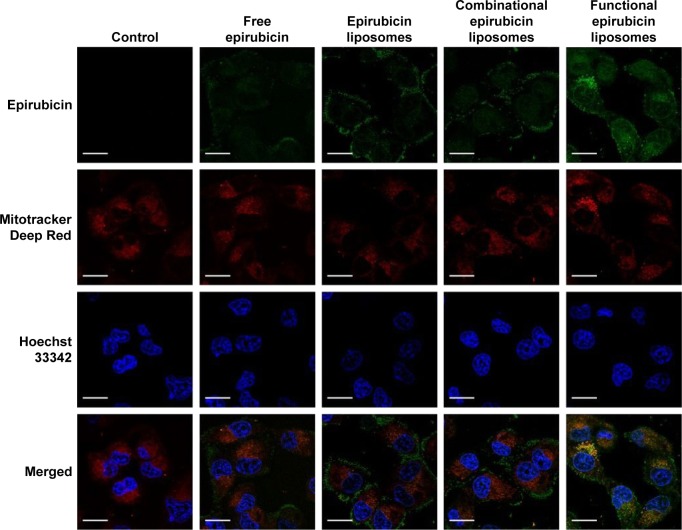
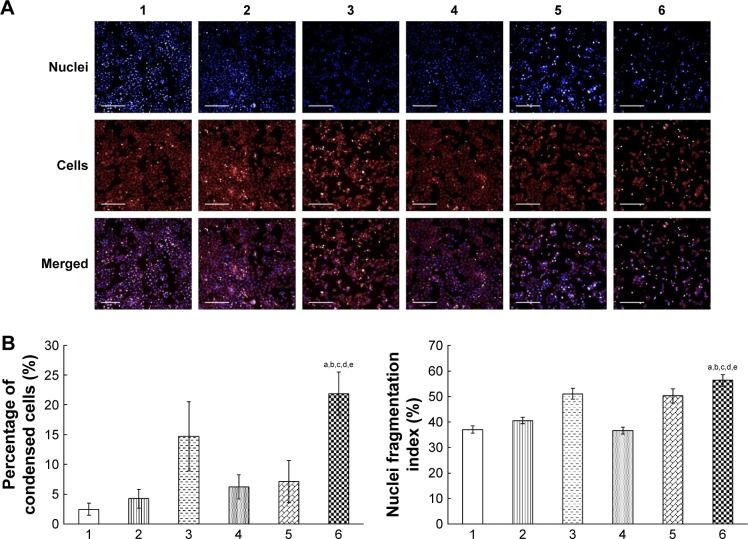
Currently, chemotherapy is less efficient in controlling the continued development of breast cancer because it cannot eliminate extrinsic and intrinsic refractory cancers. In this study, mitochondria were modified by functional epirubicin liposomes to eliminate refractory cancers through initiation of an apoptosis cascade. The efficacy and mechanism of epirubicin liposomes were investigated on human breast cancer cells in vitro and in vivo using flow cytometry, confocal microscopy, high-content screening system, in vivo imaging system, and tumor inhibition in mice. Mechanistic studies revealed that the liposomes could target the mitochondria, activate the apoptotic enzymes caspase 8, 9, and 3, upregulate the proapoptotic protein Bax while downregulating the antiapoptotic protein Mcl-1, and induce the generation of reactive oxygen species (ROS) through an apoptosis cascade. In xenografted mice bearing breast cancer, the epirubicin liposomes demonstrated prolonged blood circulation, significantly increased accumulation in tumor tissue, and robust anticancer efficacy. This study demonstrated that functional epirubicin liposomes could significantly induce programmed death of refractory breast cancer by activating caspases and ROS-related apoptotic signaling pathways, in addition to the direct killing effect of the anticancer drug itself. Thus, we present a simple nanomedicine strategy to treat refractory breast cancer.
目前,化疗在控制乳腺癌的持续发展方面效率较低,因为它无法消除外在和内在的难治性癌症。在本研究中,通过功能性表柔比星脂质体对线粒体进行修饰,以通过启动凋亡级联反应来消除难治性癌症。使用流式细胞术、共聚焦显微镜、高内涵筛选系统、体内成像系统以及小鼠肿瘤抑制实验,在体外和体内对人乳腺癌细胞研究了表柔比星脂质体的疗效和作用机制。机制研究表明,脂质体可靶向线粒体,激活凋亡酶半胱天冬酶8、9和3,上调促凋亡蛋白Bax,同时下调抗凋亡蛋白Mcl-1,并通过凋亡级联反应诱导活性氧(ROS)的产生。在携带乳腺癌的异种移植小鼠中,表柔比星脂质体显示出延长的血液循环时间、肿瘤组织中积累显著增加以及强大的抗癌疗效。这项研究表明,功能性表柔比星脂质体除了具有抗癌药物本身的直接杀伤作用外,还可通过激活半胱天冬酶和ROS相关的凋亡信号通路,显著诱导难治性乳腺癌的程序性死亡。因此,我们提出了一种治疗难治性乳腺癌的简单纳米药物策略。