Cheng Stella T T, Lam Gary Y H, To Carol K S
The University of Hong Kong, Hong Kong.
University of South Florida Tampa, FL, USA.
Iperception. 2017 Jun 5;8(3):2041669517711200. doi: 10.1177/2041669517711200. eCollection 2017 May-Jun.
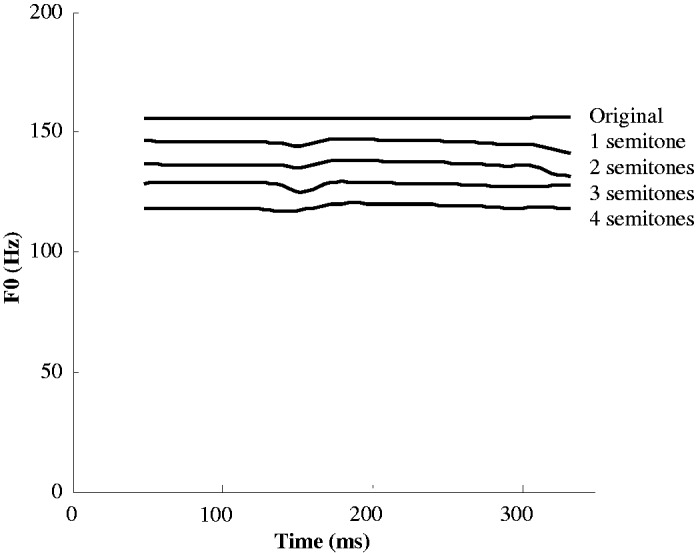
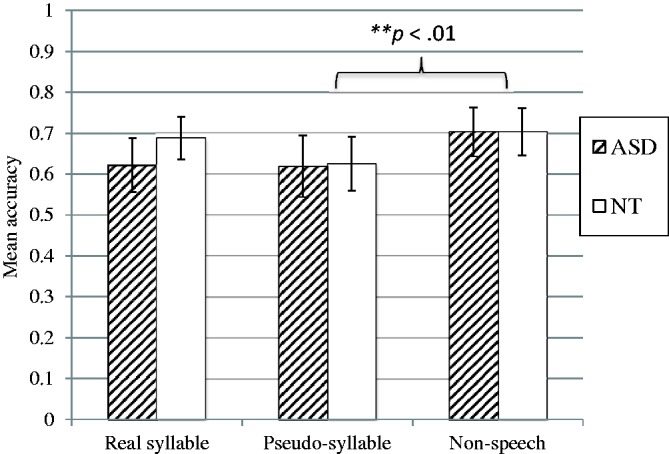
Enhanced low-level pitch perception has been universally reported in autism spectrum disorders (ASD). This study examined whether tone language speakers with ASD exhibit this advantage. The pitch perception skill of 20 Cantonese-speaking adults with ASD was compared with that of 20 neurotypical individuals. Participants discriminated pairs of real syllable, pseudo-syllable (syllables that do not conform the phonotactic rules or are accidental gaps), and non-speech (syllables with attenuated high-frequency segmental content) stimuli contrasting pitch levels. The results revealed significantly higher discrimination ability in both groups for the non-speech stimuli than for the pseudo-syllables with one semitone difference. No significant group differences were noted. Different from previous findings, post hoc analysis found that enhanced pitch perception was observed in a subgroup of participants with ASD showing no history of delayed speech onset. The tone language experience may have modulated the pitch processing mechanism in the speakers in both ASD and non-ASD groups.
在自闭症谱系障碍(ASD)中,增强的低水平音高感知已被普遍报道。本研究调查了讲声调语言的ASD患者是否也表现出这一优势。研究将20名讲粤语的成年ASD患者的音高感知技能与20名神经典型个体进行了比较。参与者对真实音节、假音节(不符合音位规则或偶然出现的音节)和非语音(高频段内容衰减的音节)刺激的音高差异进行辨别。结果显示,两组对非语音刺激的辨别能力均显著高于半音差异的假音节,未发现显著的组间差异。与以往研究结果不同的是,事后分析发现,在无语言发育迟缓病史的ASD患者亚组中观察到了增强的音高感知。声调语言经验可能调节了ASD组和非ASD组参与者的音高处理机制。