Połczyńska Monika, Japardi Kevin, Curtiss Susan, Moody Teena, Benjamin Christopher, Cho Andrew, Vigil Celia, Kuhn Taylor, Jones Michael, Bookheimer Susan
UCLA Department of Psychiatry and Biobehavioral Sciences, Los Angeles, CA 90095, USA; Faculty of English, Adam Mickiewicz University, Poznań, Poland.
UCLA Department of Psychiatry and Biobehavioral Sciences, Los Angeles, CA 90095, USA.
Neuroimage Clin. 2017 May 26;15:415-427. doi: 10.1016/j.nicl.2017.05.021. eCollection 2017.
Brain surgery in the language dominant hemisphere remains challenging due to unintended post-surgical language deficits, despite using pre-surgical functional magnetic resonance (fMRI) and intraoperative cortical stimulation. Moreover, patients are often recommended not to undergo surgery if the accompanying risk to language appears to be too high. While standard fMRI language mapping protocols may have relatively good predictive value at the group level, they remain sub-optimal on an individual level. The standard tests used typically assess lexico-semantic aspects of language, and they do not accurately reflect the complexity of language either in comprehension or production at the sentence level. Among patients who had left hemisphere language dominance we assessed which tests are best at activating language areas in the brain.
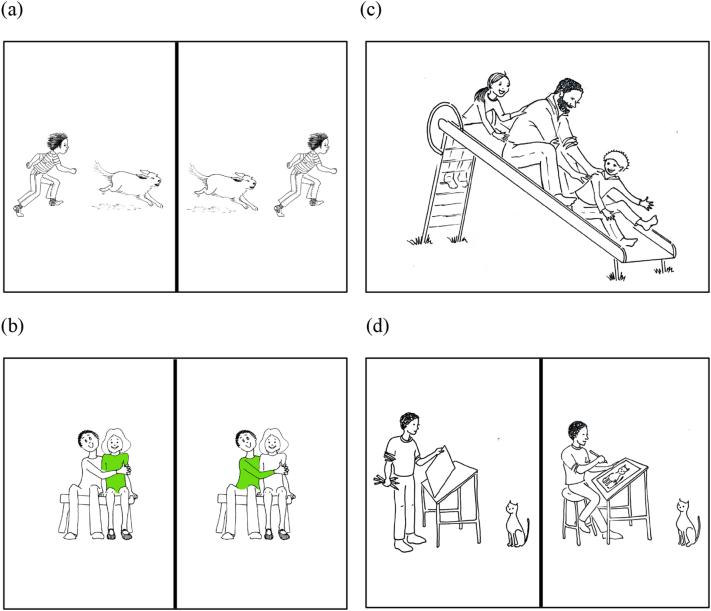
We compared grammar tests (items testing word order in actives and passives, -subject and object questions, relativized subject and object clauses and past tense marking) with standard tests (object naming, auditory and visual responsive naming), using pre-operative fMRI. Twenty-five surgical candidates (13 females) participated in this study. Sixteen patients presented with a brain tumor, and nine with epilepsy. All participants underwent two pre-operative fMRI protocols: one including CYCLE-N grammar tests (items testing word order in actives and passives, wh-subject and object questions, relativized subject and object clauses and past tense marking); and a second one with standard fMRI tests (object naming, auditory and visual responsive naming). fMRI activations during performance in both protocols were compared at the group level, as well as in individual candidates.
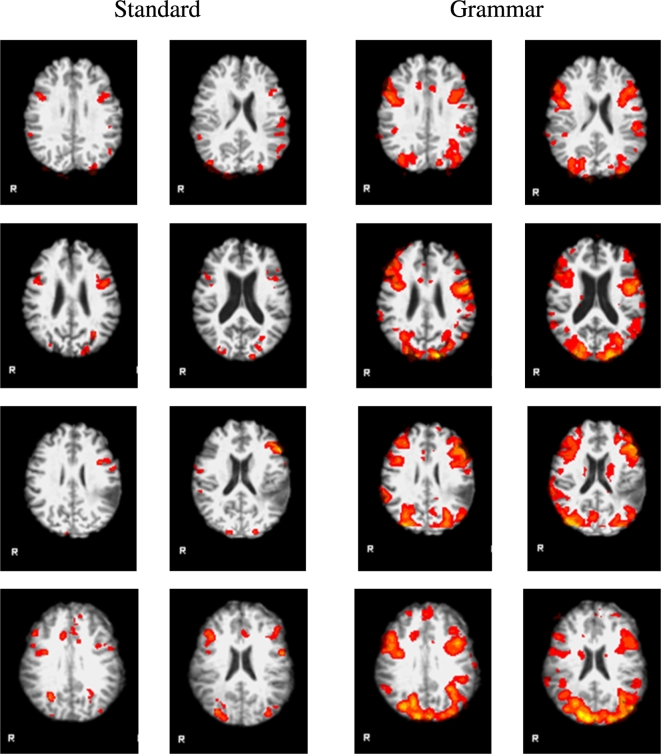
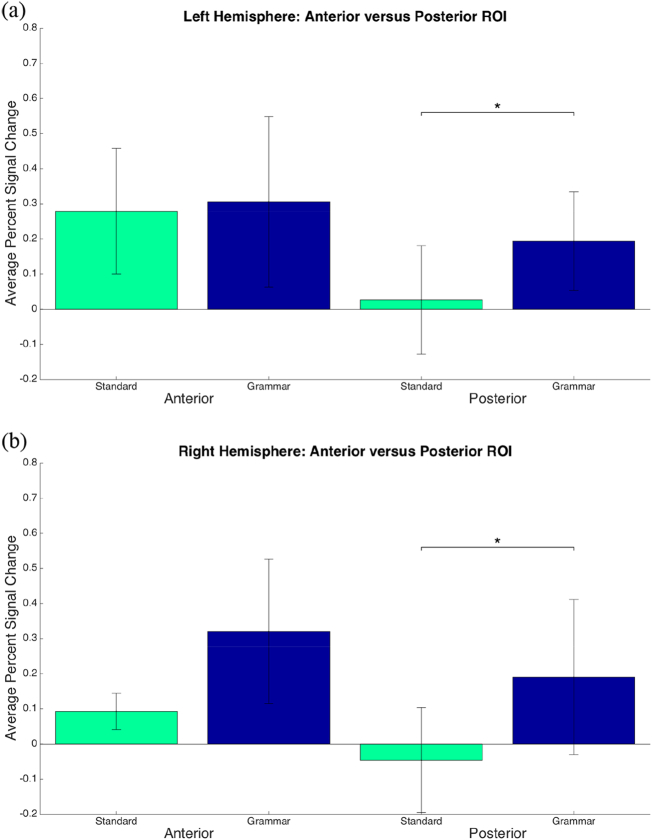
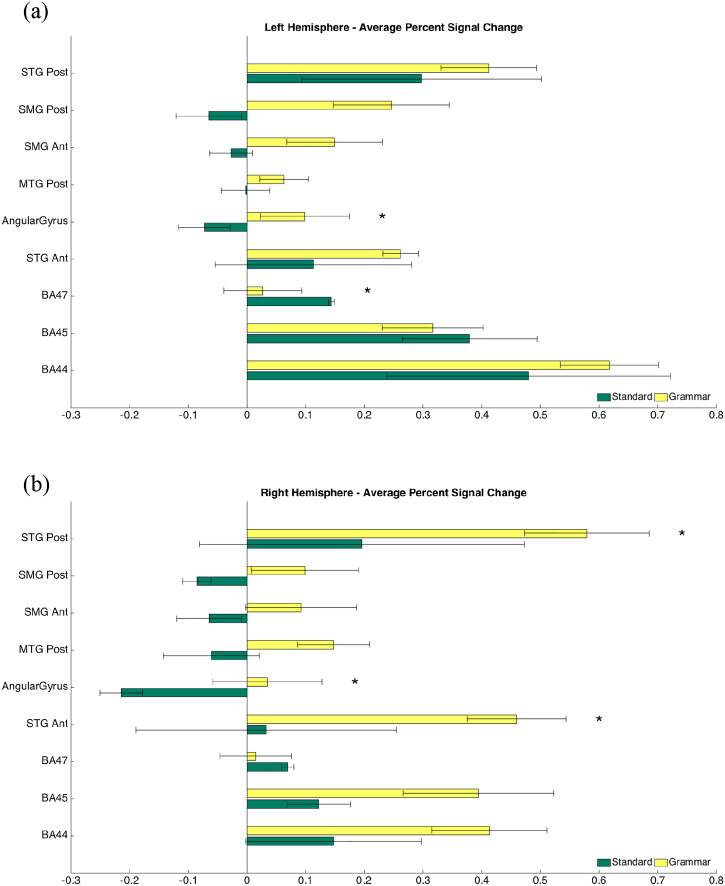
The grammar tests generated more volume of activation in the left hemisphere (left/right angular gyrus, right anterior/posterior superior temporal gyrus) and identified additional language regions not shown by the standard tests (e.g., left anterior/posterior supramarginal gyrus). The standard tests produced more activation in left BA 47. Ten participants had more robust activations in the left hemisphere in the grammar tests and two in the standard tests. The grammar tests also elicited substantial activations in the right hemisphere and thus turned out to be superior at identifying both right and left hemisphere contribution to language processing.
The grammar tests may be an important addition to the standard pre-operative fMRI testing.
尽管术前使用了功能磁共振成像(fMRI)和术中皮层刺激,但由于术后意外出现语言功能缺陷,在优势半球进行脑手术仍然具有挑战性。此外,如果语言相关风险似乎过高,通常会建议患者不要接受手术。虽然标准的fMRI语言映射协议在群体水平上可能具有相对较好的预测价值,但在个体水平上仍不尽人意。通常使用的标准测试主要评估语言的词汇语义方面,它们在句子层面的理解或生成中都无法准确反映语言的复杂性。在左侧半球具有语言优势的患者中,我们评估了哪些测试最能激活大脑中的语言区域。
我们使用术前fMRI,将语法测试(测试主动语态和被动语态中的词序、主语和宾语疑问句、关系化主语和宾语从句以及过去时态标记的项目)与标准测试(物体命名、听觉和视觉反应性命名)进行比较。25名手术候选者(13名女性)参与了本研究。16名患者患有脑肿瘤,9名患有癫痫。所有参与者都接受了两项术前fMRI检查:一项包括CYCLE-N语法测试(测试主动语态和被动语态中的词序、主语和宾语疑问句、关系化主语和宾语从句以及过去时态标记的项目);另一项是标准fMRI测试(物体命名、听觉和视觉反应性命名)。在群体水平以及个体候选者中,比较了两种检查过程中fMRI的激活情况。
语法测试在左侧半球(左侧/右侧角回、右侧前/后颞上回)产生了更多的激活区域,并识别出标准测试未显示的额外语言区域(例如,左侧前/后缘上回)。标准测试在左侧BA 47区域产生了更多的激活。10名参与者在语法测试中左侧半球的激活更强,2名在标准测试中更强。语法测试在右侧半球也引发了大量激活,因此在识别左右半球对语言处理的贡献方面表现更优。
语法测试可能是标准术前fMRI检查的重要补充。