Foroughinia Farzaneh, Foroozmehr Maryam
Clinical Neurology Research Center, Shiraz University of Medical Sciences, Shiraz, Iran.
Clinical Pharmacy Department, Shiraz University of Medical Sciences, Shiraz, Iran.
J Res Pharm Pract. 2017 Apr-Jun;6(2):94-99. doi: 10.4103/jrpp.JRPP_17_24.
Studies have demonstrated the direct relation between elevation in cardiac necrosis markers and increased risk of cardiovascular complications after percutaneous coronary intervention (PCI) in chronic kidney disease (CKD) patients. In this study, we sought to evaluate the effect of omega-3 on creatine kinase-MB (CK-MB) and troponin-I in CKD patients undergoing elective PCI.
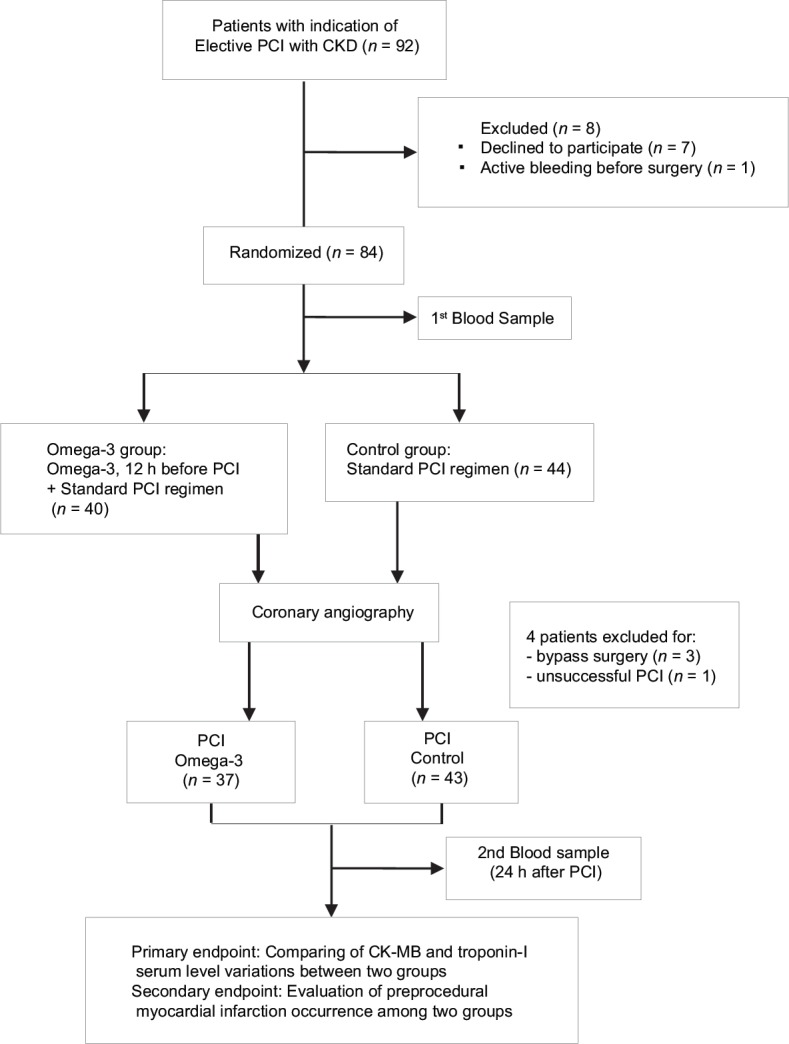
Eighty CKD patients, candidate for elective PCI, were randomly assigned into two groups: Group A - receiving omega-3 (2.5 g, 12 h before PCI) plus standard treatment ( = 37) and Group B - control group, receiving only standard therapy (aspirin 325 mg and clopidogrel 600 mg loading dose and weight-adjusted intravenous heparin) ( = 43). Blood samples were collected before and 24 h after PCI for measuring CK-MB and troponin-I. The primary endpoint was considered to be postprocedural variations of CK-MB and troponin-I levels in both groups. The secondary endpoint was the percentage of pre-procedural myocardial infarction (PMI) occurrence, defined as the elevation of post-PCI troponin-I, between study groups.
Both the baseline and 24-h CK-MB were significantly higher in omega-3 group. Although 24-h troponin-I increased less in omega-3-treated arm compared to the control group, no statistically significant variation was observed between the two groups. With regard to PMI occurrence, no significant difference was detected among study groups.
Despite the beneficial but nonsignificant effects of omega-3 on decreasing post-PCI elevation of troponin-I and PMI occurrence, further investigations with bigger study population, higher doses of omega-3 and longer duration of treatment, and long-term follow-up of patients are required to better test the potential effects of omega-3 in improving clinical outcomes in CKD patients undergoing PCI.
研究表明,慢性肾脏病(CKD)患者经皮冠状动脉介入治疗(PCI)后,心脏坏死标志物升高与心血管并发症风险增加之间存在直接关联。在本研究中,我们旨在评估ω-3对择期行PCI的CKD患者肌酸激酶同工酶(CK-MB)和肌钙蛋白I的影响。
80例择期行PCI的CKD患者被随机分为两组:A组——接受ω-3(2.5 g,PCI前12小时)加标准治疗(n = 37);B组——对照组,仅接受标准治疗(阿司匹林325 mg和氯吡格雷600 mg负荷剂量以及根据体重调整的静脉肝素)(n = 43)。在PCI前和PCI后24小时采集血样,测定CK-MB和肌钙蛋白I。主要终点被认为是两组中CK-MB和肌钙蛋白I水平的术后变化。次要终点是研究组之间术前心肌梗死(PMI)的发生率,定义为PCI后肌钙蛋白I升高。
ω-3组的基线和24小时CK-MB均显著更高。尽管与对照组相比,ω-3治疗组的24小时肌钙蛋白I升高较少,但两组之间未观察到统计学上的显著差异。关于PMI的发生,研究组之间未检测到显著差异。
尽管ω-3在降低PCI后肌钙蛋白I升高和PMI发生方面有有益但不显著的作用,但需要更大的研究人群、更高剂量的ω-3和更长的治疗时间以及对患者进行长期随访的进一步研究,以更好地测试ω-3在改善接受PCI治疗的CKD患者临床结局方面的潜在作用。