Merz Tamara, Vogt Josef A, Wachter Ulrich, Calzia Enrico, Szabo Csaba, Wang Rui, Radermacher Peter, McCook Oscar
Institute of Anesthesiological Pathophysiology and Process Engineering, University Medical School, Helmholtzstrasse 8-1, 89081, Ulm, Germany.
Department of Anesthesiology, University Hospital, Ulm, Germany.
Intensive Care Med Exp. 2017 Dec;5(1):30. doi: 10.1186/s40635-017-0140-7. Epub 2017 Jun 14.
Cystathionine-γ-lyase (CSE) was shown to have a regulatory role in glucose metabolism. Circulatory shock can induce metabolic stress, thereby leading to hyperglycemia and mitochondrial dysfunction. In vitro data suggest an effect of high glucose on CSE expression. Therefore, the aim of this study was to investigate the effects of hyperglycemia on CSE expression in resuscitated murine septic shock.
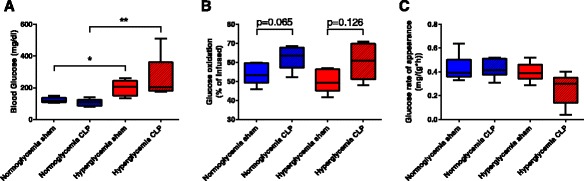
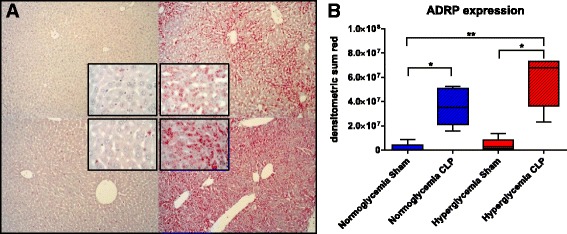
Normo- (80-150 mg/dl) and hyperglycemic (>200 mg/dl) male C57/BL6J mice (n = 5-6 per group) underwent cecal ligation and puncture (CLP)-induced polymicrobial sepsis or sham procedure (n = 6 per group) and, 15 h afterwards, were anesthetized again, surgically instrumented and received intensive care treatment, including antibiotics, lung protective mechanical ventilation, circulatory support, and intravenous (i.v.) glucose infusion (50% as stable-isotope labeled 1,2,3,4,5,6-C glucose). Blood and breath gas were sampled hourly to quantify parameters of glucose metabolism. 5 h later, mice were sacrificed and organs were harvested. The liver mitochondrial respiratory activity was determined via high resolution respirometry; CSE, peroxisome proliferator-activated receptor gamma coactivator 1-alpha (PGC1α), and adipocyte differentiation-related protein (ADRP) expression was immunohistochemically investigated.
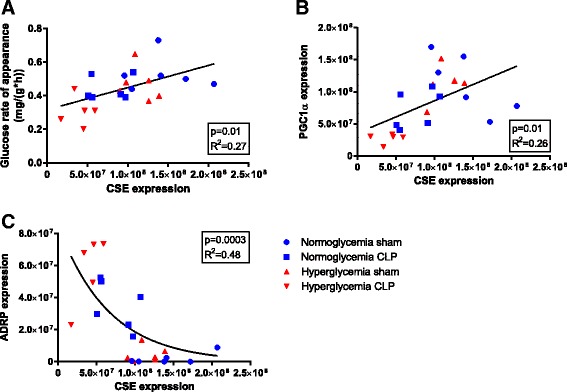
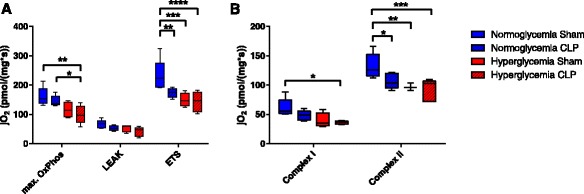
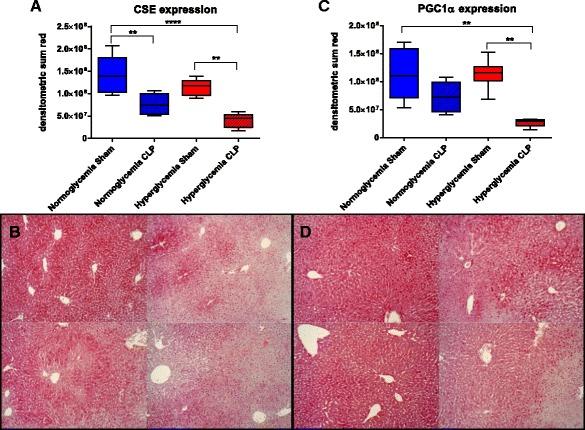
In sepsis combined with hyperglycemia the least CSE and PGC1α expression could be detected, along with reduced mitochondrial respiratory activity, and enhanced ADRP expression, a marker of lipid droplet formation, in the liver. A novel in vivo finding is the CSE translocation from the cytosol to the nucleus triggered by metabolic stress.
A relationship between CSE and glucose metabolism was established, which, when dysregulated, may contribute to fatty liver disease and hepatic steatosis.
胱硫醚-γ-裂解酶(CSE)在葡萄糖代谢中具有调节作用。循环性休克可诱导代谢应激,进而导致高血糖和线粒体功能障碍。体外数据表明高糖对CSE表达有影响。因此,本研究旨在探讨高血糖对复苏的小鼠脓毒症休克中CSE表达的影响。
正常血糖(80 - 150mg/dl)和高血糖(>200mg/dl)的雄性C57/BL6J小鼠(每组n = 5 - 6)接受盲肠结扎和穿刺(CLP)诱导的混合菌败血症或假手术(每组n = 6),15小时后再次麻醉,进行手术器械植入并接受重症监护治疗,包括抗生素、肺保护性机械通气、循环支持和静脉输注葡萄糖(50%为稳定同位素标记的1,2,3,4,5,6-C葡萄糖)。每小时采集血液和呼吸气体样本以量化葡萄糖代谢参数。5小时后,处死小鼠并采集器官。通过高分辨率呼吸测定法测定肝脏线粒体呼吸活性;免疫组织化学研究CSE、过氧化物酶体增殖物激活受体γ共激活因子1α(PGC1α)和脂肪细胞分化相关蛋白(ADRP)的表达。
在败血症合并高血糖的情况下,肝脏中可检测到最少的CSE和PGC1α表达,同时线粒体呼吸活性降低,脂滴形成标志物ADRP表达增强。一个新的体内发现是代谢应激触发CSE从细胞质转位至细胞核。
建立了CSE与葡萄糖代谢之间的关系,当这种关系失调时,可能导致脂肪肝疾病和肝脂肪变性。