Maheu-Giroux Mathieu, Vesga Juan F, Diabaté Souleymane, Alary Michel, Baral Stefan, Diouf Daouda, Abo Kouamé, Boily Marie-Claude
Department of Epidemiology, Biostatistics, and Occupational Health, McGill University, Montréal, Québec, Canada.
Department of Infectious Disease Epidemiology, Imperial College London, St Mary's Hospital, London, United Kingdom.
PLoS Med. 2017 Jun 15;14(6):e1002321. doi: 10.1371/journal.pmed.1002321. eCollection 2017 Jun.
National responses will need to be markedly accelerated to achieve the ambitious target of the Joint United Nations Programme on HIV/AIDS (UNAIDS). This target aims for 90% of HIV-positive individuals to be aware of their status, for 90% of those aware to receive antiretroviral therapy (ART), and for 90% of those on treatment to have a suppressed viral load by 2020, with each individual target reaching 95% by 2030. We aimed to estimate the impact of various treatment-as-prevention scenarios in Côte d'Ivoire, one of the countries with the highest HIV incidence in West Africa, with unmet HIV prevention and treatment needs, and where key populations are important to the broader HIV epidemic.
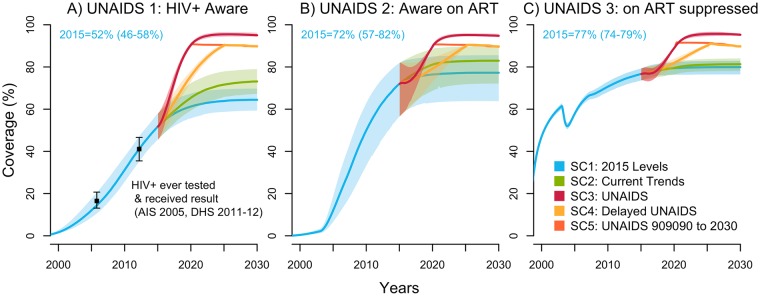
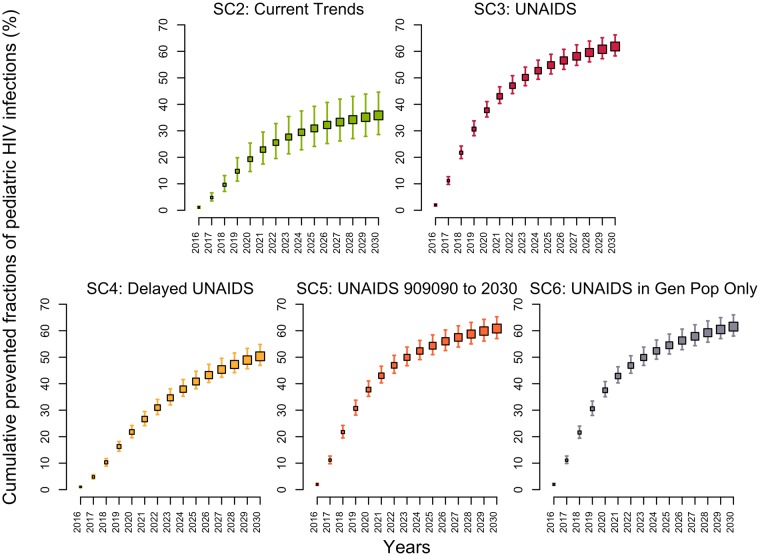
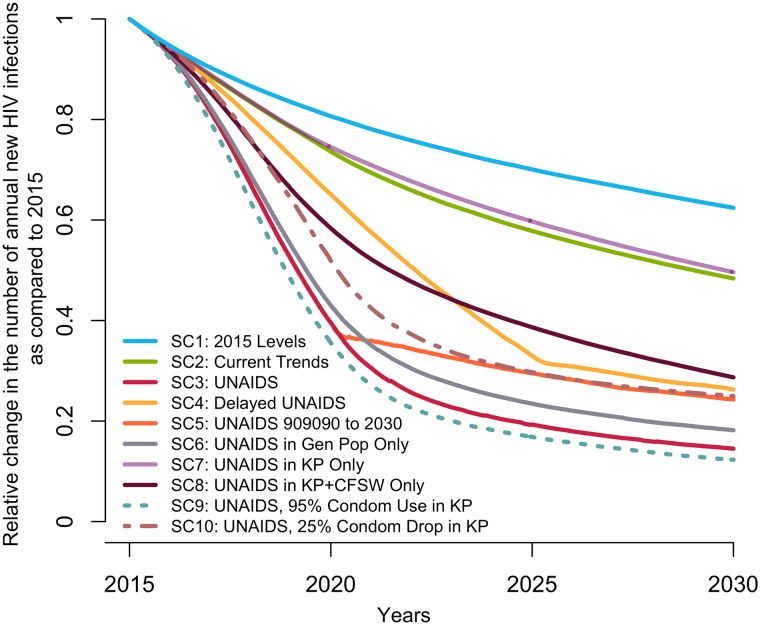
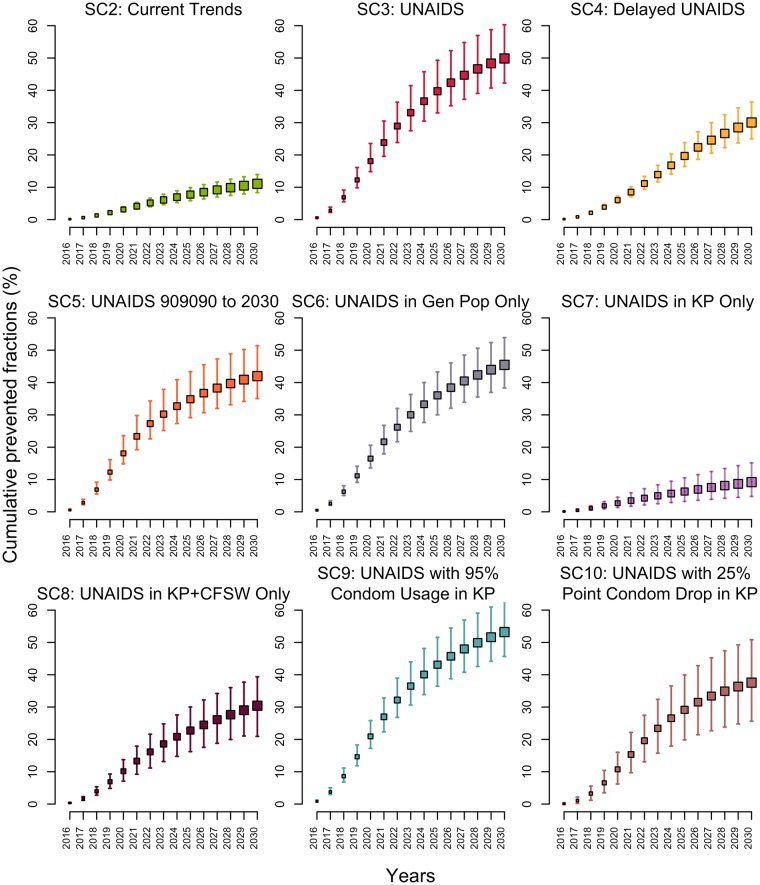
An age-stratified dynamic model was developed and calibrated to epidemiological and programmatic data using a Bayesian framework. The model represents sexual and vertical HIV transmission in the general population, female sex workers (FSW), and men who have sex with men (MSM). We estimated the impact of scaling up interventions to reach the UNAIDS targets, as well as the impact of 8 other scenarios, on HIV transmission in adults and children, compared to our baseline scenario that maintains 2015 rates of testing, ART initiation, ART discontinuation, treatment failure, and levels of condom use. In 2015, we estimated that 52% (95% credible intervals: 46%-58%) of HIV-positive individuals were aware of their status, 72% (57%-82%) of those aware were on ART, and 77% (74%-79%) of those on ART were virologically suppressed. Reaching the UNAIDS targets on time would avert 50% (42%-60%) of new HIV infections over 2015-2030 compared to 30% (25%-36%) if the 90-90-90 target is reached in 2025. Attaining the UNAIDS targets in FSW, their clients, and MSM (but not in the rest of the population) would avert a similar fraction of new infections (30%; 21%-39%). A 25-percentage-point drop in condom use from the 2015 levels among FSW and MSM would reduce the impact of reaching the UNAIDS targets, with 38% (26%-51%) of infections averted. The study's main limitation is that homogenous spatial coverage of interventions was assumed, and future lines of inquiry should examine how geographical prioritization could affect HIV transmission.
Maximizing the impact of the UNAIDS targets will require rapid scale-up of interventions, particularly testing, ART initiation, and limiting ART discontinuation. Reaching clients of FSW, as well as key populations, can efficiently reduce transmission. Sustaining the high condom-use levels among key populations should remain an important prevention pillar.
要实现联合国艾滋病规划署(UNAIDS)设定的宏伟目标,各国的应对措施需大幅加速。该目标旨在到2020年使90%的艾滋病毒呈阳性者知晓自身感染状况,使90%知晓自身感染状况者接受抗逆转录病毒治疗(ART),使90%接受治疗者的病毒载量得到抑制,到2030年每个单独目标都达到95%。我们旨在评估在科特迪瓦这一西非艾滋病毒发病率最高的国家,各种治疗即预防方案的影响,该国存在未满足的艾滋病毒预防和治疗需求,且关键人群对更广泛的艾滋病毒流行至关重要。
利用贝叶斯框架开发了一个按年龄分层的动态模型,并根据流行病学和规划数据进行校准。该模型代表了一般人群、女性性工作者(FSW)和男男性行为者(MSM)中的性传播和垂直传播艾滋病毒情况。与维持2015年检测率、开始接受抗逆转录病毒治疗率、停止治疗率、治疗失败率及避孕套使用率的基线情景相比,我们估计了扩大干预措施以实现联合国艾滋病规划署目标以及其他8种情景对成人和儿童艾滋病毒传播的影响。2015年,我们估计52%(95%可信区间:46%-58%)的艾滋病毒呈阳性者知晓自身感染状况,72%(57%-82%)知晓自身感染状况者接受了抗逆转录病毒治疗,77%(74%-79%)接受治疗者的病毒载量得到了抑制。与如果在2025年实现90-90-90目标可避免30%(25%-36%)的新感染相比,按时实现联合国艾滋病规划署目标将在2015年至2030年期间避免50%(42%-60%)的新艾滋病毒感染。在女性性工作者、其客户和男男性行为者(但非其他人群)中实现联合国艾滋病规划署目标将避免类似比例的新感染(30%;21%-39%)。女性性工作者和男男性行为者的避孕套使用率从2015年水平下降25个百分点将降低实现联合国艾滋病规划署目标的影响效果,可避免38%(26%-51%)的感染。该研究的主要局限性在于假设干预措施在空间上具有均匀覆盖,未来的研究方向应探讨地理优先排序如何影响艾滋病毒传播。
要使联合国艾滋病规划署目标的影响最大化,需要迅速扩大干预措施,特别是检测、开始接受抗逆转录病毒治疗以及限制停止治疗。覆盖女性性工作者的客户以及关键人群能够有效减少传播。维持关键人群中的高避孕套使用率应始终是重要的预防支柱。