Sollero Bruna P, Junqueira Vinícius S, Gomes Cláudia C G, Caetano Alexandre R, Cardoso Fernando F
Embrapa Pecuária Sul, Caixa Postal 242 - BR 153 - Km 633, Bagé, Rio Grande do Sul, 96.401-970, Brazil.
Departamento de Zootecnia, Universidade Federal de Viçosa, Avenida Peter Henry Rolfs, s/n - Campus Universitário, Viçosa, Minas Gerais, 36.570-000, Brazil.
Genet Sel Evol. 2017 Jun 15;49(1):49. doi: 10.1186/s12711-017-0325-2.
Cattle resistance to ticks is known to be under genetic control with a complex biological mechanism within and among breeds. Our aim was to identify genomic segments and tag single nucleotide polymorphisms (SNPs) associated with tick-resistance in Hereford and Braford cattle. The predictive performance of a very low-density tag SNP panel was estimated and compared with results obtained with a 50 K SNP dataset.
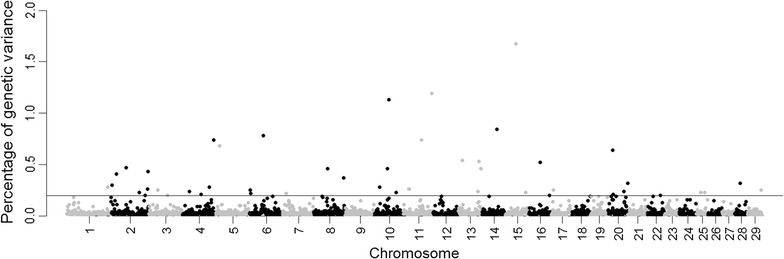
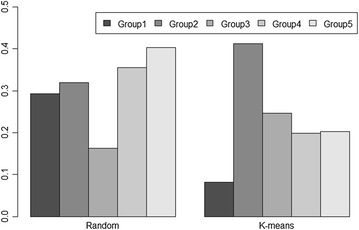
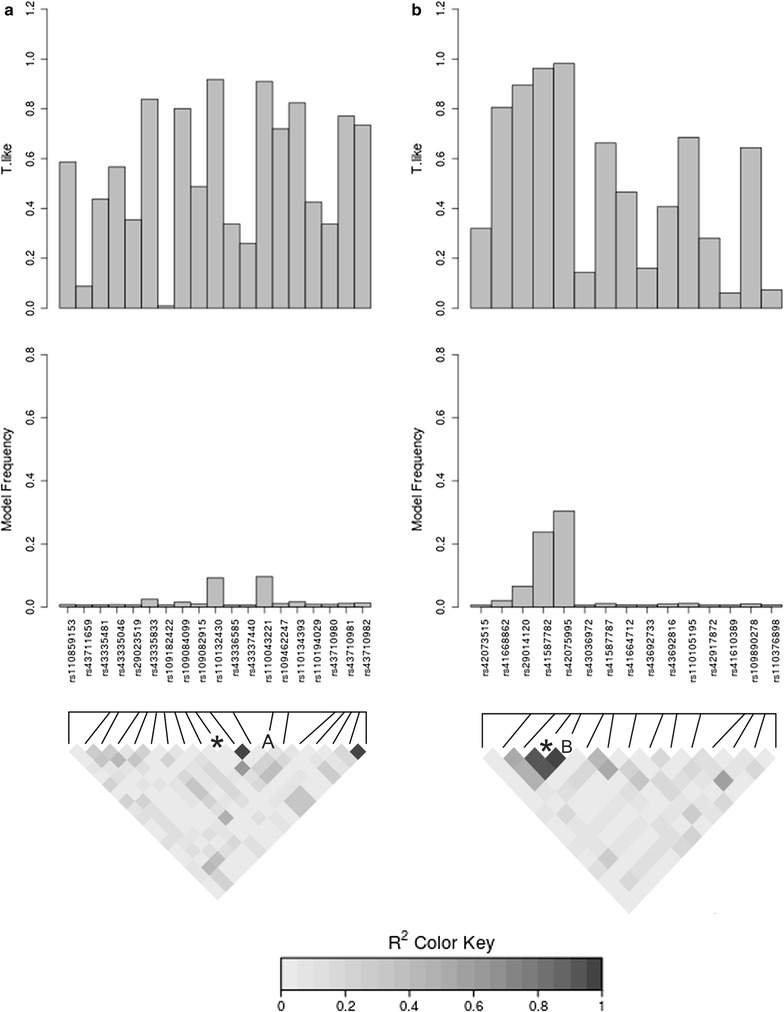
BayesB (π = 0.99) was initially applied in a genome-wide association study (GWAS) for this complex trait by using deregressed estimated breeding values for tick counts and 41,045 SNP genotypes from 3455 animals raised in southern Brazil. To estimate the combined effect of a genomic region that is potentially associated with quantitative trait loci (QTL), 2519 non-overlapping 1-Mb windows that varied in SNP number were defined, with the top 48 windows including 914 SNPs and explaining more than 20% of the estimated genetic variance for tick resistance. Subsequently, the most informative SNPs were selected based on Bayesian parameters (model frequency and t-like statistics), linkage disequilibrium and minor allele frequency to propose a very low-density 58-SNP panel. Some of these tag SNPs mapped close to or within genes and pseudogenes that are functionally related to tick resistance. Prediction ability of this SNP panel was investigated by cross-validation using K-means and random clustering and a BayesA model to predict direct genomic values. Accuracies from these cross-validations were 0.27 ± 0.09 and 0.30 ± 0.09 for the K-means and random clustering groups, respectively, compared to respective values of 0.37 ± 0.08 and 0.43 ± 0.08 when using all 41,045 SNPs and BayesB with π = 0.99, or of 0.28 ± 0.07 and 0.40 ± 0.08 with π = 0.999.
Bayesian GWAS model parameters can be used to select tag SNPs for a very low-density panel, which will include SNPs that are potentially linked to functional genes. It can be useful for cost-effective genomic selection tools, when one or a few key complex traits are of interest.
已知牛对蜱虫的抗性受遗传控制,品种内和品种间存在复杂的生物学机制。我们的目标是在海福特牛和布拉福德牛中鉴定与蜱虫抗性相关的基因组片段和标签单核苷酸多态性(SNP)。估计了一个极低密度标签SNP面板的预测性能,并与使用50K SNP数据集获得的结果进行比较。
最初通过使用来自巴西南部饲养的3455头动物的蜱虫计数的去回归估计育种值和41045个SNP基因型,将贝叶斯B(π = 0.99)应用于该复杂性状的全基因组关联研究(GWAS)。为了估计潜在与数量性状基因座(QTL)相关的基因组区域的综合效应,定义了2519个不重叠的1-Mb窗口,这些窗口的SNP数量各不相同,前48个窗口包含914个SNP,解释了超过20%的蜱虫抗性估计遗传方差。随后,根据贝叶斯参数(模型频率和t统计量)、连锁不平衡和次要等位基因频率选择信息性最强的SNP,以提出一个极低密度的58-SNP面板。其中一些标签SNP映射到与蜱虫抗性功能相关的基因和假基因附近或内部。使用K均值和随机聚类以及贝叶斯A模型通过交叉验证研究了该SNP面板的预测能力,以预测直接基因组值。K均值和随机聚类组的交叉验证准确率分别为0.27±0.09和0.30±0.09,而使用所有41045个SNP和π = 0.99的贝叶斯B时,相应值分别为0.37±0.08和0.43±0.08,或使用π = 0.999时为0.28±0.07和0.40±0.08。
贝叶斯GWAS模型参数可用于为极低密度面板选择标签SNP,该面板将包括可能与功能基因连锁的SNP。当关注一个或几个关键复杂性状时,它对于具有成本效益的基因组选择工具可能是有用的。