Ludwig-Maximilians-Universität München, Department of Earth & Environmental Sciences, Palaeontology & Geobiology, Richard-Wagner-Str. 10, 80333, Munich, Germany.
GeoBio-CenterLMU, Ludwig-Maximilians-Universität München, Richard-Wagner Str. 10, 80333, Munich, Germany.
Sci Rep. 2017 Jun 15;7(1):3599. doi: 10.1038/s41598-017-03791-w.
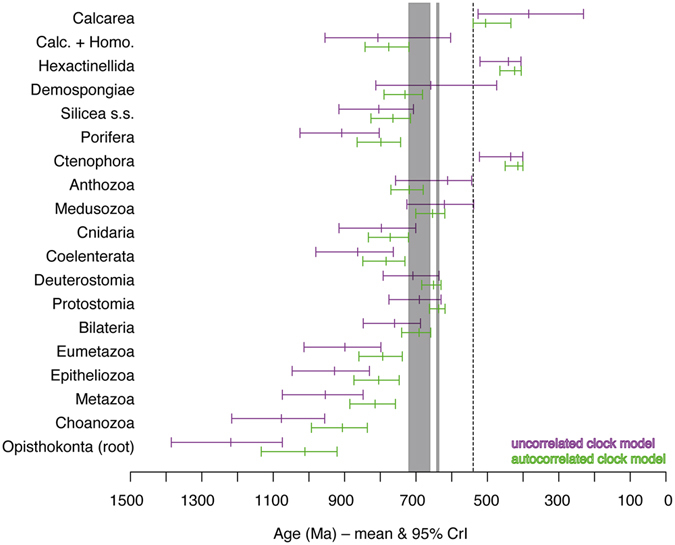
Information about the geological timeframe during which animals radiated into their major subclades is crucial to understanding early animal ecology and evolution. Unfortunately, the pre-Cambrian fossil record is sparse and its interpretation controversial. Relaxed molecular-clock methods provide an alternative means of estimating the timing of cladogenesis deep in the metazoan tree of life. So far, thorough molecular clock studies focusing specifically on Metazoa as a whole have been based on relatively small datasets or incomplete representation of the main non-bilaterian lineages (such as sponges and ctenophores), which are fundamental for understanding early metazoan evolution. Here, we use a previously published phylogenomic dataset that includes a fair sampling of all relevant groups to estimate the timing of early animal evolution with Bayesian relaxed-clock methods. According to our results, all non-bilaterian phyla, as well as total-group Bilateria, evolved in an ancient radiation during a geologically relatively short time span, before the onset of long-term global glaciations ("Snowball Earth"; ~720-635 Ma). Importantly, this result appears robust to alterations of a number of important analytical variables, such as models of among-lineage rate variation and sets of fossil calibrations used.
有关动物辐射到其主要亚类的地质时间框架的信息对于理解早期动物生态学和进化至关重要。不幸的是,前寒武纪化石记录稀缺,其解释存在争议。放松的分子钟方法为估计后生动物生命树中深层分类群发生的时间提供了另一种手段。到目前为止,专门针对整个后生动物作为一个整体的彻底的分子钟研究基于相对较小的数据集或主要非双侧体谱系(如海绵和栉水母)的不完全表示,这对于理解早期后生动物进化至关重要。在这里,我们使用以前发表的系统基因组数据集,该数据集包括对所有相关组的公平采样,使用贝叶斯放松时钟方法来估计早期动物进化的时间。根据我们的结果,所有非双侧体门以及总组双侧体都在地质上相对较短的时间内发生了古老的辐射,在长期的全球冰川作用(“雪球地球”;~720-635Ma)之前。重要的是,该结果似乎不受许多重要分析变量的改变的影响,例如谱系间速率变化的模型和使用的化石校准集。