Lavocat Fabien, Ndongo-Thiam Ndiémé, Miossec Pierre
Department of Immunology and Rheumatology, Immunogenomics and Inflammation Research Unit EA 4130, University of Lyon, Edouard Herriot Hospital, Lyon, France.
Front Immunol. 2017 May 31;8:647. doi: 10.3389/fimmu.2017.00647. eCollection 2017.
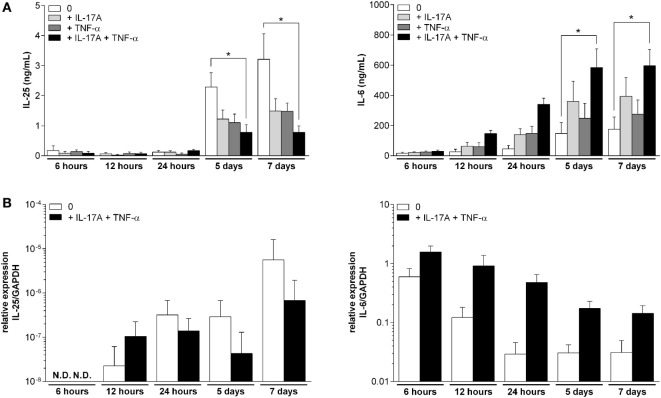
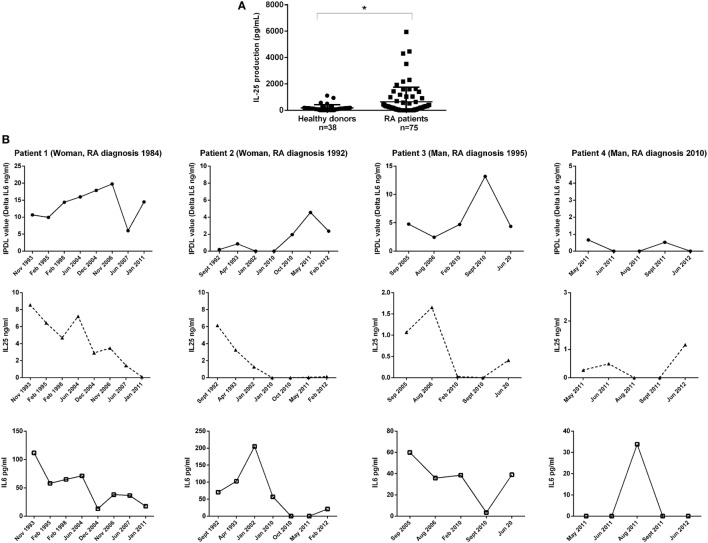
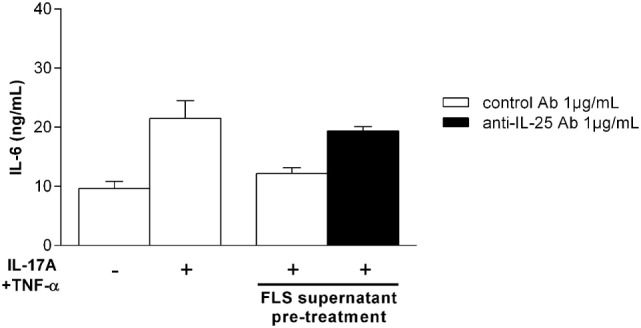
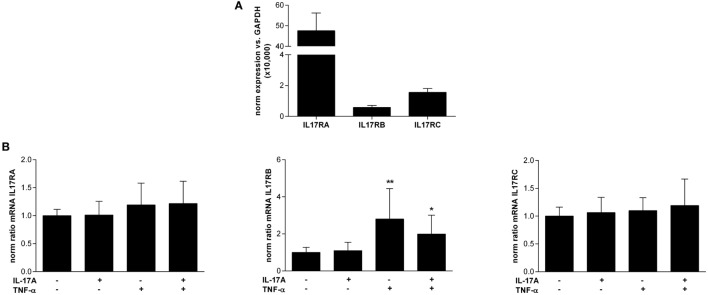
The production and function of cytokines are highly regulated. One mechanism is the balance between pro- and anti-inflammatory cytokines. As interleukin (IL)-17A and IL-25 share the IL-17RA receptor chain, we hypothesize that IL-25 acts as an IL-17A receptor antagonist and limits its pro-inflammatory effects. The production and expression kinetics of IL-25 and its receptor chains IL-17RA and RB were analyzed in rheumatoid synoviocytes alone or in coculture with peripheral blood mononuclear cells (PBMCs). The effects of autocrine or exogenous IL-25 on synoviocytes were investigated in the presence or not of an anti-IL-25 antibody. To study the regulatory effects of IL-25, synoviocytes and/or PBMCs were exposed to IL-25 before being treated with IL-17A and tumor necrosis factor alpha (TNF-α) alone or combined. IL-25, IL-6, and bioactive IL-17A were quantified in rheumatoid arthritis (RA) patient plasma. Synoviocytes expressed and secreted IL-25, and expressed the two chains of its receptor IL-17RA and IL-17RB. IL-17RB expression was increased by TNF-α. IL-25 production occurred at a delayed time point (5 days) after stimulation with IL-17A and TNF-α. Synoviocytes pretreated with IL-25 were less responsive to IL-17A and TNF-α. PBMCs exposed to IL-25 showed a decreased production of pro-inflammatory mediators, including IL-17A with a 57% decrease; = 0.002. IL-25 levels were elevated in the plasma of RA patients compared to healthy subjects ( = 0.03). However, these levels are not high enough to inhibit the function of circulating IL-17A. In conclusion, it was shown for the first time that synoviocytes produce IL-25, specifically at late time points and that IL-25 acts as a regulator of IL-17A-driven inflammation, as indicated by results and , in a long-term RA patient follow-up. These results may be important when considering IL-17A inhibition.
细胞因子的产生和功能受到高度调控。一种机制是促炎细胞因子和抗炎细胞因子之间的平衡。由于白细胞介素(IL)-17A和IL-25共用IL-17RA受体链,我们推测IL-25作为IL-17A受体拮抗剂,限制其促炎作用。单独或与外周血单核细胞(PBMC)共培养的类风湿滑膜细胞中分析了IL-25及其受体链IL-17RA和RB的产生及表达动力学。在存在或不存在抗IL-25抗体的情况下,研究了自分泌或外源性IL-25对滑膜细胞的影响。为了研究IL-25的调节作用,在单独或联合用IL-17A和肿瘤坏死因子α(TNF-α)处理之前,将滑膜细胞和/或PBMC暴露于IL-25。对类风湿关节炎(RA)患者血浆中的IL-25、IL-6和生物活性IL-17A进行了定量。滑膜细胞表达并分泌IL-25,并表达其受体IL-17RA和IL-17RB的两条链。TNF-α可增加IL-17RB的表达。在用IL-17A和TNF-α刺激后的延迟时间点(5天)出现IL-25的产生。用IL-25预处理的滑膜细胞对IL-17A和TNF-α的反应性较低。暴露于IL-25的PBMC显示促炎介质的产生减少,包括IL-17A减少57%;P = 0.002。与健康受试者相比,RA患者血浆中的IL-25水平升高(P = 0.03)。然而,这些水平不足以抑制循环IL-17A的功能。总之,首次表明滑膜细胞产生IL-25,特别是在晚期时间点,并且如结果所示,在长期RA患者随访中,IL-25作为IL-17A驱动炎症的调节剂。在考虑抑制IL-17A时,这些结果可能很重要。