Agarwal Nitin, Arkilo Dimitrios, Farooq Osman, Gillogly Cynthia, Kavak Katelyn S, Weinstock Arie
Department of Pediatric Neurology, The State University of New York at Buffalo, Buffalo, NY, USA.
Department of Pediatric Neurology, Children's Hospitals and Clinics of Minnesota, St. Paul, MN, USA.
SAGE Open Med. 2017 Jun 6;5:2050312117712887. doi: 10.1177/2050312117712887. eCollection 2017.
The ketogenic diet is an effective non-pharmacologic treatment for medically resistant epilepsy. The aim of this study was to identify any predictors that may influence the response of ketogenic diet.
A retrospective chart review for all patients with medically resistant epilepsy was performed at a tertiary care epilepsy center from 1996 to 2012. Patient- and diet-related variables were evaluated with respect to seizure reduction at 1, 3, 6, 9 and 12-month intervals and divided into four possible outcome classes.
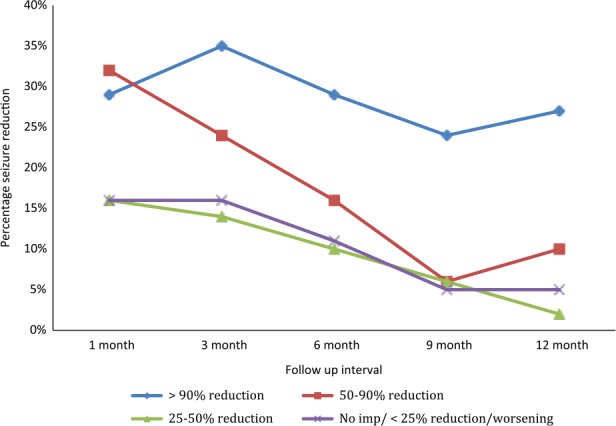
Sixty-three patients met inclusion. Thirty-seven (59%) reported >50% seizure reduction at 3 months with 44% and 37% patients benefiting at 6-month and 12-month follow up, respectively. A trend toward significant seizure improvement was noted in 48% patients with seizure onset >1 year at 12-month (p = 0.09) interval and in 62% patients with >10 seizure/day at 6-month interval (p = 0.054). An ordinal logistic regression showed later age of seizure to have higher odds of favorable response at 1-month (p = 0.005) and 3-month (p = 0.013) follow up. Patients with non-fasting diet induction were more likely to have a favorable outcome at 6 months (p = 0.008) as do females (p = 0.037) and those treated with higher fat ratio diet (p = 0.034).
Our study reports the effectiveness of ketogenic diet in children with medically resistant epilepsy. Later age of seizure onset, female gender, higher ketogenic diet ratio and non-fasting induction were associated with better odds of improved seizure outcome. A larger cohort is required to confirm these findings.
生酮饮食是治疗药物难治性癫痫的一种有效的非药物治疗方法。本研究的目的是确定可能影响生酮饮食反应的任何预测因素。
对1996年至2012年在一家三级癫痫治疗中心就诊的所有药物难治性癫痫患者进行回顾性病历审查。评估患者和饮食相关变量在1、3、6、9和12个月时的癫痫发作减少情况,并分为四种可能的结果类别。
63名患者符合纳入标准。37名(59%)患者报告在3个月时癫痫发作减少>50%,44%和37%的患者在6个月和12个月随访时受益。在癫痫发作>1年的患者中,48%在12个月时癫痫发作有显著改善趋势(p = 0.09),在癫痫发作>10次/天的患者中,62%在6个月时有改善趋势(p = 0.054)。有序逻辑回归显示,癫痫发作年龄较大的患者在1个月(p = 0.005)和3个月(p = 0.013)随访时获得良好反应的几率更高。非禁食饮食诱导的患者在6个月时更有可能获得良好结果(p = 0.008),女性患者(p = 0.037)以及采用高脂肪比例饮食治疗的患者(p = 0.034)也是如此。
我们的研究报告了生酮饮食对药物难治性癫痫儿童的有效性。癫痫发作年龄较大、女性、较高的生酮饮食比例和非禁食诱导与癫痫发作结果改善的几率更高相关。需要更大规模的队列研究来证实这些发现。