Department of Pathology, Leiden University Medical Center, L1Q, Room P0-107, P.O. Box 9600, 2300 RC, Leiden, the Netherlands.
Department of Medical Statistics and Bioinformatics, Leiden University Medical Center, Leiden, the Netherlands.
Diabetologia. 2017 Sep;60(9):1813-1821. doi: 10.1007/s00125-017-4322-3. Epub 2017 Jun 15.
AIMS/HYPOTHESIS: Animal models of diabetic nephropathy show increased levels of glomerular vascular endothelial growth factor (VEGF)-A, and several studies have shown that inhibiting VEGF-A in animal models of diabetes can prevent albuminuria and glomerular hypertrophy. However, in those studies, treatment was initiated before the onset of kidney damage. Therefore, the aim of this study was to investigate whether transfecting mice with the VEGF-A inhibitor sFlt-1 (encoding soluble fms-related tyrosine kinase 1) can reverse pre-existing kidney damage in a mouse model of type 1 diabetes. In addition, we investigated whether transfection with sFlt-1 can reduce endothelial activation and inflammation in these mice.
Subgroups of untreated 8-week-old female C57BL/6J control (n = 5) and diabetic mice (n = 7) were euthanised 5 weeks after the start of the experiment in order to determine the degree of kidney damage prior to treatment with sFLT-1. Diabetes was induced with three i.p. injections of streptozotocin (75 mg/kg) administered at 2 day intervals. Diabetic nephropathy was then investigated in diabetic mice transfected with sFlt-1 (n = 6); non-diabetic, non-transfected control mice (n = 5); non-diabetic control mice transfected with sFlt-1(n = 10); and non-transfected diabetic mice (n = 6). These mice were euthanised at the end of week 15. Transfection with sFlt-1 was performed in week 6.
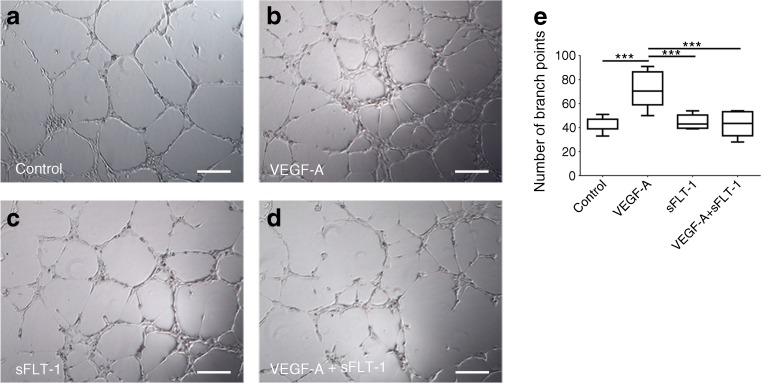
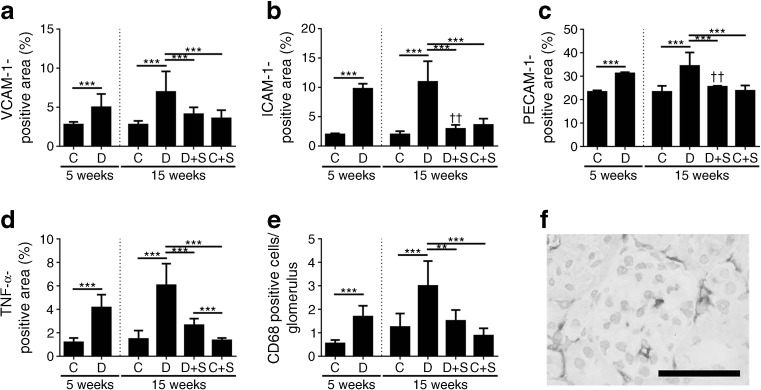
We found that transfection with sFlt-1 significantly reduced kidney damage by normalising albuminuria, glomerular hypertrophy and mesangial matrix content (i.e. glomerular collagen type IV protein levels) (p < 0.001). We also found that transfection with sFlt-1 reduced endothelial activation (p < 0.001), glomerular macrophage infiltration (p < 0.001) and glomerular TNF-α protein levels (p < 0.001). Finally, sFLT-1 decreased VEGF-A-induced endothelial activation in vitro (p < 0.001).
CONCLUSIONS/INTERPRETATION: These results suggest that sFLT-1 might be beneficial in treating diabetic nephropathy by inhibiting VEGF-A, thereby reducing endothelial activation and glomerular inflammation, and ultimately reversing kidney damage.
目的/假设:糖尿病肾病的动物模型显示肾小球血管内皮生长因子(VEGF)-A 水平升高,多项研究表明,在糖尿病动物模型中抑制 VEGF-A 可以预防白蛋白尿和肾小球肥大。然而,在这些研究中,治疗是在肾脏损伤发生之前开始的。因此,本研究旨在探讨在 1 型糖尿病小鼠模型中,用 VEGF-A 抑制剂 sFlt-1(编码可溶性 fms 相关酪氨酸激酶 1)转染小鼠是否可以逆转预先存在的肾脏损伤。此外,我们还研究了 sFlt-1 的转染是否可以减少这些小鼠的内皮激活和炎症。
在实验开始后 5 周,未治疗的 8 周龄雌性 C57BL/6J 对照(n=5)和糖尿病小鼠(n=7)亚组被安乐死,以确定在用 sFLT-1 治疗前肾脏损伤的程度。糖尿病通过三次腹腔注射链脲佐菌素(75mg/kg),间隔 2 天进行诱导。然后研究了 sFlt-1 转染的糖尿病小鼠(n=6);非糖尿病、非转染对照小鼠(n=5);sFlt-1 转染的非糖尿病对照小鼠(n=10);和非转染的糖尿病小鼠(n=6)的糖尿病肾病。这些小鼠在第 15 周末被安乐死。sFlt-1 的转染在第 6 周进行。
我们发现,sFlt-1 的转染通过使白蛋白尿、肾小球肥大和系膜基质含量(即肾小球胶原 IV 蛋白水平)正常化,显著减轻了肾脏损伤(p<0.001)。我们还发现,sFlt-1 的转染减少了内皮激活(p<0.001)、肾小球巨噬细胞浸润(p<0.001)和肾小球 TNF-α 蛋白水平(p<0.001)。最后,sFLT-1 减少了 VEGF-A 诱导的体外内皮激活(p<0.001)。
结论/解释:这些结果表明,sFLT-1 通过抑制 VEGF-A 可能对治疗糖尿病肾病有益,从而减少内皮激活和肾小球炎症,最终逆转肾脏损伤。