Tong Yingna, Liu Xiaobin, Guan Mingxiu, Wang Meng, Zhang Lufang, Dong Dong, Niu Ruifang, Zhang Fei, Zhou Yunli
Department of Clinical Laboratory, Tianjin Medical University Cancer Institute and Hospital, National Clinical Research Center for Cancer, Key Laboratory of Cancer Prevention and Therapy, Tianjin, Tianjin's Clinical Research Center for Cancer, Tianjin, China (mainland).
Department of Clinical Laboratory, Tianjin Baodi Affiliated Hospital of Tianjin Medical University, Tianjin, China (mainland).
Med Sci Monit. 2017 Jun 17;23:2949-2960. doi: 10.12659/msm.902138.
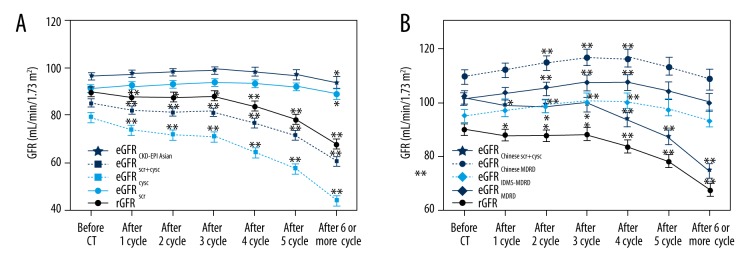
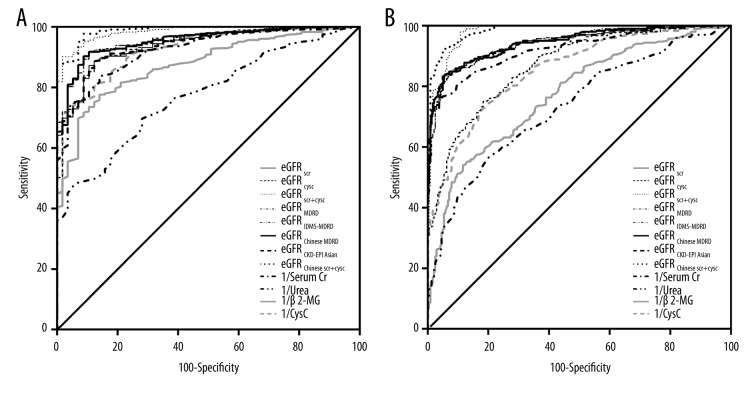
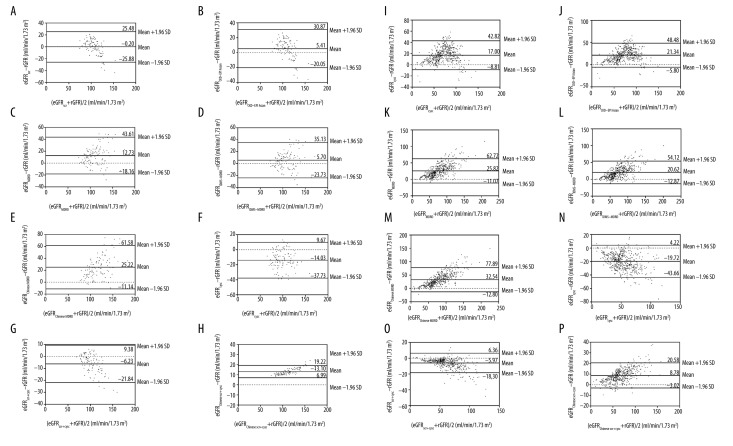
BACKGROUND The performance of estimated glomerular filtration rate (eGFR) have been proved to vary according to the races of the target population. The eGFR equations have not been validated in the Chinese cancer population received chemotherapy. Meanwhile, serum cystatin C (CysC), urea, β2 microglobulin (β2-MG), and creatinine (SCr) were also evaluated in a cohort of Chinese cancer patients. MATERIAL AND METHODS A total of 1000 cancer patients undergoing combination chemotherapy and 108 healthy volunteers were included in this study, and their renal function parameters were evaluated. The eGFR values were compared with reference GFR (rGFR) according to correlation, consistency, precision, and accuracy. Receiver operating characteristic (ROC) curves were used to evaluate the discriminating ability of the GFR equations and serological indicators of renal function. RESULTS (1) The equations contained CysC had the same varying tendency as rGFR in relation to the chemotherapeutic cycle. (2) eGFRscr+cysc and eGFRChinese scr+cysc worked better than the other equations, as indicated by a stronger correlation, less bias, improved precision, higher accuracy, and greater AUC. (3) CysC was more sensitive than the other serological indicators for identifying early renal injury. (4) Each parameter showed different characteristics in subgroups of Chinese cancer patients. CONCLUSIONS CysC was the most sensitive marker for early renal injury. Among the 8 most commonly used eGFR equations, the combination equation eGFRscr+cysc and eGFRChinese scr+cysc exhibited the best performance in the assessment of the renal function of Chinese cancer patients.
背景 已证明估算肾小球滤过率(eGFR)的表现因目标人群的种族而异。eGFR方程在中国接受化疗的癌症人群中尚未得到验证。同时,还对一组中国癌症患者的血清胱抑素C(CysC)、尿素、β2微球蛋白(β2-MG)和肌酐(SCr)进行了评估。材料与方法 本研究共纳入1000例接受联合化疗的癌症患者和108名健康志愿者,并对他们的肾功能参数进行评估。根据相关性、一致性、精密度和准确性将eGFR值与参考GFR(rGFR)进行比较。采用受试者工作特征(ROC)曲线评估GFR方程和肾功能血清学指标的鉴别能力。结果 (1)包含CysC的方程在化疗周期方面与rGFR具有相同的变化趋势。(2)eGFRscr+cysc和eGFRChinese scr+cysc比其他方程表现更好,表现为更强的相关性、更小的偏差、更高的精密度、更高的准确性和更大的AUC。(3)CysC在识别早期肾损伤方面比其他血清学指标更敏感。(4)每个参数在中国癌症患者亚组中表现出不同的特征。结论 CysC是早期肾损伤最敏感的标志物。在8个最常用的eGFR方程中,联合方程eGFRscr+cysc和eGFRChinese scr+cysc在评估中国癌症患者肾功能方面表现最佳。