Brédart Anne, Kop Jean-Luc, Antoniou Antonis C, Cunningham Alex P, De Pauw Antoine, Tischkowitz Marc, Ehrencrona Hans, Dolbeault Sylvie, Robieux Léonore, Rhiem Kerstin, Easton Douglas F, Devilee Peter, Stoppa-Lyonnet Dominique, Schmutlzer Rita
Institut Curie, Supportive Care Department, Psycho-oncology Unit, 26 rue d'Ulm, 75005, Paris Cedex 05, France.
University Paris Descartes, 71 avenue Edouard Vaillant, 92774, Boulogne-Billancourt, France.
Fam Cancer. 2018 Jan;17(1):31-41. doi: 10.1007/s10689-017-0014-x.
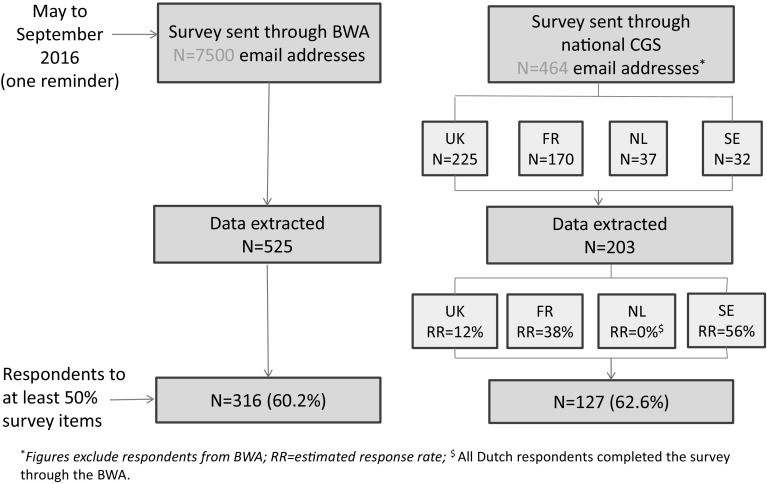
The 'BOADICEA' Web Application (BWA) used to assess breast cancer risk, is currently being further developed, to integrate additional genetic and non-genetic factors. We surveyed clinicians' perceived acceptability of the existing BWA v3. An online survey was conducted through the BOADICEA website, and the British, Dutch, French and Swedish genetics societies. Cross-sectional data from 443 participants who provided at least 50% responses were analysed. Respondents varied in age and, clinical seniority, but mainly comprised women (77%) and genetics professionals (82%). Some expressed negative opinions about the scientific validity of BOADICEA (9%) and BWA v3 risk presentations (7-9%). Data entry time (62%), clinical utility (22%) and ease of communicating BWA v3 risks (13-17%) received additional negative appraisals. In multivariate analyses, controlling for gender and country, data entry time was perceived as longer by genetic counsellors than clinical geneticists (p < 0.05). Respondents who (1) considered hormonal BC risk factors as more important (p < 0.01), and (2) communicated numerical risk estimates more frequently (p < 0.001), judged BWA v3 of lower clinical utility. Respondents who carried out less frequent clinical activity (p < 0.01) and respondents with '11 to 15 years' seniority (p < 0.01) had less favourable opinions of BWA v3 risk presentations. Seniority of '6 to 10 years' (p < 0.05) and more frequent numerical risk communication (p < 0.05) were associated with higher fear of communicating the BWA v3 risks to patients. The level of genetics training did not affect opinions. Further development of BWA should consider technological, genetics service delivery and training initiatives.
用于评估乳腺癌风险的“BOADICEA”网络应用程序(BWA)目前正在进一步开发,以整合更多的遗传和非遗传因素。我们调查了临床医生对现有BWA v3的可接受性认知。通过BOADICEA网站以及英国、荷兰、法国和瑞典的遗传学协会进行了一项在线调查。对443名至少提供了50%回答的参与者的横断面数据进行了分析。受访者在年龄和临床资历方面各不相同,但主要是女性(77%)和遗传学专业人员(82%)。一些人对BOADICEA的科学有效性(9%)和BWA v3风险呈现方式(7 - 9%)表达了负面意见。数据录入时间(62%)、临床实用性(22%)以及传达BWA v3风险的难易程度(13 - 17%)受到了更多负面评价。在多变量分析中,在控制性别和国家的情况下,遗传咨询师认为数据录入时间比临床遗传学家更长(p < 0.05)。(1)认为激素性乳腺癌风险因素更重要的受访者(p < 0.01),以及(2)更频繁传达数值风险估计的受访者(p < 0.001),认为BWA v3的临床实用性较低。临床活动频率较低的受访者(p < 0.01)和资历为“11至15年”的受访者(p < 0.01)对BWA v3风险呈现方式的评价较低。“6至10年”的资历(p < 0.05)和更频繁的数值风险沟通(p < 0.05)与向患者传达BWA v3风险的更高恐惧相关。遗传学培训水平并未影响观点。BWA的进一步开发应考虑技术、遗传学服务提供和培训举措。