Schilsky Juliana B, Ni Ai, Ahn Linda, Datta Sutirtha, Travis William D, Kris Mark G, Chaft Jamie E, Rekhtman Natasha, Hellmann Matthew D
Thoracic Oncology Service, Division of Solid Tumor Oncology, Department of Medicine, Memorial Sloan Kettering Cancer Center, 300 E 66(th) St., New York, NY 10065, USA.
Department of Epidemiology and Biostatistics, Memorial Sloan Kettering Cancer Center, 485 Lexington Ave., New York, NY 10017, USA.
Lung Cancer. 2017 Jun;108:205-211. doi: 10.1016/j.lungcan.2017.03.015. Epub 2017 Mar 28.
Thyroid transcription factor 1 (TTF-1) is routinely tested in the diagnostic evaluation of suspected lung cancers, is commonly expressed by lung adenocarcinomas, and may modulate lung cancer biology. We examined the role of TTF-1 as a predictive and prognostic marker in patients with advanced lung adenocarcinomas.
We analyzed clinical, pathologic, and molecular features, treatments received, and overall survival obtained from the medical records of 479 consecutive patients at a single site with stage IV lung adenocarcinomas and evaluable TTF-1 expression. TTF-1 expression was determined by immunohistochemistry using antibody 8G7G3/1.
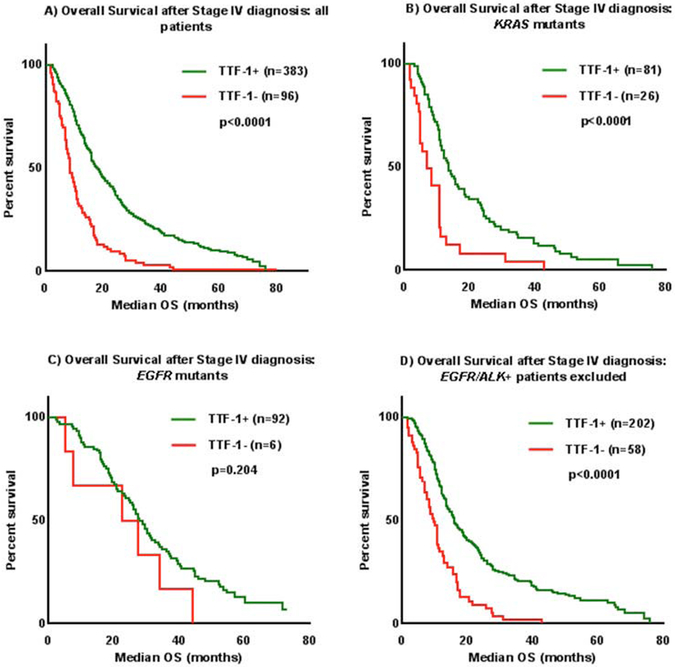
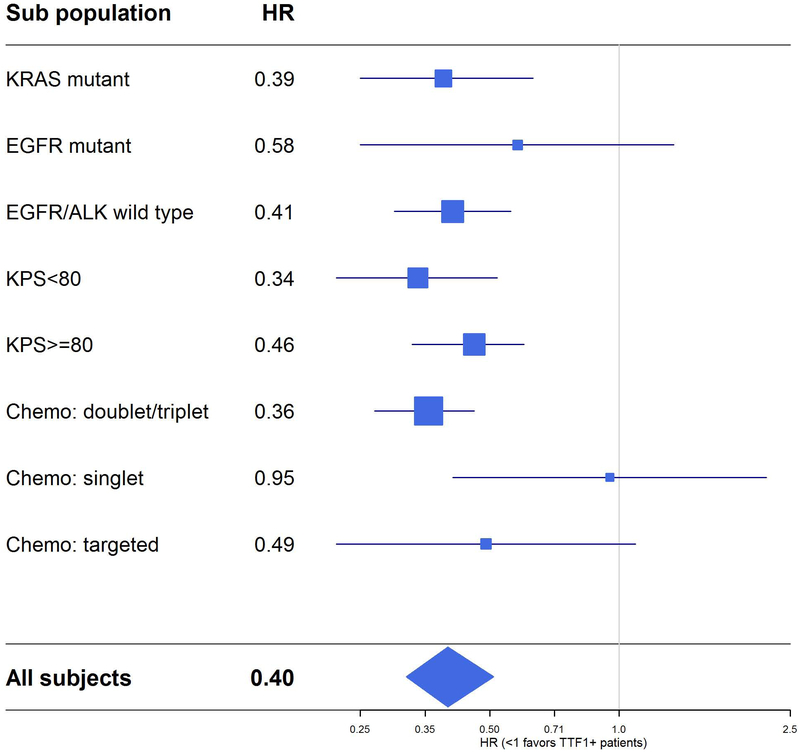
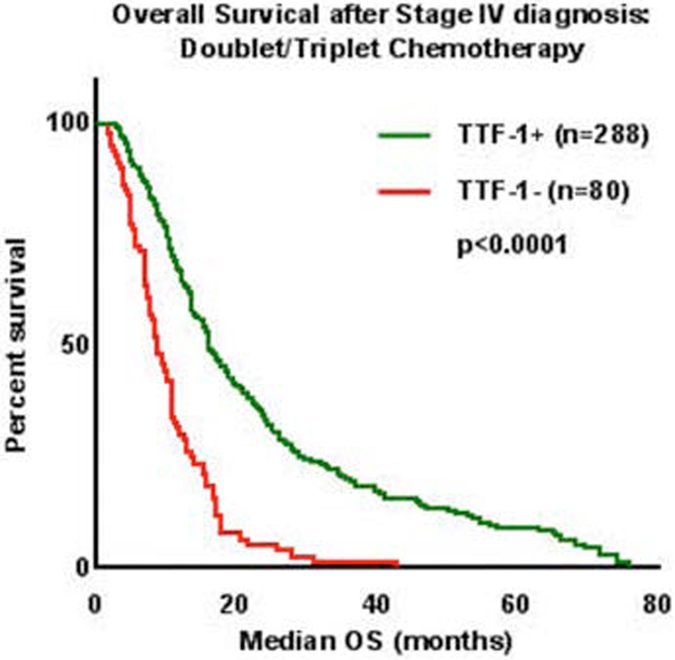
TTF-1 expression was evaluable in 479 (75%) of all patients reviewed, and was positive in 383 (80%, 95% CI 76-83%). Clinicopathologic features were similar between TTF-1 positive and TTF-1 negative tumors, except EGFR mutations were more common in TTF-1 positive cases (24% vs 6%, p<0.001). In univariate analysis, overall survival was significantly longer in patients with TTF-1 positive versus TTF-1 negative tumors (18 months vs 9 months, p<0.0001). In multivariate analysis, TTF-1 positivity remained associated with better overall survival (HR=0.38, p<0.0001), exceeding the prognostic impact of Karnofsky performance status >/=80% (HR 0.62, p=0.0003) and receipt of first-line combination chemotherapy or targeted therapy (HR relative to first-line single agent chemotherapy 0.59, p=0.05 and 0.51, p=0.05 respectively). Both patients with TTF-1 positive and TTF-1 negative cancers had longer durations of initial therapy when treated with pemetrexed-based chemotherapy. In patients with advanced lung adenocarcinomas, TTF-1 expression is associated with better survival but is not predictive of distinct benefit from pemetrexed-based chemotherapy.
甲状腺转录因子1(TTF-1)常用于疑似肺癌的诊断评估,在肺腺癌中普遍表达,且可能调节肺癌生物学行为。我们研究了TTF-1作为晚期肺腺癌患者预测和预后标志物的作用。
我们分析了479例在单一中心连续入组的IV期肺腺癌患者的临床、病理和分子特征、接受的治疗以及总生存期,这些患者的TTF-1表达可评估。TTF-1表达通过使用抗体8G7G3/1的免疫组织化学方法确定。
在所有回顾的患者中,479例(75%)的TTF-1表达可评估,其中383例(80%,95%CI 76-83%)为阳性。TTF-1阳性和TTF-1阴性肿瘤的临床病理特征相似,但EGFR突变在TTF-1阳性病例中更常见(24%对6%,p<0.001)。单因素分析显示,TTF-1阳性患者的总生存期显著长于TTF-1阴性患者(18个月对9个月,p<0.0001)。多因素分析显示,TTF-1阳性仍与更好的总生存期相关(HR=0.38,p<0.0001),超过卡氏功能状态≥80%(HR 0.62,p=0.0003)以及接受一线联合化疗或靶向治疗的预后影响(相对于一线单药化疗,HR分别为0.59,p=0.05和0.51,p=0.05)。接受培美曲塞为基础的化疗时,TTF-1阳性和TTF-阴性癌症患者的初始治疗持续时间均较长。在晚期肺腺癌患者中,TTF-1表达与更好的生存期相关,但不能预测培美曲塞为基础的化疗有明显获益。