Beutel Manfred E, Giralt Sebastian, Wölfling Klaus, Stöbel-Richter Yve, Subic-Wrana Claudia, Reiner Iris, Tibubos Ana Nanette, Brähler Elmar
Department of Psychosomatic Medicine and Psychotherapy, University Medical Center, Mainz, Germany.
Faculty of Managerial and Cultural Studies, University of Applied Sciences Zittau/ Goerlitz, Goerlitz, Germany.
PLoS One. 2017 Jun 19;12(6):e0176449. doi: 10.1371/journal.pone.0176449. eCollection 2017.
The unlimited access to sexual features in the World Wide Web has raised concerns about excessive and problematic online-sex use. However, little is known about antecedents of internet-sex use of different intensity. Based on a representative German sample of 2,522 participants between the ages of 14 and 97 years, the aims of the present study were (1) to determine the prevalence rates of online-sex users with the short version (ISSTGSV) of the Internet Sex Screening Test and (2) to associate online-sex use with anxious vs. avoidant partner attachment patterns and "Big Five" personality traits as potential antecedents.
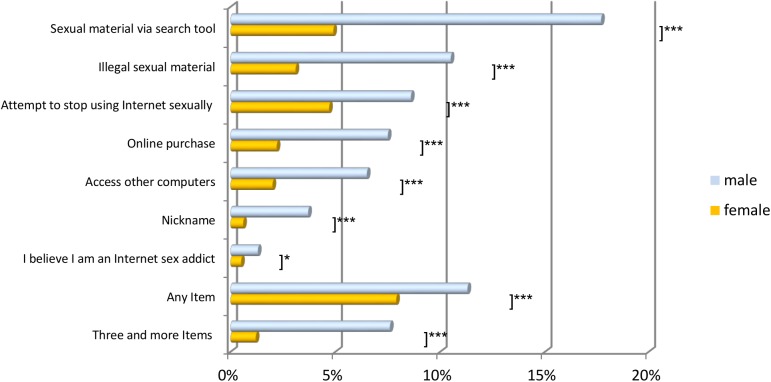
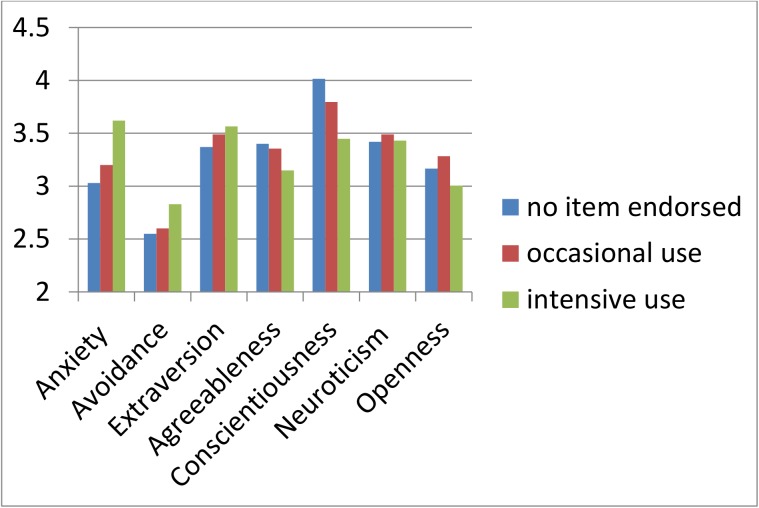
The ISST is a brief, one-dimensional and reliable measure of online-sex activities (rtt = .69). Overall, 14.7% of respondents reported occasional and 4.2% intensive online-sex use. In multivariate analysis, online-sex use was significantly positively associated with male sex, younger age, unemployment and an anxious partner attachment pattern and negatively with conscientiousness and agreeableness.
Arousal and satisfaction by virtual enactment of sexual phantasies may be attractive for anxiously attached persons who find it difficult to commit to a real life relationship due to fear of rejection or low self-esteem. More knowledge about the individual antecedents of intensive online-sex use may also be helpful for the development of consultation and treatment strategies for excessive and addictive online-sex use.
万维网上对性内容的无限制访问引发了人们对过度和有问题的网络性使用的担忧。然而,对于不同强度的网络性使用的前因却知之甚少。基于一个有代表性的2522名年龄在14至97岁之间的德国参与者样本,本研究的目的是:(1)使用网络性筛查测试的简短版本(ISSTGSV)来确定网络性使用者的患病率;(2)将网络性使用与焦虑型与回避型伴侣依恋模式以及作为潜在前因的“大五”人格特质联系起来。
ISST是一种对网络性活动进行简短、单维度且可靠测量的工具(rtt = 0.69)。总体而言,14.7%的受访者报告偶尔有网络性使用,4.2%报告有频繁的网络性使用。在多变量分析中,网络性使用与男性、较年轻的年龄、失业以及焦虑型伴侣依恋模式呈显著正相关,与尽责性和宜人性呈负相关。
通过虚拟演绎性幻想所带来的兴奋和满足感,可能对那些因害怕被拒绝或自卑而难以投入现实生活关系的焦虑依恋者具有吸引力。更多关于频繁网络性使用的个体前因的知识,也可能有助于制定针对过度和成瘾性网络性使用的咨询和治疗策略。