Department of Integrative Structural Biology, Institut de Génétique et de Biologie Moléculaire et Cellulaire, INSERM, U964, CNRS, UMR-7104, Université de Strasbourg, 1 rue Laurent Fries, 67404 Illkirch-Graffenstaden, France.
Heidelberg University Biochemistry Center (BZH), INF 328, D-69120 Heidelberg, Germany.
Biomolecules. 2017 Jun 19;7(2):44. doi: 10.3390/biom7020044.
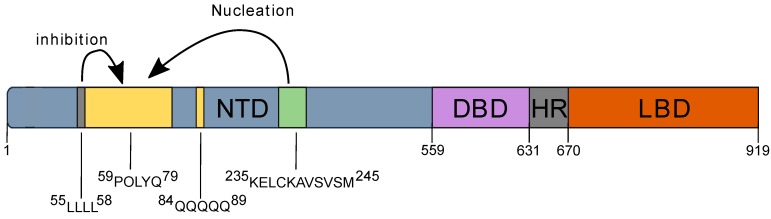
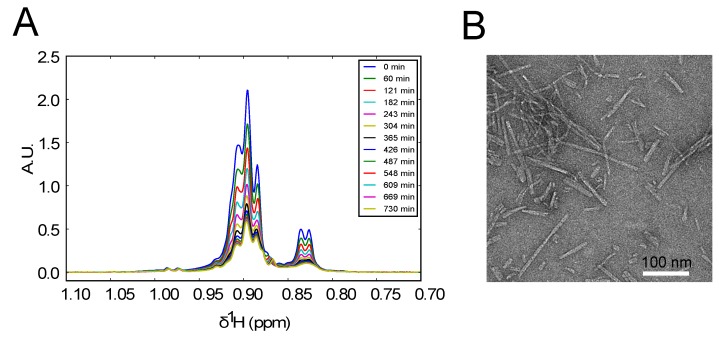
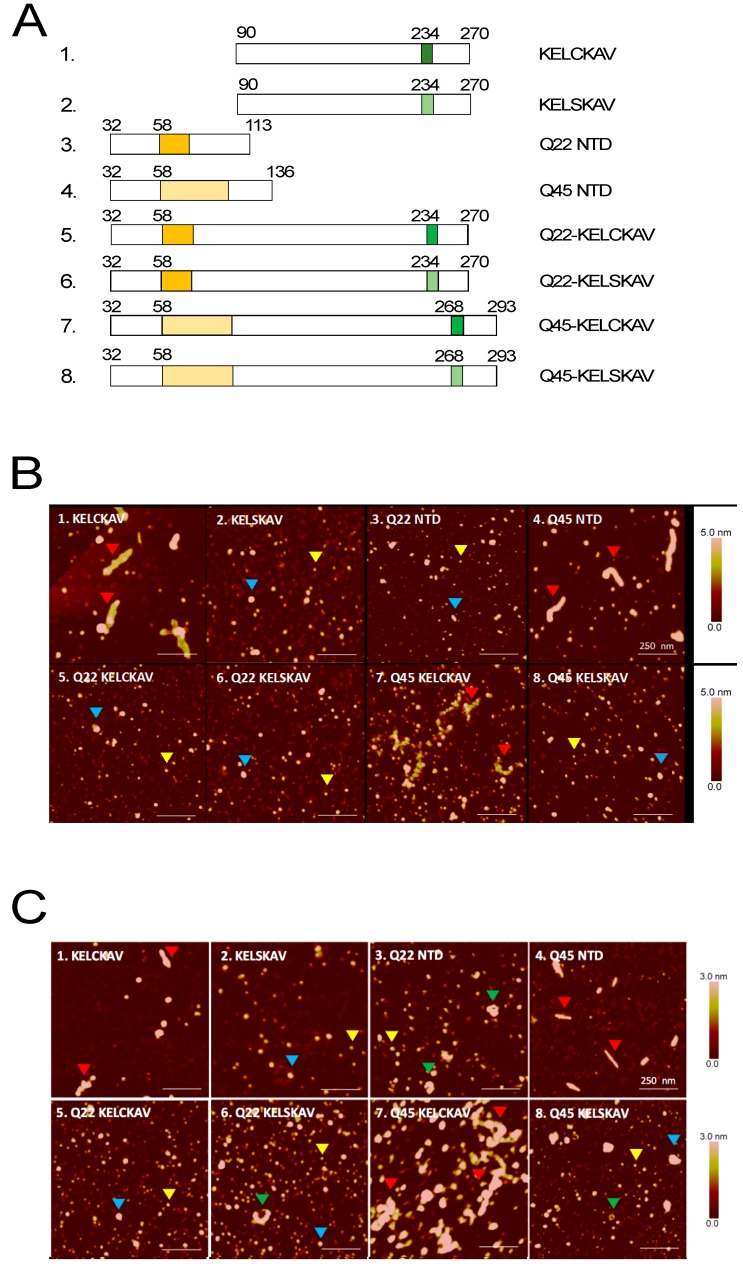
The human androgen receptor (AR) is a ligand inducible transcription factor that harbors an amino terminal domain (AR-NTD) with a ligand-independent activation function. AR-NTD is intrinsically disordered and displays aggregation properties conferred by the presence of a poly-glutamine (polyQ) sequence. The length of the polyQ sequence as well as its adjacent sequence motifs modulate this aggregation property. AR-NTD also contains a conserved KELCKAVSVSM sequence motif that displays an intrinsic property to form amyloid fibrils under mild oxidative conditions. As peptide sequences with intrinsic oligomerization properties are reported to have an impact on the aggregation of polyQ tracts, we determined the effect of the KELCKAVSVSM on the polyQ stretch in the context of the AR-NTD using atomic force microscopy (AFM). Here, we present evidence for a crosstalk between the amyloidogenic properties of the KELCKAVSVSM motif and the polyQ stretch at the AR-NTD.
人类雄激素受体 (AR) 是一种配体诱导的转录因子,其具有带有配体非依赖性激活功能的氨基末端结构域 (AR-NTD)。AR-NTD 是固有无序的,并表现出由多聚谷氨酰胺 (polyQ) 序列存在赋予的聚集特性。polyQ 序列的长度及其相邻序列基序调节这种聚集特性。AR-NTD 还包含一个保守的 KELCKAVSVSM 序列基序,该基序在温和的氧化条件下表现出形成淀粉样纤维的内在特性。由于具有内在聚合性质的肽序列据报道会影响 polyQ 片段的聚集,因此我们使用原子力显微镜 (AFM) 确定了 KELCKAVSVSM 对 AR-NTD 中 polyQ 延伸的影响。在这里,我们提供了证据表明 KELCKAVSVSM 基序的淀粉样特性与 AR-NTD 中的 polyQ 延伸之间存在串扰。