Nwidu Lucky Legbosi, Elmorsy Ekramy, Thornton Jack, Wijamunige Buddhika, Wijesekara Anusha, Tarbox Rebecca, Warren Averil, Carter Wayne Grant
a Department of Experimental Pharmacology and Toxicology, Faculty of Pharmaceutical Science , University of Port Harcourt , Port Harcourt , Rivers State , Nigeria.
b School of Medicine , University of Nottingham Medical School, Royal Derby Hospital Centre , Derby , UK.
Pharm Biol. 2017 Dec;55(1):1875-1883. doi: 10.1080/13880209.2017.1339283.
There is an unmet need to discover new treatments for Alzheimer's disease. This study determined the anti-acetylcholinesterase (AChE) activity, DPPH free radical scavenging and antioxidant properties of Carpolobia lutea G. Don (Polygalaceae).
The objective of this study is to quantify C. lutea anti-AChE, DPPH free radical scavenging, and antioxidant activities and cell cytotoxicity.
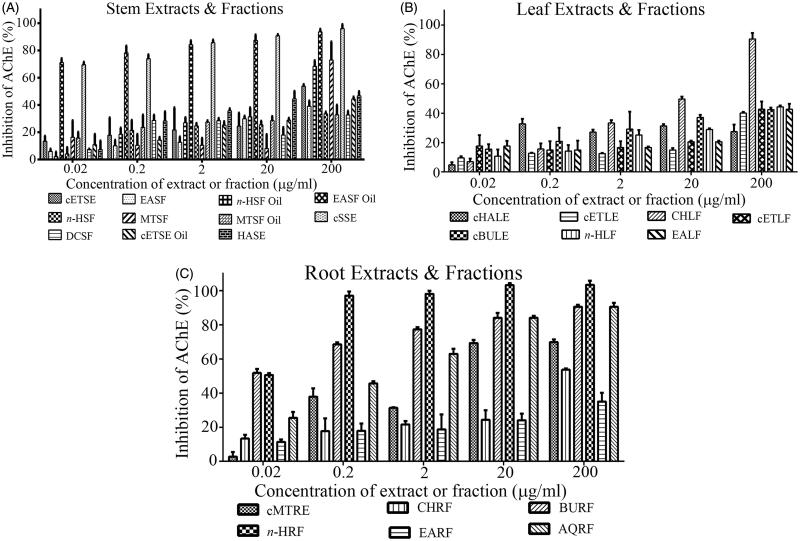
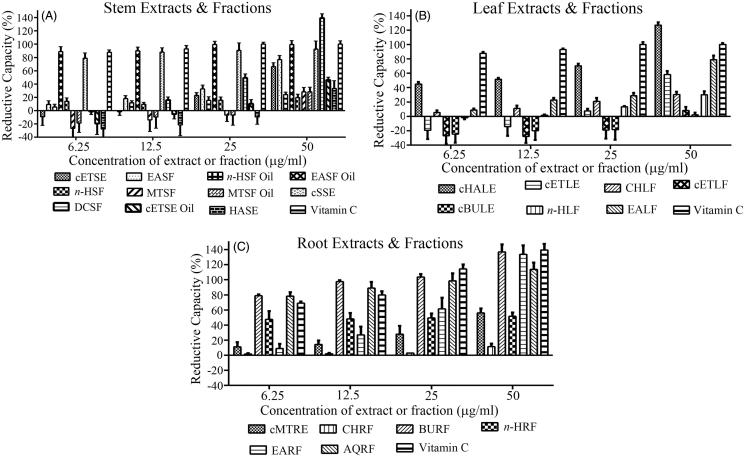
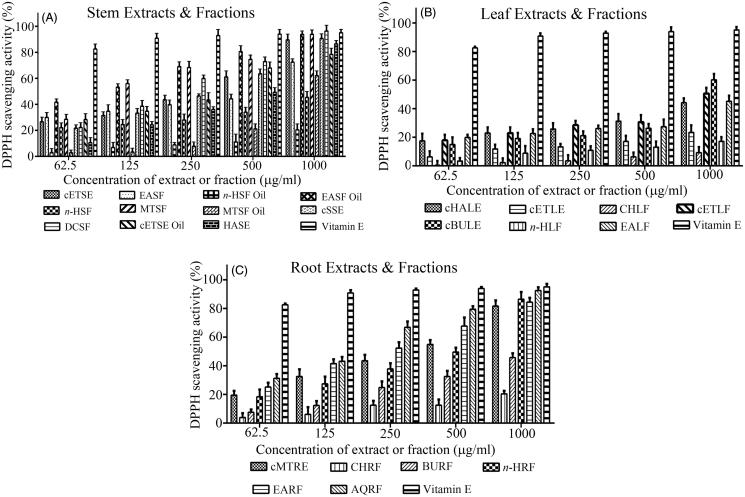
Plant stem, leaves and roots were subjected to sequential solvent extractions, and screened for anti-AChE activity across a concentration range of 0.02-200 μg/mL. Plant DPPH radical scavenging activity, reducing power, and total phenolic and flavonoid contents were determined, and cytotoxicity evaluated using human hepatocytes.
Carpolobia lutea exhibited concentration-dependent anti-AChE activity. The most potent inhibitory activity for the stem was the crude ethanol extract and hexane stem fraction oil (IC = 140 μg/mL); for the leaves, the chloroform leaf fraction (IC = 60 μg/mL); and for roots, the methanol, ethyl acetate and aqueous root fractions (IC = 0.3-3 μg/mL). Dose-dependent free radical scavenging activity and reducing power were observed with increasing stem, leaf or root concentration. Total phenolic contents were the highest in the stem: ∼632 mg gallic acid equivalents/g for a hexane stem fraction oil. Total flavonoid content was the highest in the leaves: ∼297 mg quercetin equivalents/g for a chloroform leaf fraction. At 1 μg/mL, only the crude ethanol extract oil was significantly cytotoxic to hepatocytes.
Carpolobia lutea possesses anti-AChE activity and beneficial antioxidant capacity indicative of its potential development as a treatment of Alzheimer's and other diseases characterized by a cholinergic deficit.
对于阿尔茨海默病,仍有未满足的需求来发现新的治疗方法。本研究测定了黄花假牛繁缕(远志科)的抗乙酰胆碱酯酶(AChE)活性、DPPH自由基清除能力和抗氧化特性。
本研究的目的是量化黄花假牛繁缕的抗AChE、DPPH自由基清除和抗氧化活性以及细胞毒性。
对植物的茎、叶和根进行连续溶剂萃取,并在0.02 - 200μg/mL的浓度范围内筛选抗AChE活性。测定了植物的DPPH自由基清除活性、还原能力以及总酚和黄酮含量,并使用人肝细胞评估细胞毒性。
黄花假牛繁缕表现出浓度依赖性的抗AChE活性。茎的最有效抑制活性来自粗乙醇提取物和己烷茎部分油(IC = 140μg/mL);叶的最有效抑制活性来自氯仿叶部分(IC = 60μg/mL);根的最有效抑制活性来自甲醇、乙酸乙酯和水相根部分(IC = 0.3 - 3μg/mL)。随着茎、叶或根浓度的增加,观察到剂量依赖性的自由基清除活性和还原能力。总酚含量在茎中最高:己烷茎部分油约为632mg没食子酸当量/g。总黄酮含量在叶中最高:氯仿叶部分约为297mg槲皮素当量/g。在1μg/mL时,只有粗乙醇提取物油对肝细胞具有显著细胞毒性。
黄花假牛繁缕具有抗AChE活性和有益的抗氧化能力,表明其有潜力开发成为治疗阿尔茨海默病和其他以胆碱能缺陷为特征的疾病的药物。