Gavin Hannah E, Satchell Karla J F
Department of Microbiology-Immunology, Northwestern University Feinberg School of Medicine, 303 E. Chicago Ave, Ward 6-205, Chicago, IL, 60611, USA.
BMC Microbiol. 2017 Jun 19;17(1):136. doi: 10.1186/s12866-017-1045-z.
The Gram-negative bacterium Vibrio vulnificus can cause severe disease in humans who consume undercooked, contaminated seafood. To study food-borne V. vulnificus disease in the laboratory, mouse virulence studies predominantly use death as the primary experimental endpoint because behaviorally based moribund status does not consistently predict lethality. This study assessed ventral surface temperature (VST) and its association with mouse survival during V. vulnificus virulence studies as an efficacious, humane alternative.
VST of mice intragastrically inoculated with V. vulnificus was measured every 2-h for 24 h and data for minimal VST analyzed for prediction of lethal outcome.
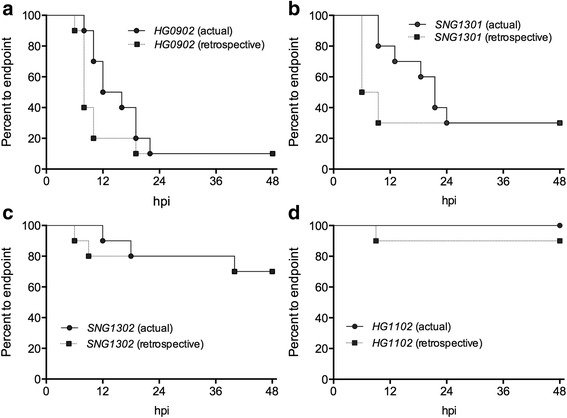
In contrast to the relatively stable VST of mock-infected control animals, mice infected with V. vulnificus exhibited hypothermia with minima occurring 8 to 12 h post-inoculation. The minimum VST of mice that proceeded to death was significantly lower than that of surviving mice. VST ≤ 23.5 °C was predictive of subsequent death with a sensitivity of 68% and specificity of 95%.
Use of VST ≤ 23.5 °C as an experimental endpoint during V. vulnificus infection has potential to reduce suffering of nearly 70% of mice for a mean of 10 h per mouse, without compromising experimental efficacy. Temperature cutoff of 23.5 °C exhibited 93% positive and 77% negative predictive value. For future V. vulnificus virulence studies requiring only binary comparison (e.g., LD assays), we find that VST can be applied as a humane endpoint. However, use of VST is not recommended when detailed survival kinetics are desired.
革兰氏阴性菌创伤弧菌可导致食用未煮熟的受污染海鲜的人患上严重疾病。为了在实验室研究食源性创伤弧菌病,小鼠毒力研究主要将死亡作为主要实验终点,因为基于行为的濒死状态并不能始终如一地预测致死性。本研究评估了创伤弧菌毒力研究期间小鼠的腹面温度(VST)及其与小鼠存活的关联,作为一种有效、人道的替代方法。
对经胃内接种创伤弧菌的小鼠,每2小时测量一次VST,持续24小时,并分析最低VST数据以预测致死结果。
与模拟感染的对照动物相对稳定的VST相比,感染创伤弧菌的小鼠表现出体温过低,最低温度出现在接种后8至12小时。死亡小鼠的最低VST显著低于存活小鼠。VST≤23.5°C可预测随后的死亡,敏感性为68%,特异性为95%。
在创伤弧菌感染期间,将VST≤23.5°C用作实验终点有可能减少近70%小鼠的痛苦,平均每只小鼠减少10小时,且不影响实验效果。23.5°C的温度临界值显示出93%的阳性预测值和77%的阴性预测值。对于未来仅需要二元比较(例如LD测定)的创伤弧菌毒力研究,我们发现VST可作为人道终点应用。然而,当需要详细的存活动力学时,不建议使用VST。