Hsieh Shie-Liang, Lin Wan-Wan
Genomics Research Center, Academia Sinica, 128 Academia Road, Section 2, Nankang, Taipei, 115, Taiwan.
Institute of Clinical Medicine & Immunology Research Center, National Yang-Ming University, Taipei, Taiwan.
J Biomed Sci. 2017 Jun 19;24(1):39. doi: 10.1186/s12929-017-0347-7.
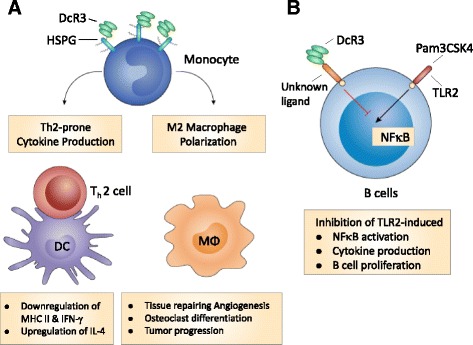
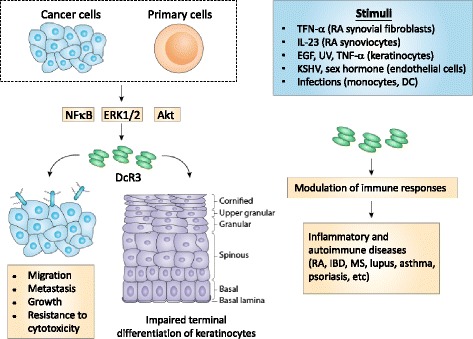
Decoy receptor 3 (DcR3), also known as tumor necrosis factor receptor (TNFR) superfamily member 6b (TNFRSF6B), is a soluble decoy receptor which can neutralize the biological functions of three members of tumor necrosis factor superfamily (TNFSF): Fas ligand (FasL), LIGHT, and TL1A. In addition to 'decoy' function, recombinant DcR3.Fc is able to modulate the activation and differentiation of dendritic cells (DCs) and macrophages via 'non-decoy' action. DcR3-treated DCs skew T cell differentiation into Th2 phenotype, while DcR3-treated macrophages behave M2 phenotype. DcR3 is upregulated in various cancer cells and several inflammatory tissues, and is regarded as a potential biomarker to predict inflammatory disease progression and cancer metastasis. However, whether DcR3 is a pathogenic factor or a suppressor to attenuate inflammatory reactions, has not been discussed comprehensively yet. Because mouse genome does not have DcR3, it is not feasible to investigate its physiological functions by gene-knockout approach. However, DcR3-mediated effects in vitro are determined via overexpressing DcR3 or addition of recombinant DcR3.Fc fusion protein. Moreover, CD68-driven DcR3 transgenic mice are used to investigate DcR3-mediated systemic effects in vivo. Upregulation of DcR3 during inflammatory reactions exerts negative-feedback to suppress inflammation, while tumor cells hijack DcR3 to prevent apoptosis and promote tumor growth and invasion. Thus, 'switch-on' of DcR3 expression may be feasible for the treatment of inflammatory diseases and enhance tissue repairing, while 'switch-off' of DcR3 expression can enhance tumor apoptosis and suppress tumor growth in vivo.
诱骗受体3(DcR3),也被称为肿瘤坏死因子受体(TNFR)超家族成员6b(TNFRSF6B),是一种可溶性诱骗受体,它可以中和肿瘤坏死因子超家族(TNFSF)三个成员的生物学功能:Fas配体(FasL)、LIGHT和TL1A。除了“诱骗”功能外,重组DcR3.Fc还能够通过“非诱骗”作用调节树突状细胞(DCs)和巨噬细胞的活化与分化。经DcR3处理的DCs使T细胞分化偏向Th2表型,而经DcR3处理的巨噬细胞表现出M2表型。DcR3在多种癌细胞和一些炎症组织中上调,被视为预测炎症性疾病进展和癌症转移的潜在生物标志物。然而,DcR3是致病因素还是减轻炎症反应的抑制因子,目前尚未得到全面讨论。由于小鼠基因组中没有DcR3,通过基因敲除方法研究其生理功能是不可行的。然而,DcR3在体外介导的作用是通过过表达DcR3或添加重组DcR3.Fc融合蛋白来确定的。此外,利用CD68驱动的DcR3转基因小鼠来研究DcR3在体内介导的全身效应。炎症反应期间DcR3的上调发挥负反馈作用以抑制炎症,而肿瘤细胞利用DcR3来防止细胞凋亡并促进肿瘤生长和侵袭。因此,开启DcR3表达可能对治疗炎症性疾病和促进组织修复可行,而关闭DcR3表达可增强体内肿瘤细胞凋亡并抑制肿瘤生长。