Li Caina, Hou Shaocong, Liu Shuainan, Huan Yi, Sun Sujuan, Liu Quan, Shen Zhufang
State Key Laboratory of Bioactive Substances and Functions of Natural Medicines, Institute of Materia Medica, Chinese Academy of Medical Sciences and Peking Union Medical College, Xiannongtan Street, Beijing, 100050, China.
BMC Pharmacol Toxicol. 2017 Jun 19;18(1):48. doi: 10.1186/s40360-017-0143-8.
E2HSA is a genetic fusion protein that consists of two tandem exendin-4 molecules that are covalently bonded to recombinant human serum albumin via a peptide linker. Previous studies have demonstrated that E2HSA significantly decreased blood glucose levels, improved β-cell function and promoted β-cell proliferation in diabetic db/dB mice. This study aimed to evaluate the benefits of E2HSA on glucose and lipid metabolism in a spontaneous diabetes animal model, KKAy mice.
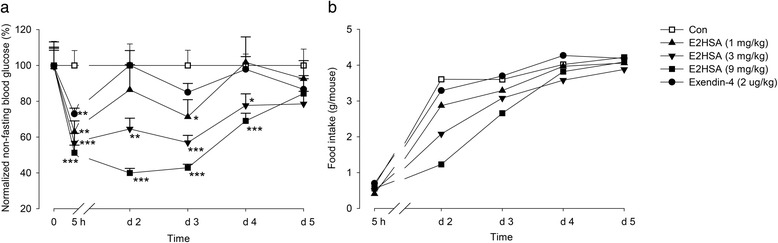
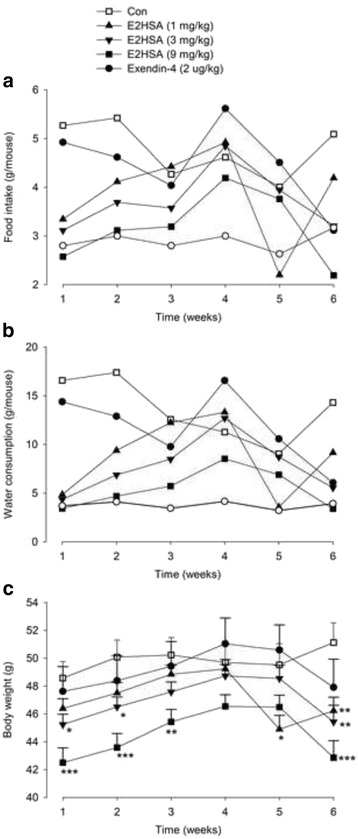
E2HSA was acutely administered at doses of 1, 3 and 9 mg/kg by subcutaneous injection in diabetic KKAy mice with exendin-4 (2 μg/kg) as a positive reference, and then the non-fasting blood glucose and food intake levels were dynamically monitored. In addition, different doses of E2HSA were injected once daily, as well as with exendin-4 twice daily, for 7 weeks to evaluate the effect on glucose and lipid metabolism, as well as the body weight, food and water intake.
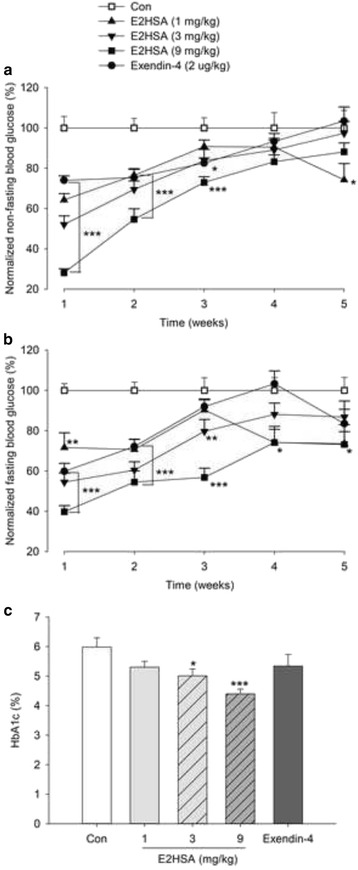
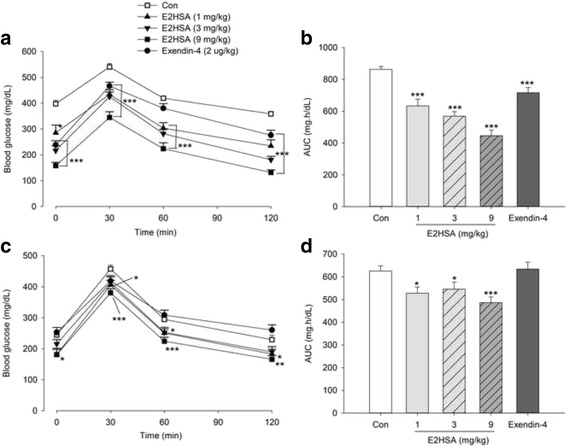
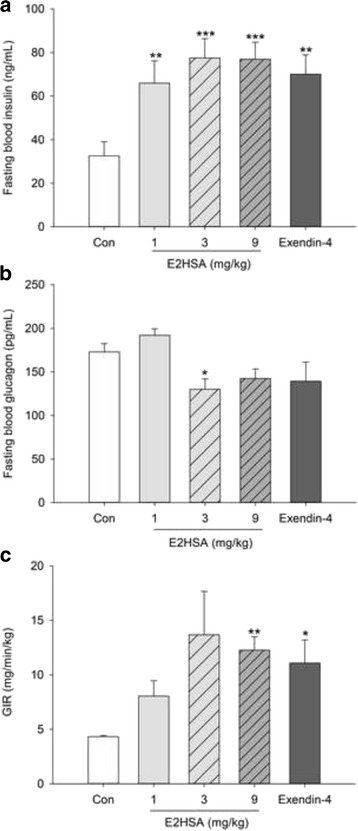
Single injection of E2HSA decreased non-fasting blood glucose and food intake levels in a dose-dependent manner for 4 days and 2 days, respectively. Repeated injections with E2HSA significantly decreased variations in blood glucose levels with a reduction of HbA1c levels by 1.6% at a 9 mg/kg dose, simultaneously increased fasting blood insulin levels, inhibited fasting blood glucagon levels, improved the impaired oral glucose tolerance and enhanced glucose infusion rate, which is the gold standard for evaluating β-cell function. Moreover, repeated injections with E2HSA also ameliorated the dyslipidemia and reduced body weight, food and water intake in diabetic KKAy mice.
E2HSA significantly reduced blood glucose levels over a prolonged duration, enhanced β-cell function, and ameliorated dyslipidemia and obesity in diabetic KKAy mice. Thus, E2HSA may be a new candidate for the treatment of type 2 diabetes.
E2HSA是一种基因融合蛋白,由两个串联的艾塞那肽-4分子组成,它们通过肽接头与重组人血清白蛋白共价结合。先前的研究表明,E2HSA可显著降低糖尿病db/dB小鼠的血糖水平,改善β细胞功能并促进β细胞增殖。本研究旨在评估E2HSA对自发性糖尿病动物模型KKAy小鼠糖脂代谢的益处。
对糖尿病KKAy小鼠皮下注射剂量为1、3和9 mg/kg的E2HSA进行急性给药,以艾塞那肽-4(2 μg/kg)作为阳性对照,然后动态监测非空腹血糖和食物摄入量水平。此外,每天注射一次不同剂量的E2HSA以及每天注射两次艾塞那肽-4,持续7周,以评估对糖脂代谢以及体重、食物和水摄入量的影响。
单次注射E2HSA分别在4天和2天内以剂量依赖性方式降低非空腹血糖和食物摄入量水平。重复注射E2HSA可显著降低血糖水平的变化,9 mg/kg剂量时HbA1c水平降低1.6%,同时提高空腹血胰岛素水平,抑制空腹血胰高血糖素水平,改善受损的口服糖耐量并提高葡萄糖输注率,这是评估β细胞功能的金标准。此外,重复注射E2HSA还改善了糖尿病KKAy小鼠的血脂异常,降低了体重、食物和水的摄入量。
E2HSA可在较长时间内显著降低血糖水平,增强β细胞功能,并改善糖尿病KKAy小鼠的血脂异常和肥胖。因此,E2HSA可能是治疗2型糖尿病的新候选药物。