He Jinshui, Kang Yueya, Lian Chaowei, Wu Jinzhi, Zhou Huowang, Ye Xiaoling
Department of Pediatrics, Zhangzhou Affiliated Hospital of Fujian Medical University, Zhangzhou, Fujian 363000, P.R. China.
Department of Endocrinology, Zhangzhou Affiliated Hospital of Fujian Medical University, Zhangzhou, Fujian 363000, P.R. China.
Exp Ther Med. 2019 Jul;18(1):503-508. doi: 10.3892/etm.2019.7598. Epub 2019 May 22.
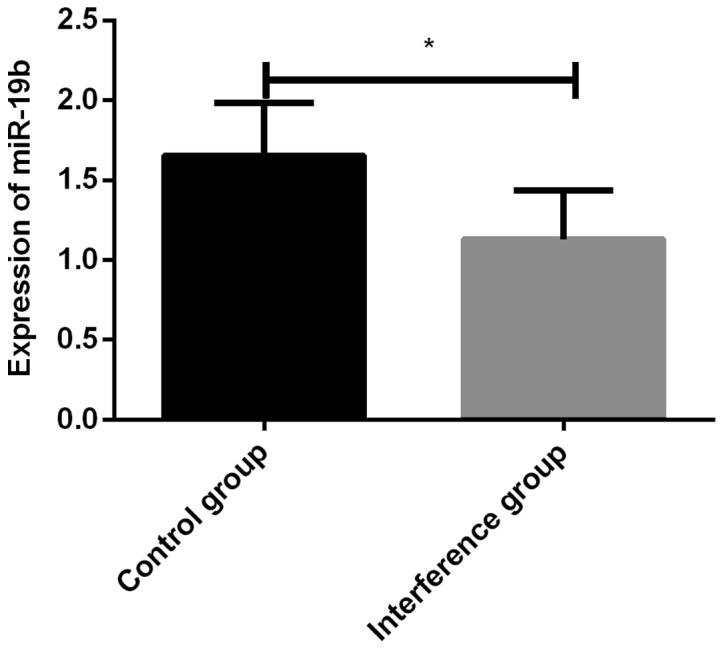
This study analyzed the effect of miR-19b on the protective effect of Exendin-4 on islet cells in non-obese diabetic (NOD) mice. Twenty-four NOD/LT mice were randomized, according to the random number table, into a control group (4 µg/kg•day), a low-dose group (2 µg/kg•day Exendin-4), a medium-dose group (4 µg/kg•day Exendin-4) and a high-dose group (8 µg/kg•day Exendin-4) (n=6), with miR-19b expression interfered (an interference group) except for the control group. RT-qPCR was used to detect interference results and different doses of Exendin-4 were given for 8 weeks of intervention after the interference. CD4 and CD8 cell levels were detected by flow cytometry, IL-2 and IL-10 levels in the peripheral blood by enzyme-linked immunosorbent assay, and the apoptosis rate of islet cells in the pancreatic tissue by TUNEL. After 4 and 8 weeks of Exendin-4 intervention, mice in the high-dose group had lower blood glucose level than the medium-dose group (P<0.05). The medium-dose group had lower CD4 cell level than the high-dose group (P<0.05), while the medium-dose group had higher CD8 cell level than the high-dose group (P<0.05). After 8 weeks of intervention, compared with the medium-dose group, the high-dose group had lower IL-2 level (P<0.05), but higher IL-10 level (P<0.05). After 8 weeks of intervention, the medium-dose group had a higher apoptosis rate than the high-dose group (P<0.05). In conclusion, the decrease in miR-19b expression can improve the therapeutic effect of Exendin-4 on NOD, control blood glucose effectively and improve inflammatory response and immune function, as well as reduce islet cell injury. The increase in the dose of Exendin-4 can further improve its therapeutic effect on NOD.
本研究分析了miR-19b对艾塞那肽-4(Exendin-4)对非肥胖糖尿病(NOD)小鼠胰岛细胞保护作用的影响。将24只NOD/LT小鼠根据随机数字表随机分为对照组(4μg/kg•天)、低剂量组(2μg/kg•天Exendin-4)、中剂量组(4μg/kg•天Exendin-4)和高剂量组(8μg/kg•天Exendin-4)(n = 6),除对照组外,其余组miR-19b表达均受到干扰(干扰组)。采用RT-qPCR检测干扰结果,干扰后给予不同剂量的Exendin-4进行8周干预。通过流式细胞术检测CD4和CD8细胞水平,采用酶联免疫吸附测定法检测外周血中IL-2和IL-10水平,通过TUNEL检测胰腺组织中胰岛细胞的凋亡率。Exendin-4干预4周和8周后,高剂量组小鼠血糖水平低于中剂量组(P<0.05)。中剂量组CD4细胞水平低于高剂量组(P<0.05),而中剂量组CD8细胞水平高于高剂量组(P<0.05)。干预8周后,与中剂量组相比,高剂量组IL-2水平较低(P<0.05),但IL-10水平较高(P<0.05)。干预8周后,中剂量组凋亡率高于高剂量组(P<0.05)。综上所述,miR-19b表达降低可提高Exendin-4对NOD的治疗效果,有效控制血糖,改善炎症反应和免疫功能,减少胰岛细胞损伤。增加Exendin-4剂量可进一步提高其对NOD的治疗效果。