Gelli Aulo, Margolies Amy, Santacroce Marco, Sproule Katie, Theis Sophie, Roschnik Natalie, Twalibu Aisha, Chidalengwa George, Cooper Amrik, Moorhead Tyler, Gladstone Melissa, Kariger Patricia, Kutundu Mangani
International Food Policy Research Institute (IFPRI), 2033 K Street NW, Washington, DC, 20006, USA.
Johns Hopkins University, Baltimore, MD, USA.
Trials. 2017 Jun 19;18(1):284. doi: 10.1186/s13063-017-2003-7.
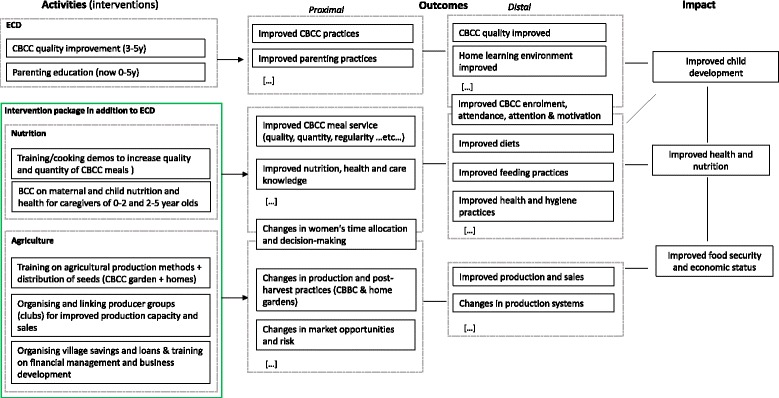
The Nutrition Embedded Evaluation Programme Impact Evaluation (NEEP-IE) study is a cluster randomised controlled trial designed to evaluate the impact of a childcare centre-based integrated nutritional and agricultural intervention on the diets, nutrition and development of young children in Malawi. The intervention includes activities to improve nutritious food production and training/behaviour-change communication to improve food intake, care and hygiene practices. This paper presents the rationale and study design for this randomised control trial.
Sixty community-based childcare centres (CBCCs) in rural communities around Zomba district, Malawi, were randomised to either (1) a control group where children were attending CBCCs supported by Save the Children's Early Childhood Health and Development (ECD) programme, or (2) an intervention group where nutritional and agricultural support activities were provided alongside the routine provision of the Save the Children's ECD programme. Primary outcomes at child level include dietary intake (measured through 24-h recall), whilst secondary outcomes include child development (Malawi Development Assessment Tool (MDAT)) and nutritional status (anthropometric measurements). At household level, primary outcomes include smallholder farmer production output and crop-mix (recall of last production season). Intermediate outcomes along theorised agricultural and nutritional pathways were measured. During this trial, we will follow a mixed-methods approach and undertake child-, household-, CBCC- and market-level surveys and assessments as well as in-depth interviews and focus group discussions with project stakeholders.
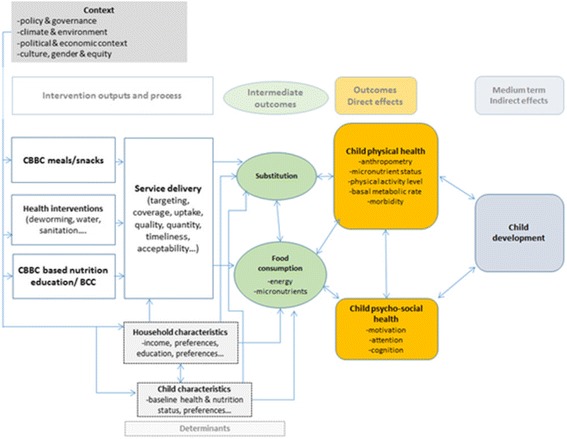
Assessing the simultaneous impact of preschool meals on diets, nutrition, child development and agriculture is a complex undertaking. This study is the first to explicitly examine, from a food systems perspective, the impact of a preschool meals programme on dietary choices, alongside outcomes in the nutritional, child development and agricultural domains. The findings of this evaluation will provide evidence to support policymakers in the scale-up of national programmes.
ISRCTN registry, ID: ISRCTN96497560 . Registered on 21 September 2016.
营养嵌入式评估项目影响评估(NEEP - IE)研究是一项整群随机对照试验,旨在评估以儿童保育中心为基础的综合营养与农业干预措施对马拉维幼儿饮食、营养和发育的影响。该干预措施包括改善营养食品生产的活动以及旨在改善食物摄入量、护理和卫生习惯的培训/行为改变宣传。本文介绍了这项随机对照试验的基本原理和研究设计。
在马拉维松巴区周边农村社区的60个社区儿童保育中心(CBCC)被随机分为两组:(1)对照组,儿童在由救助儿童会的幼儿健康与发展(ECD)项目支持的社区儿童保育中心就读;(2)干预组,在提供救助儿童会ECD项目常规服务的同时,提供营养和农业支持活动。儿童层面的主要结局包括饮食摄入量(通过24小时回顾法测量),次要结局包括儿童发育(马拉维发展评估工具(MDAT))和营养状况(人体测量)。在家庭层面,主要结局包括小农户的产量和作物组合(回顾上一个生产季节)。对理论上的农业和营养途径的中间结局进行了测量。在该试验期间,我们将采用混合方法,进行儿童、家庭、社区儿童保育中心和市场层面的调查与评估,以及与项目利益相关者进行深入访谈和焦点小组讨论。
评估学前膳食对饮食、营养、儿童发育和农业的同时影响是一项复杂的工作。本研究首次从食物系统的角度明确考察学前膳食项目对饮食选择的影响,以及在营养、儿童发育和农业领域的结局。该评估的结果将为政策制定者扩大国家项目提供证据支持。
ISRCTN注册库,编号:ISRCTN96497560。于2016年9月21日注册。