Lyttle Mark D, Gamble Carrol, Messahel Shrouk, Hickey Helen, Iyer Anand, Woolfall Kerry, Humphreys Amy, Bacon Naomi E A, Roper Louise, Babl Franz E, Dalziel Stuart R, Ryan Mary, Appleton Richard E
Bristol Royal Hospital for Children, Bristol, UK.
Faculty of Health and Applied Sciences, University of the West of England, Bristol, UK.
Trials. 2017 Jun 19;18(1):283. doi: 10.1186/s13063-017-2010-8.
Convulsive status epilepticus (CSE) is the most common life-threatening neurological emergency in childhood. These children are also at risk of significant morbidity, with acute and chronic impact on the family and the health and social care systems. The current recommended first-choice, second-line treatment in children aged 6 months and above is intravenous phenytoin (fosphenytoin in the USA), although there is a lack of evidence for its use and it is associated with significant side effects. Emerging evidence suggests that intravenous levetiracetam may be effective as a second-line agent for CSE, and fewer adverse effects have been described. This trial therefore aims to determine whether intravenous phenytoin or levetiracetam is more effective, and safer, in treating childhood CSE.
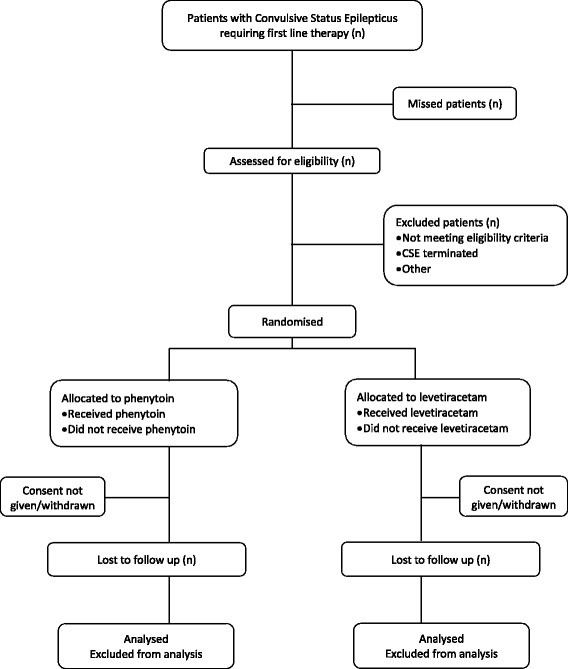
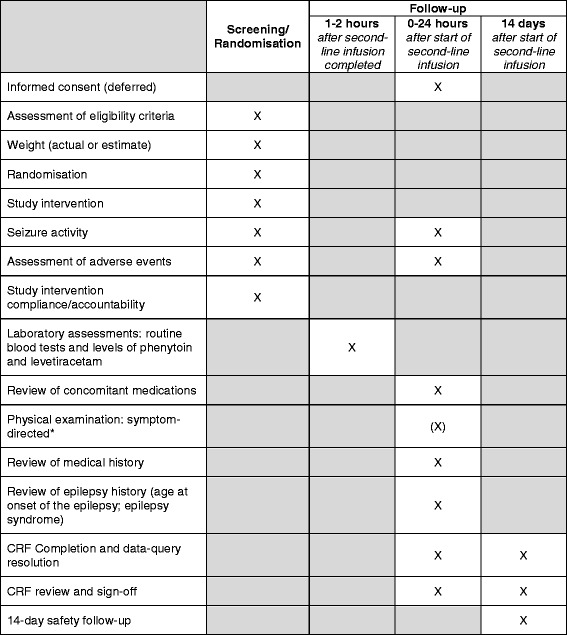
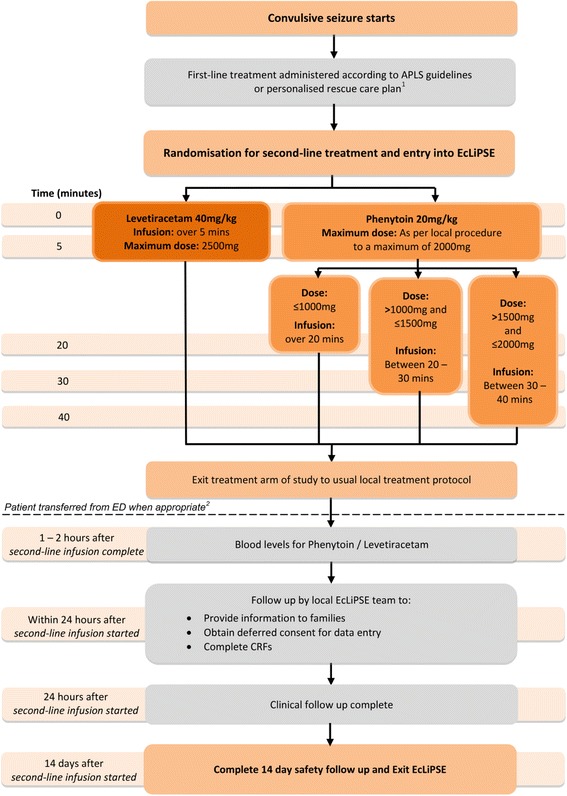
METHODS/DESIGN: This is a phase IV, multi-centre, parallel group, randomised controlled, open-label trial. Following treatment for CSE with first-line treatment, children with ongoing seizures are randomised to receive either phenytoin (20 mg/kg, maximum 2 g) or levetiracetam (40 mg/kg, maximum 2.5 g) intravenously. The primary outcome measure is the cessation of all visible signs of CSE as determined by the treating clinician. Secondary outcome measures include the need for further anti-seizure medications or rapid sequence induction for ongoing CSE, admission to critical care areas, and serious adverse reactions. Patients are recruited without prior consent, with deferred consent sought at an appropriate time for the family. The primary analysis will be by intention-to-treat. The primary outcome is a time to event outcome and a sample size of 140 participants in each group will have 80% power to detect an increase in CSE cessation rates from 60% to 75%. Our total sample size of 308 randomised and treated participants will allow for 10% loss to follow-up.
This clinical trial will determine whether phenytoin or levetiracetam is more effective as an intravenous second-line agent for CSE, and provide evidence for management recommendations. In addition, this trial will also provide data on which of these therapies is safer in this setting.
ISRCTN identifier, ISRCTN22567894 . Registered on 27 August 2015 EudraCT identifier, 2014-002188-13 . Registered on 21 May 2014 NIHR HTA Grant: 12/127/134.
惊厥性癫痫持续状态(CSE)是儿童期最常见的危及生命的神经急症。这些儿童还面临着严重发病的风险,对家庭以及卫生和社会护理系统产生急性和慢性影响。目前,6个月及以上儿童推荐的一线二线治疗药物是静脉注射苯妥英钠(美国使用磷苯妥英钠),尽管缺乏其使用证据且该药有显著副作用。新出现的证据表明,静脉注射左乙拉西坦可能作为CSE的二线药物有效,且不良反应较少。因此,本试验旨在确定静脉注射苯妥英钠或左乙拉西坦在治疗儿童CSE方面是否更有效、更安全。
方法/设计:这是一项IV期、多中心、平行组、随机对照、开放标签试验。在采用一线治疗方法治疗CSE后,仍有癫痫发作的儿童被随机分组,静脉注射苯妥英钠(20mg/kg,最大剂量2g)或左乙拉西坦(40mg/kg,最大剂量2.5g)。主要结局指标是由治疗医生确定的CSE所有可见体征的停止。次要结局指标包括对持续CSE是否需要进一步的抗癫痫药物治疗或快速顺序诱导、入住重症监护病房以及严重不良反应。患者在未经事先同意的情况下入组,之后在适当时间寻求家属的延迟同意。主要分析将采用意向性分析。主要结局是一个事件发生时间结局,每组140名参与者的样本量将有80%的把握度检测到CSE停止率从60%提高到75%。我们总共308名随机分组并接受治疗的参与者的样本量将允许10%的失访率。
本临床试验将确定苯妥英钠或左乙拉西坦作为CSE的静脉二线药物是否更有效,并为管理建议提供证据。此外,本试验还将提供关于在这种情况下哪种治疗方法更安全的数据。
国际标准随机对照试验编号,ISRCTN22567894。于2015年8月27日注册 欧洲药品管理局临床试验编号,2014 - 002188 - 13。于2014年5月21日注册 英国国家卫生研究院健康技术评估资助项目:12/127/134。