Division of Pediatric Pulmonology, Department of Pediatrics, College of Physicians and Surgeons, Columbia University, 3959 Broadway CHC-745, New York, NY 10032 USA.
Division of Pulmonary, Allergy and Critical Care of Medicine, Department of Medicine, College of Physicians and Surgeons, Columbia University, PH8E-101, 630 W. 168 St, New York, NY 10032 USA.
Clin Epigenetics. 2017 Jun 13;9:65. doi: 10.1186/s13148-017-0364-0. eCollection 2017.
Physical activity is associated with improvement in lung function; however, pollution exposure during physical activity can lead to a transient reduction in lung function. This paradoxical relationship may be linked to altered T regulatory (Treg) cell activity, which increases with exercise and suppresses airway inflammation, but decreases in association with exposure to air pollution. To clarify these relationships, we investigated buccal cell DNA methylation of the forkhead box p3 () gene promoter, a proposed biomarker of Treg activity. We hypothesized that active urban children would have lower promoter methylation, associated with better lung function compared to non-active children. We also hypothesized that this relationship would be attenuated by high exposure to the air pollutant black carbon (BC).
We performed a cross-sectional study of 135 children ages 9-14 who live in New York City. Activity was measured across 6 days. BC exposure was assessed by personal monitors worn for two 24-h periods, followed by lung function assessment. Buccal swabs were collected for DNA methylation analysis of three regions (six CpG sites) in the promoter.
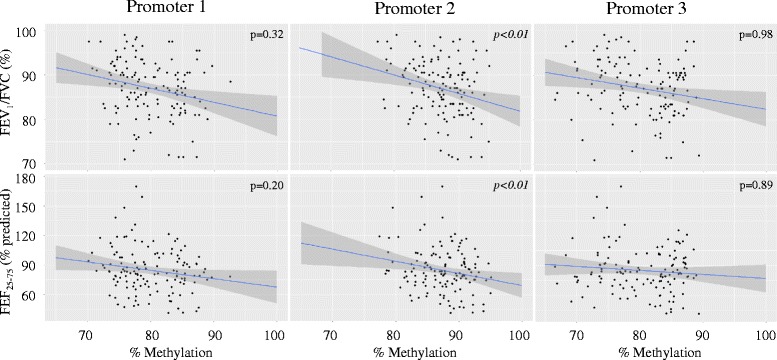
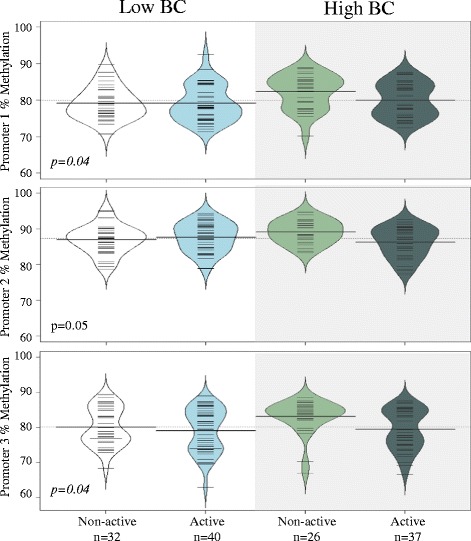
In multivariable regression models, overall, there was no significant relationship between physical activity and promoter methylation ( > 0.05). However, in stratified analyses, among children with higher BC exposure (≥1200 ng/m), physical activity was associated with 2.37% lower methylation in promoter 2 (CpGs -77, -65, and -58) ( = -2.37%, < 0.01) but not among those with lower BC exposure ( = 0.54%, > 0.05). Differences across strata were statistically significant ( = 0.04). Among all children, after controlling for BC concentration, promoter 2 methylation was associated with reduced FEV/FVC ( = -0.40%, < 0.01) and reduced FEF ( = -1.46%, < 0.01).
Physical activity in urban children appeared associated with lower promoter methylation, a possible indicator of greater Treg function, under conditions of high BC exposure. Reduced promoter methylation was associated with higher lung function. These findings suggest that physical activity may induce immunologic benefits, particularly for urban children with greater risk of impaired lung function due to exposure to higher air pollution. promoter buccal cell methylation may function as a useful biomarker of that benefit.
身体活动与肺功能改善相关;然而,身体活动期间接触污染会导致肺功能短暂下降。这种矛盾的关系可能与调节性 T 细胞(Treg)活性的改变有关,Treg 细胞活性随运动而增加,可抑制气道炎症,但随空气污染暴露而减少。为了阐明这些关系,我们检测了叉头框 P3(Foxp3)基因启动子的口腔颊细胞 DNA 甲基化,这是 Treg 活性的一个潜在生物标志物。我们假设与非活跃儿童相比,活跃的城市儿童口腔颊细胞 Foxp3 基因启动子的甲基化程度较低,肺功能更好。我们还假设,这种关系会因暴露于高浓度的空气污染物黑碳(BC)而减弱。
我们对 135 名年龄在 9-14 岁之间、居住在纽约市的儿童进行了横断面研究。活动情况通过 6 天的监测来评估。BC 暴露情况通过佩戴两个 24 小时个人监测器来评估,随后进行肺功能评估。采集口腔拭子进行 Foxp3 基因启动子三个区域(六个 CpG 位点)的 DNA 甲基化分析。
在多变量回归模型中,总体而言,体力活动与 Foxp3 基因启动子的甲基化之间没有显著关系( > 0.05)。然而,在分层分析中,在 BC 暴露水平较高(≥1200ng/m)的儿童中,体力活动与启动子 2 中 2.37%的低甲基化(CpG-77、-65 和-58)有关( = -2.37%, < 0.01),但在 BC 暴露水平较低的儿童中没有关系( = 0.54%, > 0.05)。各层之间的差异具有统计学意义( = 0.04)。在所有儿童中,在校正 BC 浓度后,启动子 2 甲基化与 FEV/FVC 降低有关( = -0.40%, < 0.01),与 FEF 降低有关( = -1.46%, < 0.01)。
在高 BC 暴露的情况下,城市儿童的体力活动似乎与 Foxp3 基因启动子的低甲基化有关,这可能是 Treg 功能增强的一个指标。Foxp3 基因启动子的低甲基化与较高的肺功能有关。这些发现表明,体力活动可能会带来免疫益处,特别是对于因暴露于较高的空气污染而肺功能受损风险较高的城市儿童而言。Foxp3 基因启动子口腔颊细胞的甲基化可能是这种益处的有用生物标志物。