Lovinsky-Desir Stephanie, Jung Kyung Hwa, Rundle Andrew G, Hoepner Lori A, Bautista Joshua B, Perera Frederica P, Chillrud Steven N, Perzanowski Matthew S, Miller Rachel L
Division of Pediatric Pulmonology, Department of Pediatrics, College of Physicians and Surgeons, Columbia University, 3959 Broadway CHC-745, New York, NY 10032, United States.
Division of Pulmonary, Allergy and Critical Care of Medicine, Department of Medicine, College of Physicians and Surgeons, Columbia University, PH8E-101, 630 W. 168S., New York, NY 10032, United States.
Environ Res. 2016 Nov;151:756-762. doi: 10.1016/j.envres.2016.09.005. Epub 2016 Sep 29.
Regular physical activity can improve cardiopulmonary health; however, increased respiratory rates and tidal volumes during activity may increase the effective internal dose of air pollution exposure. Our objective was to investigate the impact of black carbon (BC) measured by personal sampler on the relationship between physical activity and fractional exhaled nitric oxide (FeNO), a marker of airway inflammation. We hypothesized that higher personal BC would attenuate the protective effect of physical activity on airway inflammation.
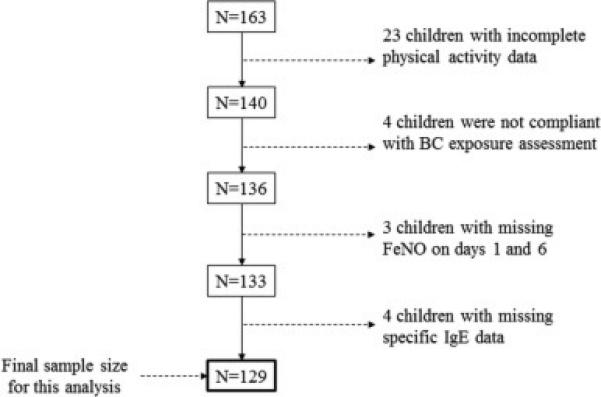
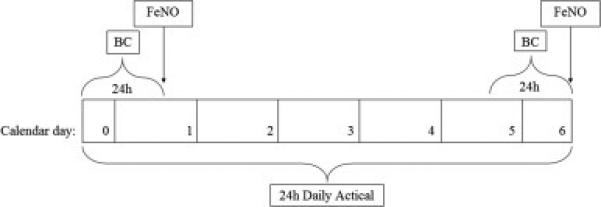
We performed a cross-sectional study nested in a birth cohort of African American and Dominican children living in the Bronx and Northern Manhattan, New York City. Children were recruited based on age (target 9-14 year olds) and presence (n=70) or absence (n=59) of current asthma. Children wore wrist mounted accelerometers for 6 days and were classified as 'active' if they had ≥60min of moderate-to-vigorous activity (MVA) each day and 'non-active' if they had <60min of MVA on any given day, based on CDC guidelines. Personal BC measured using a MicroAeth, was assessed during two 24-h periods, at the beginning and end of physical activity assessment. High BC was defined as the upper tertile of BC measured with personal sampler. FeNO measurements were sampled at the beginning and end of the of physical activity assessment.
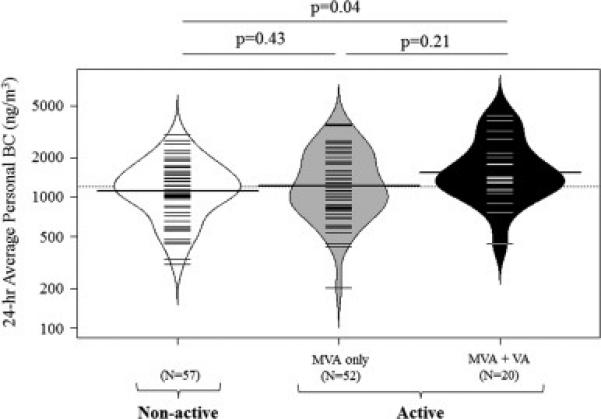
In multivariable linear regression models, 'active' children had 25% higher personal BC concentrations (p=0.02) and 20% lower FeNO (p=0.04) compared to 'non-active' children. Among children with high personal BC (n=33), there was no relationship between activity and FeNO (p=1.00). The significant protective relationship between activity and airway inflammation was largely driven by children with lower personal BC (n=96, p=0.04).
Children that live in an urban environment and are physically active on a daily basis have higher personal exposure to BC. High BC offsets the protective relationship between physical activity and airway inflammation.
规律的体育活动可改善心肺健康;然而,活动期间呼吸频率和潮气量增加可能会提高空气污染暴露的有效内部剂量。我们的目的是研究用个人采样器测量的黑碳(BC)对体育活动与呼出一氧化氮分数(FeNO,一种气道炎症标志物)之间关系的影响。我们假设个人BC水平较高会减弱体育活动对气道炎症的保护作用。
我们在纽约市布朗克斯区和曼哈顿北部的非裔美国儿童和多米尼加儿童出生队列中进行了一项横断面研究。根据年龄(目标年龄为9至14岁)以及是否患有当前哮喘(n = 70)或未患哮喘(n = 59)招募儿童。儿童佩戴腕式加速度计6天,根据美国疾病控制与预防中心的指南,如果他们每天有≥60分钟的中度至剧烈活动(MVA),则被分类为“活跃”;如果他们在任何一天的MVA少于60分钟,则被分类为“不活跃”。在体育活动评估开始和结束时的两个24小时期间,使用微型黑碳仪测量个人BC。高BC定义为用个人采样器测量的BC的上三分位数。在体育活动评估开始和结束时采集FeNO测量值。
在多变量线性回归模型中,与“不活跃”儿童相比,“活跃”儿童的个人BC浓度高25%(p = 0.02),FeNO低20%(p = 0.04)。在个人BC水平高的儿童(n = 33)中,活动与FeNO之间没有关系(p = 1.00)。活动与气道炎症之间的显著保护关系在很大程度上是由个人BC水平较低的儿童驱动的(n = 96,p = 0.04)。
生活在城市环境中且每天进行体育活动的儿童个人接触BC的水平较高。高BC抵消了体育活动与气道炎症之间的保护关系。