Pires Daniela, Tartari Ermira, Bellissimo-Rodrigues Fernando, Pittet Didier
Infection Control Programme and WHO Collaborating Centre on Patient Safety - Infection Control & Improving Practices, University of Geneva Hospitals and Faculty of Medicine, 4 Rue Gabrielle-Perret-Gentil, 1211 Geneva, Switzerland.
Department of Infectious Diseases, Centro Hospitalar Lisboa Norte and Faculdade de Medicina da Universidade de Lisboa, Lisbon, Portugal.
Antimicrob Resist Infect Control. 2017 Jun 14;6:65. doi: 10.1186/s13756-017-0218-8. eCollection 2017.
Hand hygiene has evolved over the last decades and many terminologies emerged. We aimed to analyse the evolution in the frequency of utilization of key hand hygiene terms in the literature along the years.
We identified keywords and Medical Subject Headings (MeSH) used in MEDLINE® indexation related to hand hygiene by searching international guidelines and the MeSH database. We performed a MEDLINE® search combining the selected keywords and MeSH and analysed the number of publications retrieved yearly.
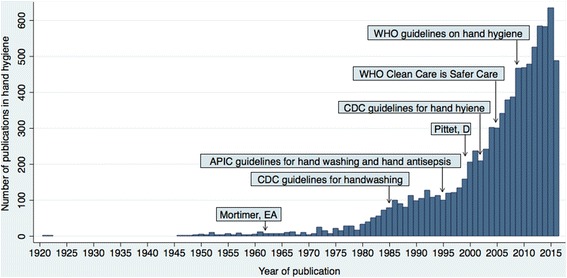
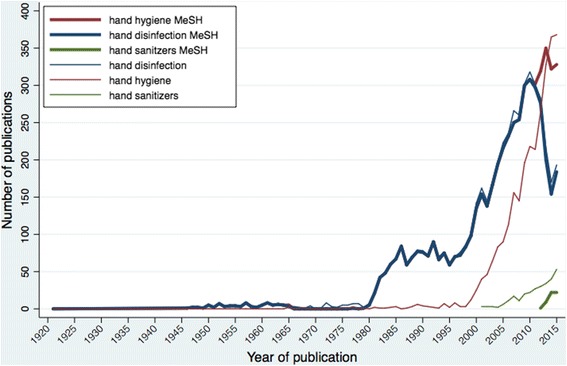
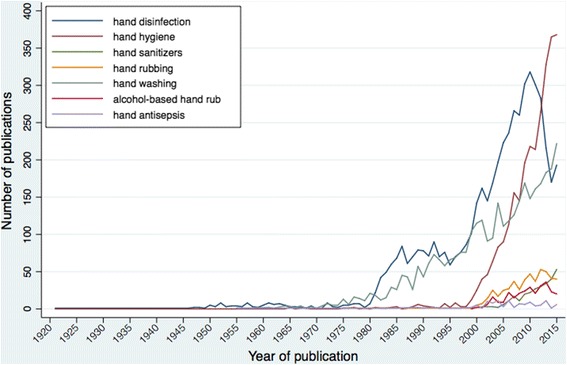
The literature search yielded 9019 publications when all hand hygiene related search terms were combined, between 1921 and November 2016. The total number of publications per year increased from a median of 4 (IQR 3, 6) in the 1950's to 554 (IQR 478, 583) between 2011 and 2015. The most frequently used keywords are hand disinfection, hand hygiene, hand washing, handrub, hand sanitizer and alcohol-based hand rub (ABHR). Until the 1990s, hand disinfection and hand washing were the most frequently used terms. Whilst the last decade has seen a remarkable increase in publications mentioning hand disinfection and hand hygiene and for the first time handrub, hand sanitizers and ABHR were introduced in the literature. Hand disinfection, hand hygiene and hand sanitizers are the main MeSH used by MEDLINE®. Since 2013 hand hygiene is the most frequently used MeSH and keyword.
The change seen in literature in the last two decades, from hand washing and hand disinfection to hand hygiene, most probably reflect the paradigm shift favouring use of ABHR over soap and water promoted by international guidelines in the early 2000s.
在过去几十年中,手部卫生观念不断演变,出现了许多术语。我们旨在分析多年来文献中关键手部卫生术语使用频率的演变情况。
通过检索国际指南和医学主题词(MeSH)数据库,我们确定了与手部卫生相关的MEDLINE®索引中使用的关键词和医学主题词。我们结合选定的关键词和医学主题词进行了MEDLINE®搜索,并分析了每年检索到的出版物数量。
1921年至2016年11月期间,当所有与手部卫生相关的搜索词组合在一起时,文献检索共得到9019篇出版物。每年的出版物总数从20世纪50年代的中位数4篇(四分位间距3,6)增加到2011年至2015年期间的554篇(四分位间距478,583)。最常用的关键词是手部消毒、手部卫生、洗手、手消毒剂、洗手液和酒精基手消毒剂(ABHR)。直到20世纪90年代,手部消毒和洗手是最常用的术语。而在过去十年中,提及手部消毒和手部卫生的出版物显著增加,并且手消毒剂、洗手液和ABHR首次出现在文献中。手部消毒、手部卫生和洗手液是MEDLINE®使用的主要医学主题词。自2013年以来,手部卫生是最常用的医学主题词和关键词。
在过去二十年的文献中看到的从洗手和手部消毒到手部卫生的变化,很可能反映了21世纪初国际指南所推动的有利于使用酒精基手消毒剂而非肥皂和水的范式转变。