Tran Son, Yang Jiawei, Gillgren Nathaniel, Espiritu Timothy, Shi Yanmeng, Watanabe Kenji, Taniguchi Takashi, Moon Seongphill, Baek Hongwoo, Smirnov Dmitry, Bockrath Marc, Chen Ruoyu, Lau Chun Ning
Department of Physics and Astronomy, University of California, Riverside, CA 92521, USA.
Department of Physics, Ohio State University, Columbus, OH 43220, USA.
Sci Adv. 2017 Jun 2;3(6):e1603179. doi: 10.1126/sciadv.1603179. eCollection 2017 Jun.
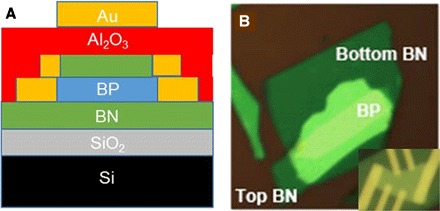
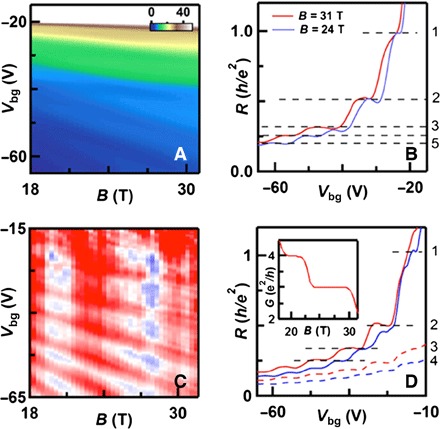
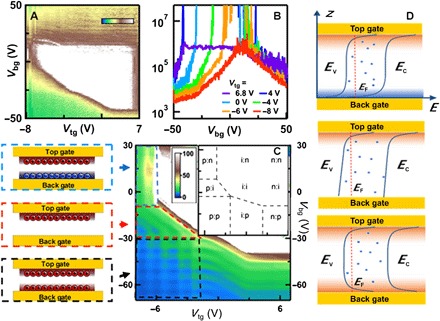
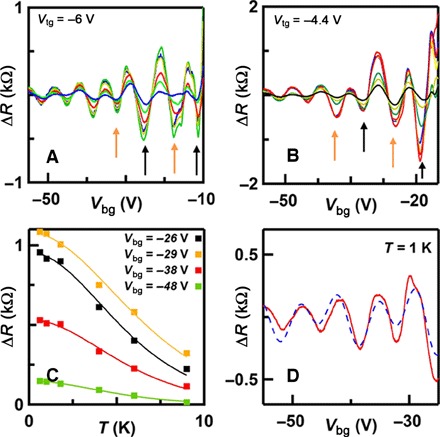
Quantum wells (QWs) constitute one of the most important classes of devices in the study of two-dimensional (2D) systems. In a double-layer QW, the additional "which-layer" degree of freedom gives rise to celebrated phenomena, such as Coulomb drag, Hall drag, and exciton condensation. We demonstrate facile formation of wide QWs in few-layer black phosphorus devices that host double layers of charge carriers. In contrast to traditional QWs, each 2D layer is ambipolar and can be tuned into n-doped, p-doped, or intrinsic regimes. Fully spin-polarized quantum Hall states are observed on each layer, with an enhanced Landé factor that is attributed to exchange interactions. Our work opens the door for using 2D semiconductors as ambipolar single, double, or wide QWs with unusual properties, such as high anisotropy.
量子阱(QWs)是二维(2D)系统研究中最重要的一类器件之一。在双层量子阱中,额外的“哪一层”自由度会引发一些著名的现象,比如库仑拖拽、霍尔拖拽和激子凝聚。我们展示了在承载双层电荷载流子的少层黑磷器件中轻松形成宽量子阱。与传统量子阱不同,每个二维层都是双极性的,可以被调制成n型掺杂、p型掺杂或本征态。在每一层上都观察到了完全自旋极化的量子霍尔态,其朗德因子增强,这归因于交换相互作用。我们的工作为将二维半导体用作具有诸如高各向异性等非凡特性的双极性单量子阱、双量子阱或宽量子阱打开了大门。