Islam Fakir M Amirul
Department of Statistics, Data Science and Epidemiology, Faculty of Health, Arts and Design, Swinburne University of Technology, Hawthorn, Victoria, Australia.
Organisation for Rural Community Development (ORCD), Dariapur, Narail, Bangladesh.
PLoS One. 2017 Jun 20;12(6):e0179310. doi: 10.1371/journal.pone.0179310. eCollection 2017.
To evaluate the accuracy and reliability of fundus retinal photos graded by local graders in Bangladesh with those graded by an expert at the Centre for Eye Research Australia (CERA) in the context of mass scale diabetic retinopathy (DR) screening in Bangladesh.
A population-based cross-sectional study of 3,104 adults identified 213 (7.2%) eligible patients with diabetes of age ≥ 40 years in 2012-2013. Retinal photographs were collected using a non-mydriatic digital fundus retinal camera and a two-field imaging protocol. The photos were graded by two remote graders (G1 and G2) who were trained by a retinal specialist (RS) in Bangladesh, by the RS himself, and by a Centre for Eye Research Australia (CERA) grader. The local graders up skilled their grading ability by comparing 30% of the photos graded by the CERA grader with their own grades. Learning from that exercise was applied to the remaining 70% of photos, which were re-graded. Reliability and accuracy of grading amongst the graders were reported using cross tabulation, inter- and intra-grader reliability, and with sensitivity and specificity.
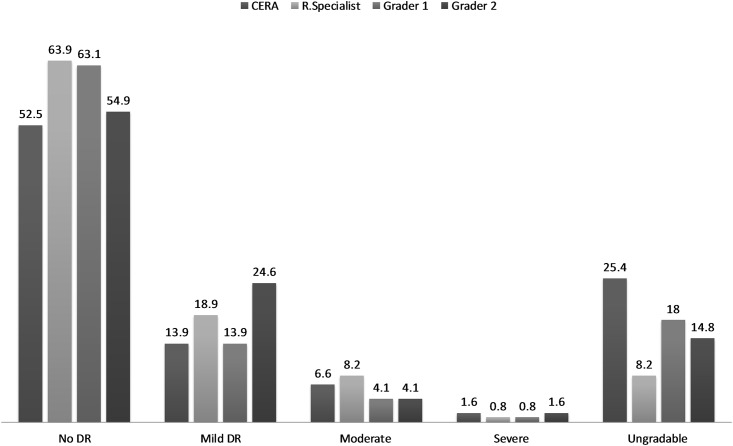
Of 122 eyes from 61 patients, the mild (R1) DR was estimated to be 14 to 25%, pre-proliferative (R2) DR 4-8%, and proliferative (R3) DR 0.8 to 1.6%, whereas 25%, 8%, 18%, and 15% were found to be ungradable by CERA, RS, G1, and G2, respectively. Of 8 (6.6%) eyes identified as R2 by the CERA grader, 5 (63%), 3 (38%) and 3 (38%) were correctly classified as R2, whereas the rest were classified either as R1 or R3 but none were classified as no DR (R0) or ungradable by the RS, G1 and G2, respectively. After getting experience reviewing the 30% test set graded by the CERA grader, the local graders graded moderate and severe DR with 100% accuracy. After excluding ungradable photos, the sensitivity (specificity) relative to the CERA grader was 82% (88%) before and 80% (93%) after training for G1 and 56% (87%) before and 77% (90%) after training for G2. In case of maculopathy, the CERA grader reported 11.2% eyes with maculopathy, which included 100% of the 4.9% by RS, 6.6% by G1, and 7.4% by G2.
Local graders in Bangladesh are able to grade retinal photos with high accuracy if the DR is at least of a moderate level. With appropriate training and experience, local graders have the ability to contribute significantly to the grading of millions of retinal photos, which required grading in resource- poor countries.
在孟加拉国大规模糖尿病视网膜病变(DR)筛查的背景下,评估孟加拉国当地分级人员对眼底视网膜照片的分级准确性和可靠性,以及与澳大利亚眼研究中心(CERA)专家的分级结果进行比较。
在2012 - 2013年对3104名成年人进行的基于人群的横断面研究中,确定了213名(7.2%)年龄≥40岁的合格糖尿病患者。使用非散瞳数字眼底视网膜相机和双视野成像方案收集视网膜照片。照片由两名远程分级人员(G1和G2)分级,他们由孟加拉国的一名视网膜专家(RS)培训,RS本人也参与分级,还有一名澳大利亚眼研究中心(CERA)的分级人员。当地分级人员通过将CERA分级人员分级的30%照片与自己的分级进行比较来提升分级能力。从该练习中学到的经验应用于其余70%的照片,并重新进行分级。使用交叉表、分级人员间和分级人员内的可靠性以及敏感性和特异性报告分级人员之间分级的可靠性和准确性。
在61名患者的122只眼中,轻度(R1)DR估计为14%至25%,增殖前期(R2)DR为4%至8%,增殖性(R3)DR为0.8%至1.6%,而CERA、RS、G1和G2分别发现25%、8%、18%和15%的照片无法分级。在CERA分级人员判定为R2的8只(6.6%)眼中,5只(63%)、3只(38%)和3只(38%)被RS、G1和G2正确分类为R2,其余则被分类为R1或R3,但RS、G1和G2均未将其分类为无DR(R0)或无法分级。在获得审阅CERA分级人员分级的30%测试集的经验后,当地分级人员对中度和重度DR的分级准确率达到100%。排除无法分级的照片后,相对于CERA分级人员,G1在培训前的敏感性(特异性)为82%(88%),培训后的敏感性(特异性)为80%(93%);G2在培训前的敏感性(特异性)为56%(87%),培训后的敏感性(特异性)为77%(90%)。在黄斑病变方面,CERA分级人员报告11.2%的眼睛有黄斑病变,其中包括RS报告的4.9%中的100%、G1报告的6.6%和G2报告的7.4%。
如果DR至少为中度水平,孟加拉国的当地分级人员能够以高准确率对视网膜照片进行分级。通过适当的培训和经验积累,当地分级人员有能力为资源匮乏国家数百万张需要分级的视网膜照片的分级工作做出重大贡献。