Baez Sandra, Flichtentrei Daniel, Prats María, Mastandueno Ricardo, García Adolfo M, Cetkovich Marcelo, Ibáñez Agustín
Laboratory of Experimental Psychology and Neuroscience (LPEN), Institute of Cognitive and Translational Neuroscience (INCyT), INECO Foundation, Favaloro University, Buenos Aires, Argentina.
Departamento de Psicología, Universidad de los Andes, Bogotá, Colombia.
PLoS One. 2017 Jun 20;12(6):e0179336. doi: 10.1371/journal.pone.0179336. eCollection 2017.
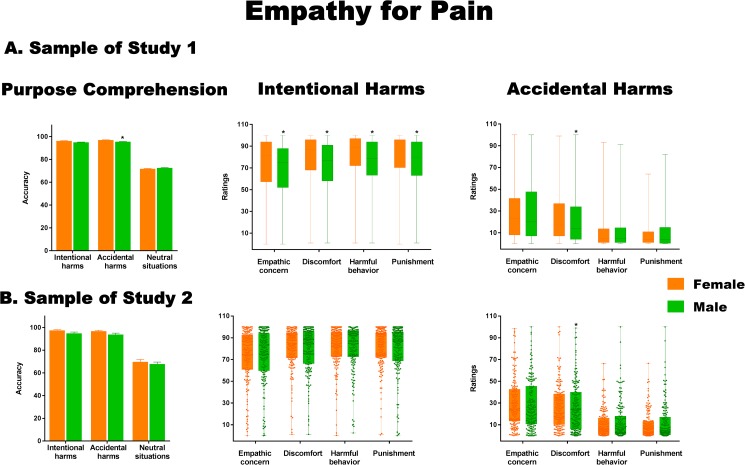
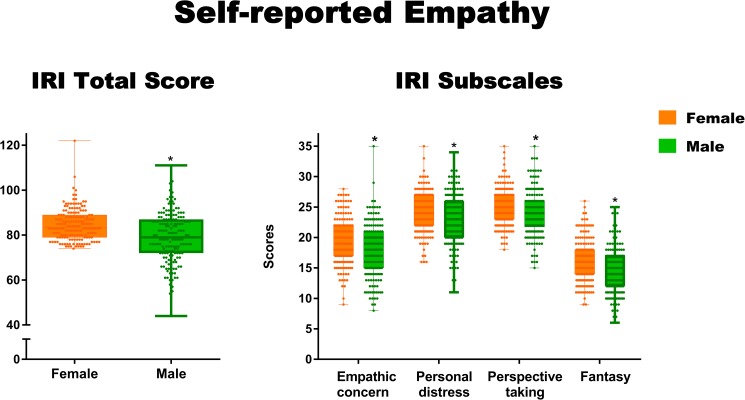
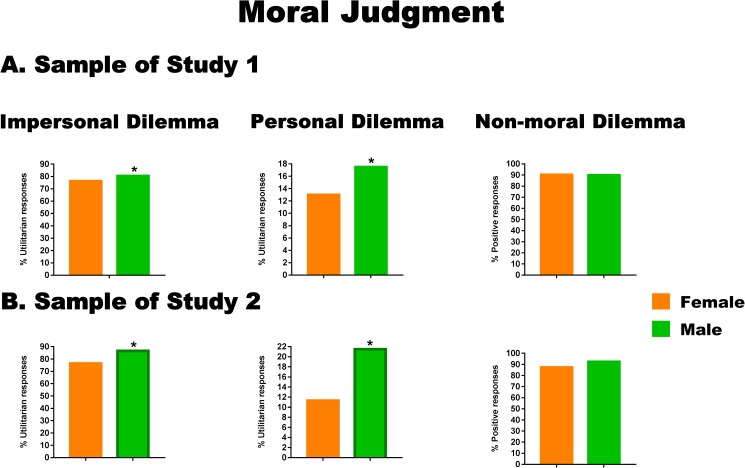
Research on sex differences in empathy has revealed mixed findings. Whereas experimental and neuropsychological measures show no consistent sex effect, self-report data consistently indicates greater empathy in women. However, available results mainly come from separate populations with relatively small samples, which may inflate effect sizes and hinder comparability between both empirical corpora. To elucidate the issue, we conducted two large-scale studies. First, we examined whether sex differences emerge in a large population-based sample (n = 10,802) when empathy is measured with an experimental empathy-for-pain paradigm. Moreover, we investigated the relationship between empathy and moral judgment. In the second study, a subsample (n = 334) completed a self-report empathy questionnaire. Results showed some sex differences in the experimental paradigm, but with minuscule effect sizes. Conversely, women did portray themselves as more empathic through self-reports. In addition, utilitarian responses to moral dilemmas were less frequent in women, although these differences also had small effect sizes. These findings suggest that sex differences in empathy are highly driven by the assessment measure. In particular, self-reports may induce biases leading individuals to assume gender-role stereotypes. Awareness of the role of measurement instruments in this field may hone our understanding of the links between empathy, sex differences, and gender roles.
关于共情方面性别差异的研究结果不一。虽然实验和神经心理学测量未显示出一致的性别效应,但自我报告数据始终表明女性的共情能力更强。然而,现有结果主要来自样本相对较小的不同人群,这可能会夸大效应量并阻碍两个实证数据集之间的可比性。为阐明这一问题,我们进行了两项大规模研究。首先,我们使用实验性疼痛共情范式测量共情时,在一个基于大量人群的样本(n = 10,802)中检验性别差异是否出现。此外,我们研究了共情与道德判断之间的关系。在第二项研究中,一个子样本(n = 334)完成了一份自我报告共情问卷。结果显示在实验范式中存在一些性别差异,但效应量极小。相反,通过自我报告,女性确实将自己描绘为更具共情能力。此外,女性对道德困境的功利主义反应较少,尽管这些差异的效应量也很小。这些发现表明,共情方面的性别差异很大程度上受评估方法的驱动。特别是,自我报告可能会引发偏差,导致个体形成性别角色刻板印象。意识到测量工具在该领域的作用可能会加深我们对共情、性别差异和性别角色之间联系的理解。