Solheim Marie H, Clermont Allen C, Winnay Jonathon N, Hallstensen Erlend, Molven Anders, Njølstad Pål R, Rødahl Eyvind, Kahn C Ronald
Joslin Diabetes Center, Harvard Medical School, Boston, Massachusetts, United States 2KG Jebsen Center for Diabetes Research, Department of Clinical Science, University of Bergen, Bergen, Norway.
Joslin Diabetes Center, Harvard Medical School, Boston, Massachusetts, United States 3Beetham Eye Institute, Boston, Massachusetts, United States.
Invest Ophthalmol Vis Sci. 2017 Jun 1;58(7):3100-3106. doi: 10.1167/iovs.16-21347.
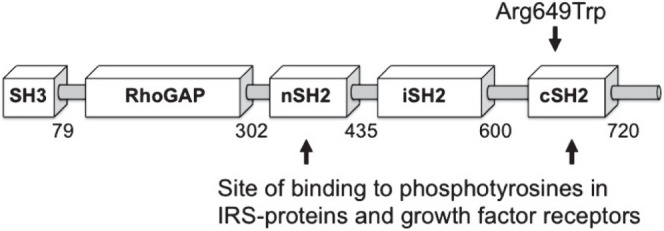
To determine the ocular consequences of a dominant-negative mutation in the p85α subunit of phosphatidylinositol 3-kinase (PIK3R1) using a knock-in mouse model of SHORT syndrome, a syndrome associated with short stature, lipodystrophy, diabetes, and Rieger anomaly in humans.
We investigated knock-in mice heterozygous for the SHORT syndrome mutation changing arginine 649 to tryptophan in p85α (PIK3R1) using physical examination, optical coherence tomography (OCT), tonometry, and histopathologic sections from paraffin-embedded eyes, and compared the findings to similar investigations in two human subjects with SHORT syndrome heterozygous for the same mutation.
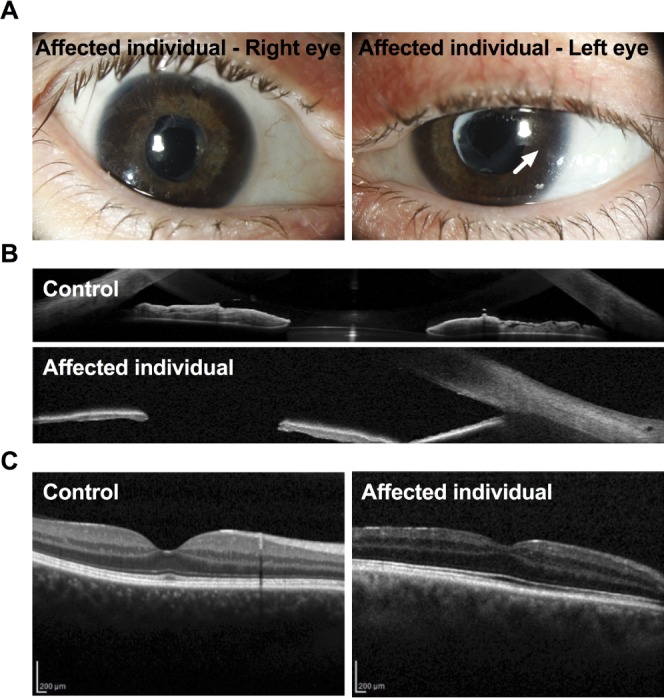
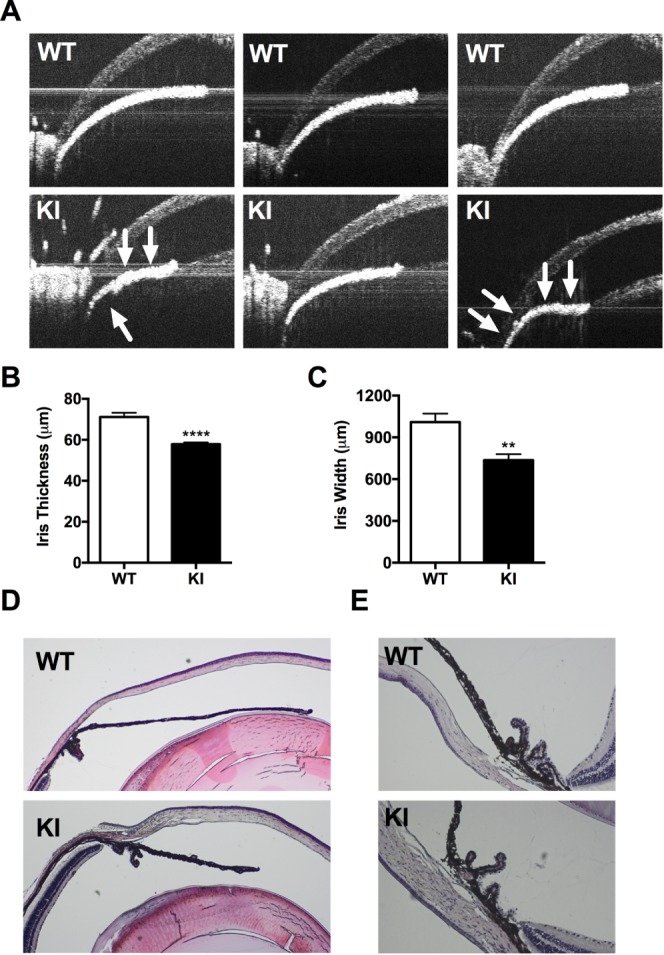
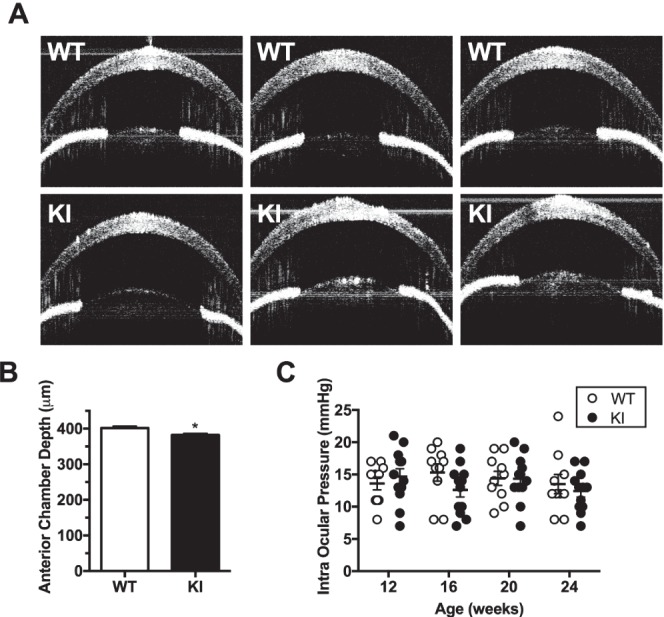
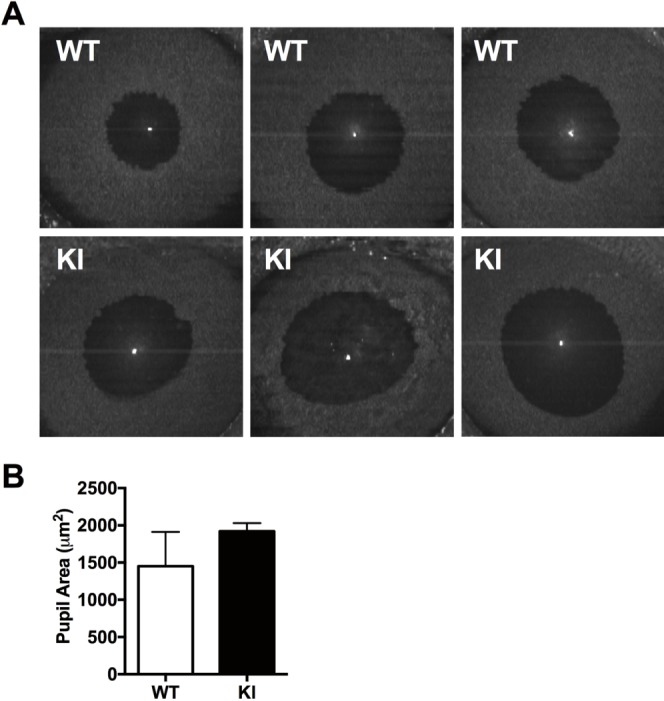
While overall eye development was normal with clear cornea and lens, normal anterior chamber volume, normal intraocular pressure, and no changes in the retinal structure, OCT images of the knock-in mouse eyes revealed a significant decrease in thickness and width of the iris resulting in increased pupil area and irregularity of shape. Both human subjects had Rieger anomaly with similar defects including thin irides and irregular pupils, as well as a prominent ring of Schwalbe, goniosynechiae, early cataract formation, and glaucoma. Although the two subjects had had diabetes for more than 30 years, there were no signs of diabetic retinopathy.
A dominant-negative mutation in the p85α regulatory subunit of PI3K affects development of the iris, and contributes to changes consistent with anterior segment dysgenesis in both humans and mice.
利用SHORT综合征的基因敲入小鼠模型,确定磷脂酰肌醇3激酶(PIK3R1)的p85α亚基显性负性突变的眼部后果。SHORT综合征与人类身材矮小、脂肪营养不良、糖尿病和里格尔异常有关。
我们通过体格检查、光学相干断层扫描(OCT)、眼压测量以及石蜡包埋眼的组织病理学切片,研究了因SHORT综合征突变导致p85α(PIK3R1)中精氨酸649变为色氨酸的杂合基因敲入小鼠,并将研究结果与两名携带相同突变的SHORT综合征杂合子人类受试者的类似研究结果进行比较。
虽然总体眼部发育正常,角膜和晶状体清晰,前房容积正常,眼压正常,视网膜结构无变化,但基因敲入小鼠眼睛的OCT图像显示虹膜厚度和宽度显著减小,导致瞳孔面积增大和形状不规则。两名人类受试者均患有里格尔异常,伴有类似缺陷,包括虹膜变薄和瞳孔不规则,以及施瓦贝环突出、前房角粘连、早期白内障形成和青光眼。尽管这两名受试者患有糖尿病超过30年,但没有糖尿病视网膜病变的迹象。
PI3K的p85α调节亚基中的显性负性突变影响虹膜发育,并导致人类和小鼠中与眼前节发育异常一致的变化。