Department of Anesthesiology, The First Affiliated Hospital, Zhengzhou University, China.
Mol Pain. 2017 Jan-Dec;13:1744806917718753. doi: 10.1177/1744806917718753.
It has been demonstrated that upregulation of CXCL12 and CXCR4 in spinal cord involves in the pathogenesis of neuropathic, inflammatory, and cancer pain. However, whether CXCL12/CXCR4 signaling contributes to postsurgical pain remains unknown. The aim of the present study is to investigate the role of CXCL12/CXCR4 signaling in the genesis of postsurgical pain and the underlying mechanism.
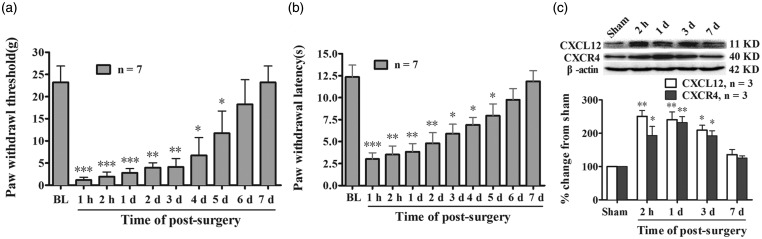
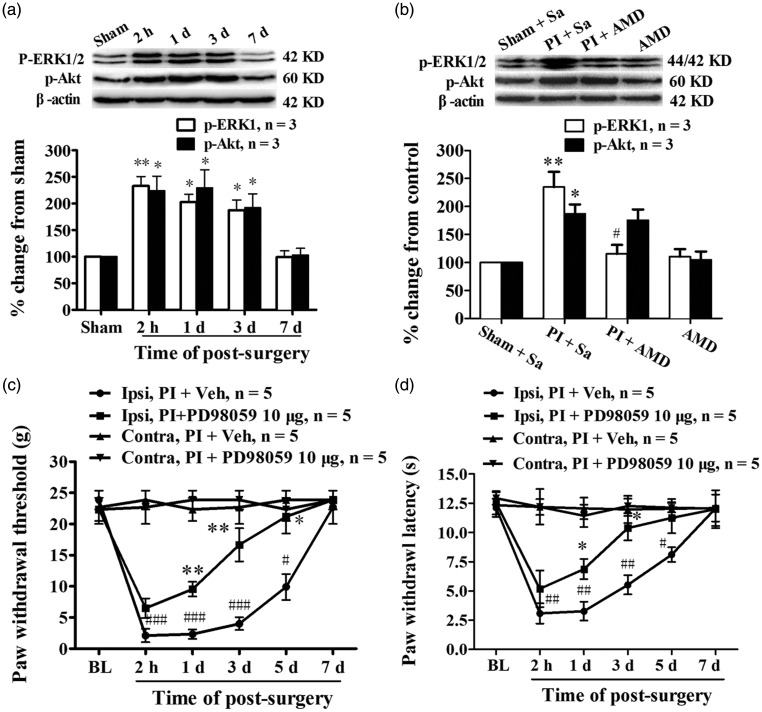
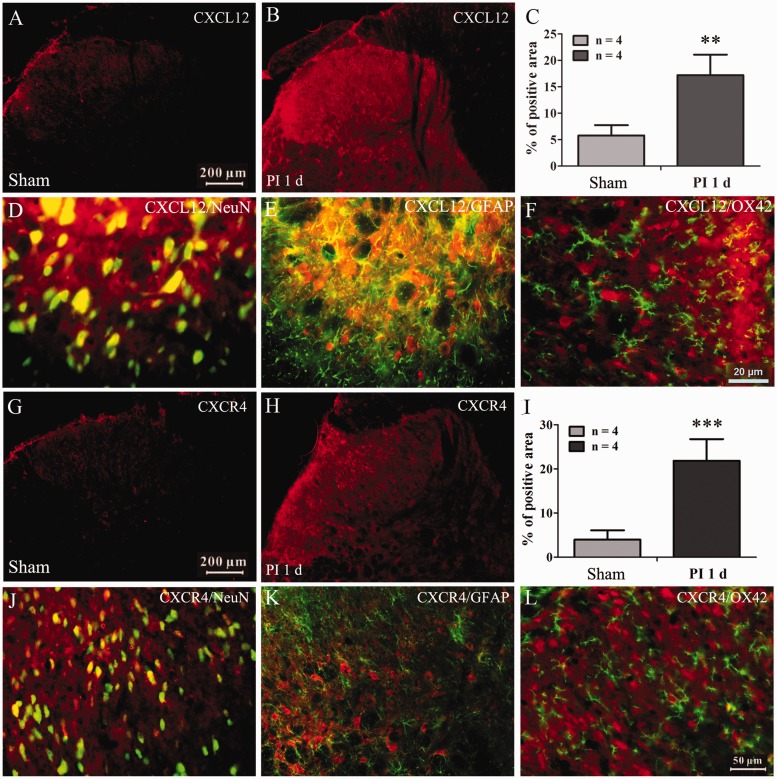
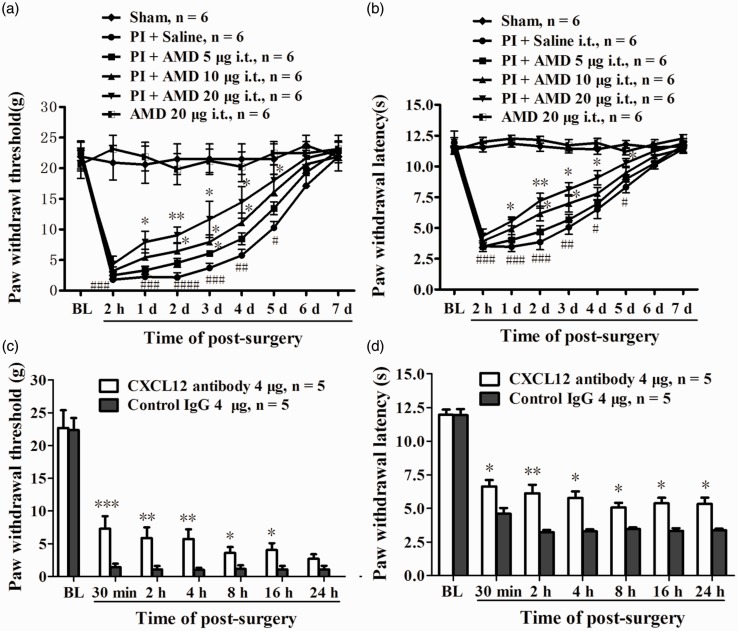
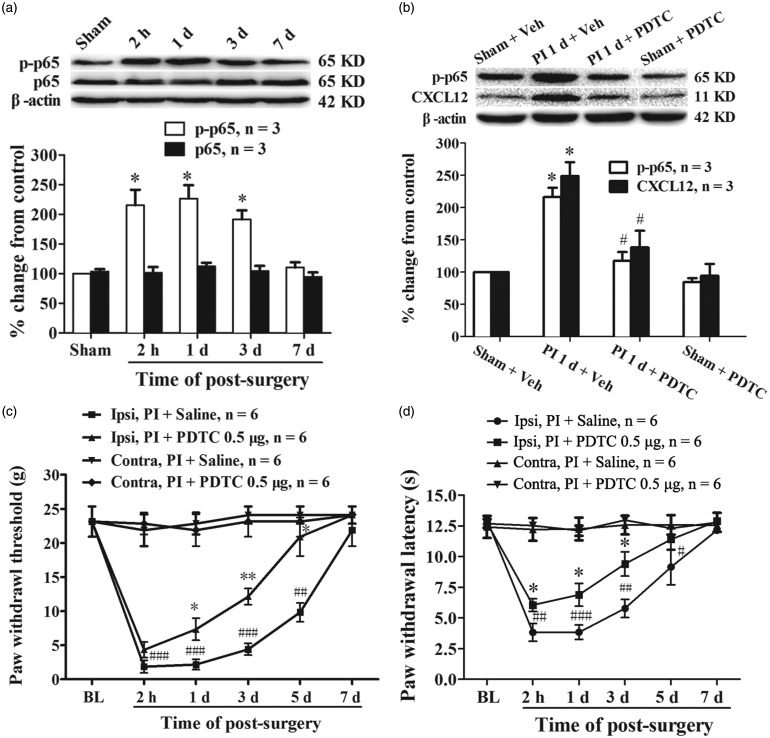
Plantar incision in rat hind paw resulted in increased expressions of CXCL12 and CXCR4 in spinal dorsal horn. Double immunofluorescence staining revealed that CXCL12 expressed in neurons and astrocytes, and CXCR4 exclusively co-localized with neuronal cells. Prior administration of AMD3100, a specific antagonist of CXCR4, or CXCL12 neutralizing antibody, intrathecally attenuated plantar incision-induced mechanical allodynia and thermal hyperalgesia. Plantar incision also augmented the phosphorylation of NF-κB p65 in spinal cord. Pre intrathecal (i.t.) injection of PDTC, a specific NF-κB activation inhibitor, alleviated plantar incision-induced postsurgical pain and reduced the expression of CXCL12 in spinal cord. Correlated with the upregulation of CXCL12 and CXCR4, plantar incision also resulted in an increased phosphorylation of extracellular signal-regulated kinase 1/2 and Akt in spinal cord. Prior i.t. administration of AMD3100 prevented extracellular signal-regulated kinase, but not Akt, activation in spinal cord. Rats when given a repetitive i.t. PD98059, a specific extracellular signal-regulated kinase inhibitor, started 30 min before surgery also ameliorate plantar incision-induced mechanical and thermal pain hypersensitivity.
Our results suggests that plantar incision-induced activation of NF-κB signaling may mediate upregulation of CXCL12 in spinal cord, and CXCL12/CXCR4 signaling via extracellular signal-regulated kinase activation contributes to the genesis of postsurgical pain.
已有研究表明,趋化因子 CXCL12 和其受体 CXCR4 在脊髓中的上调与神经性疼痛、炎症性疼痛和癌性疼痛的发病机制有关。然而,CXCL12/CXCR4 信号是否参与术后疼痛尚不清楚。本研究旨在探讨 CXCL12/CXCR4 信号在术后疼痛发生中的作用及其潜在机制。
大鼠足底切口导致脊髓背角中 CXCL12 和 CXCR4 的表达增加。双重免疫荧光染色显示 CXCL12 表达于神经元和星形胶质细胞中,而 CXCR4 仅与神经元细胞共定位。鞘内预先给予 CXCR4 的特异性拮抗剂 AMD3100 或 CXCL12 中和抗体可减轻足底切口引起的机械性痛觉过敏和热痛觉过敏。足底切口还增强了脊髓中 NF-κB p65 的磷酸化。鞘内预先注射 NF-κB 激活抑制剂 PDTC 可减轻足底切口引起的术后疼痛,并减少脊髓中 CXCL12 的表达。与 CXCL12 和 CXCR4 的上调相关,足底切口还导致脊髓中细胞外信号调节激酶 1/2 和 Akt 的磷酸化增加。鞘内预先给予 AMD3100 可阻止细胞外信号调节激酶,但不能阻止 Akt 的激活。在手术前 30 分钟开始给予大鼠重复鞘内 PD98059,一种特异性细胞外信号调节激酶抑制剂,也可改善足底切口引起的机械性和热痛觉过敏。
我们的结果表明,足底切口诱导的 NF-κB 信号激活可能介导脊髓中 CXCL12 的上调,而 CXCL12/CXCR4 信号通过细胞外信号调节激酶的激活参与术后疼痛的发生。