Liu Shichang, Zhang Nannan, Song Yueming, Song Zongrang, Zhang Liping, Liu Jijun, Xie En, Wu Qining, Hao Dingjun
Department of Spine Surgery, Honghui Hospital, Xi'an Jiaotong University College of Medicine, South door slightly Friendship Road 555, Xi'an, 710000, People's Republic of China.
National Center for Birth Defect Monitoring, West China Second University Hospital, Sichuan University and Key Laboratory of Birth Defects and Related Diseases of Women and Children (Sichuan University), Ministry of Education, Chengdu, Sichuan, 610041, People's Republic of China.
BMC Musculoskelet Disord. 2017 Jun 20;18(1):270. doi: 10.1186/s12891-017-1627-9.
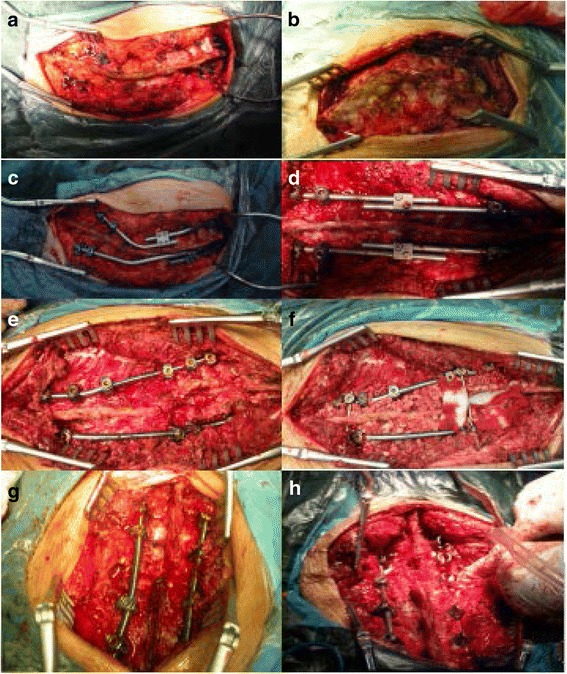
To compare radiologic results of posterior release, internal distraction, and final pedicle subtraction osteotomy (PSO) and spinal fusionwith one-stage posterior vertebral column resection (PVCR) in treating multi-level severe congenital scoliosis.
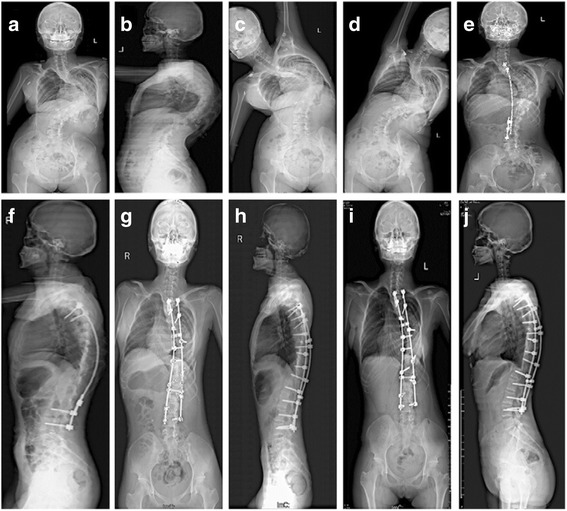
Forty-onesevere congenital scoliosis patients were used in the study. Group A comprised 24 patients who underwent one-stage PVCR. Group B comprised 17 patients who underwent posterior release with internal distraction, followed by final posterior fusion and instrumentation. The average preoperative main curve was 110.4° (95-130°) in group A and 109.4° (range 90°-126°) in group B. Postoperative follow-up time was ≥2 years (2.0-4.5 years) to analyze the radiographic and clinical outcomes.
A comparison of posterior release, internal distraction, and final spinal fusion with PVCR showed no significant differences in postoperative main curve and compensatory caudal curve correction, coronal and sagittal imbalance. However, significant differences were found between the 2 groups in compensatory cranial curve correction.
Posterior release, internal distraction, and final spinal fusion produce better corrective results in compensatory cranial curve correction than PVCR in treating severe multi-level congenital scoliosis.
比较后路松解、内撑开以及最终的椎弓根截骨术(PSO)和脊柱融合术与一期后路全脊椎切除术(PVCR)治疗多节段重度先天性脊柱侧凸的影像学结果。
41例重度先天性脊柱侧凸患者纳入本研究。A组24例患者接受一期PVCR。B组17例患者接受后路松解加内撑开,随后行最终的后路融合及内固定术。A组术前平均主弯为110.4°(95 - 130°),B组为109.4°(范围90° - 126°)。术后随访时间≥2年(2.0 - 4.5年),以分析影像学和临床结果。
后路松解、内撑开以及最终的脊柱融合术与PVCR比较,术后主弯及代偿性尾侧弯矫正、冠状面和矢状面失衡方面无显著差异。然而,两组在代偿性头侧弯矫正方面存在显著差异。
在治疗重度多节段先天性脊柱侧凸时,后路松解、内撑开以及最终的脊柱融合术在代偿性头侧弯矫正方面比PVCR产生更好的矫正效果。