Division of Endocrinology and Metabolism, Department of Internal Medicine, Myongji hospital, Seonam University College of Medicine, Gyeonggi-do, Korea.
Samsung Electronics Co. Ltd., Service R&D Team, Mobile Communications Business, Gyeonggi-do, Korea.
Sci Rep. 2017 Jun 20;7(1):3866. doi: 10.1038/s41598-017-03842-2.
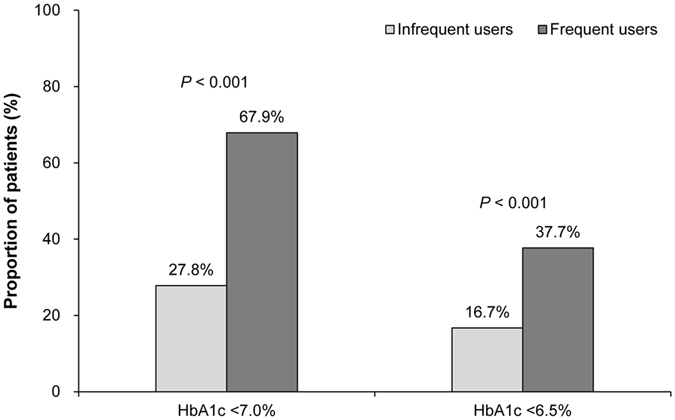
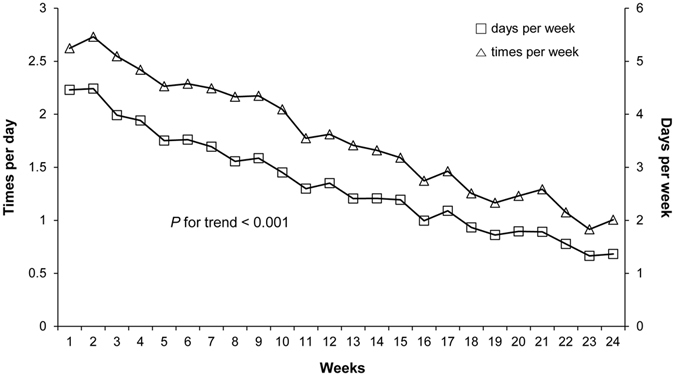
This study aimed to investigate the effect of patient engagement in self-monitoring with a telemonitoring device on glycemic control among patients with type 2 diabetes. We conducted a subanalysis of the telemonitoring device study in Kaiser Permanente Northern California members. We divided the telemonitoring group into 53 frequent and 54 infrequent users based on self-monitoring of blood glucose (SMBG) frequency of the first 6 weeks. The frequency of SMBG transmitted from the telemonitoring device was examined over 24 weeks. Clinic and laboratory tests were collected at baseline, 6 weeks and 6 months. There was no significant difference in baseline HbA1c level between the two groups. After 6 months, change in HbA1c was -2.4 ± 1.6% among frequent users and -1.5 ± 1.5% among infrequent users (p = 0.003). The proportion of patients achieving target HbA1C level at 6 months was significantly higher among frequent users than among infrequent users. An increased frequency of SMBG was significantly correlated with a reduction in HbA1c at 6 months. In conclusion, initial active engagement in self-monitoring with a telemonitoring device could provide incremental improvement of glycemic control over 6 months.
本研究旨在探讨 2 型糖尿病患者使用远程监测设备进行自我监测对血糖控制的影响。我们对 Kaiser Permanente 北加利福尼亚州成员的远程监测设备研究进行了亚组分析。我们根据前 6 周的血糖自我监测(SMBG)频率,将远程监测组分为 53 名频繁使用者和 54 名不频繁使用者。在 24 周内检查了从远程监测设备传输的 SMBG 频率。在基线、6 周和 6 个月时收集了临床和实验室检查结果。两组患者的基线 HbA1c 水平无显著差异。6 个月后,频繁使用者的 HbA1c 变化为-2.4±1.6%,不频繁使用者为-1.5±1.5%(p=0.003)。6 个月时达到目标 HbA1C 水平的患者比例在频繁使用者中明显高于不频繁使用者。SMBG 频率增加与 6 个月时 HbA1c 降低显著相关。结论:初始积极使用远程监测设备进行自我监测可在 6 个月内逐步改善血糖控制。