Division of Vaccine Discovery, La Jolla Institute for Allergy and Immunology, 9420 Athena Circle, La Jolla, CA 92037, USA.
J Immunol Res. 2017;2017:5974574. doi: 10.1155/2017/5974574. Epub 2017 May 29.
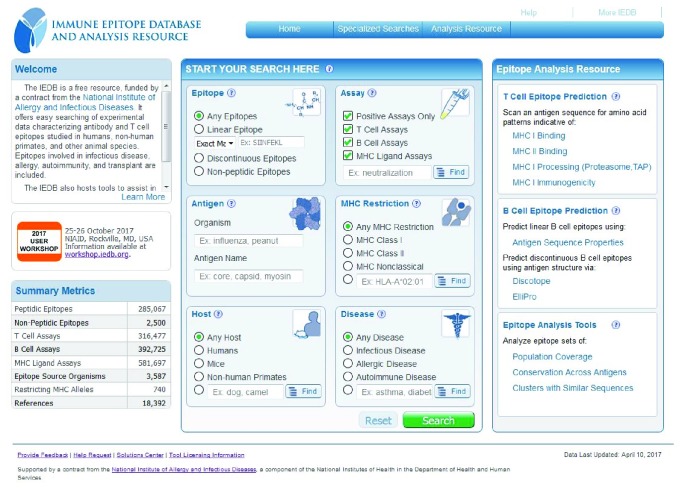
Easy access to a vast collection of experimental data on immune epitopes can greatly facilitate the development of therapeutics and vaccines. The Immune Epitope Database and Analysis Resource (IEDB) was developed to provide such a resource as a free service to the biomedical research community. The IEDB contains epitope and assay information related to infectious diseases, autoimmune diseases, allergic diseases, and transplant/alloantigens for humans, nonhuman primates, mice, and any other species studied. It contains T cell, B cell, MHC binding, and MHC ligand elution experiments. Its data are curated primarily from the published literature and also include direct submissions from researchers involved in epitope discovery. This article describes the process of capturing data from these sources and how the information is organized in the IEDB data. Different approaches for querying the data are then presented, using the home page search interface and the various specialized search interfaces. Specific examples covering diverse applications of interest are given to highlight the power and functionality of the IEDB.
易于获取大量免疫表位的实验数据,可以极大地促进治疗和疫苗的开发。免疫表位数据库和分析资源(IEDB)的开发是为了向生物医学研究界提供这样一个免费的资源。IEDB 包含了与人类、非人类灵长类动物、小鼠以及任何其他研究物种的传染病、自身免疫性疾病、过敏性疾病和移植/同种抗原相关的表位和检测信息。它包含了 T 细胞、B 细胞、MHC 结合和 MHC 配体洗脱实验的数据。其数据主要是从已发表的文献中捕获的,还包括来自参与表位发现的研究人员的直接提交。本文描述了从这些来源捕获数据的过程,以及 IEDB 数据中信息的组织方式。然后介绍了使用主页搜索界面和各种专门搜索界面查询数据的不同方法。提供了具体的示例,涵盖了各种感兴趣的应用,以突出 IEDB 的强大功能和实用性。