Reinke Lennart Michel, Spiegel Martin, Plegge Teresa, Hartleib Anika, Nehlmeier Inga, Gierer Stefanie, Hoffmann Markus, Hofmann-Winkler Heike, Winkler Michael, Pöhlmann Stefan
Abteilung Infektionsbiologie, Deutsches Primatenzentrum, Göttingen, Germany.
Institut für Mikrobiologie und Virologie, Medizinische Hochschule Brandenburg Theodor Fontane, Senftenberg, Germany.
PLoS One. 2017 Jun 21;12(6):e0179177. doi: 10.1371/journal.pone.0179177. eCollection 2017.
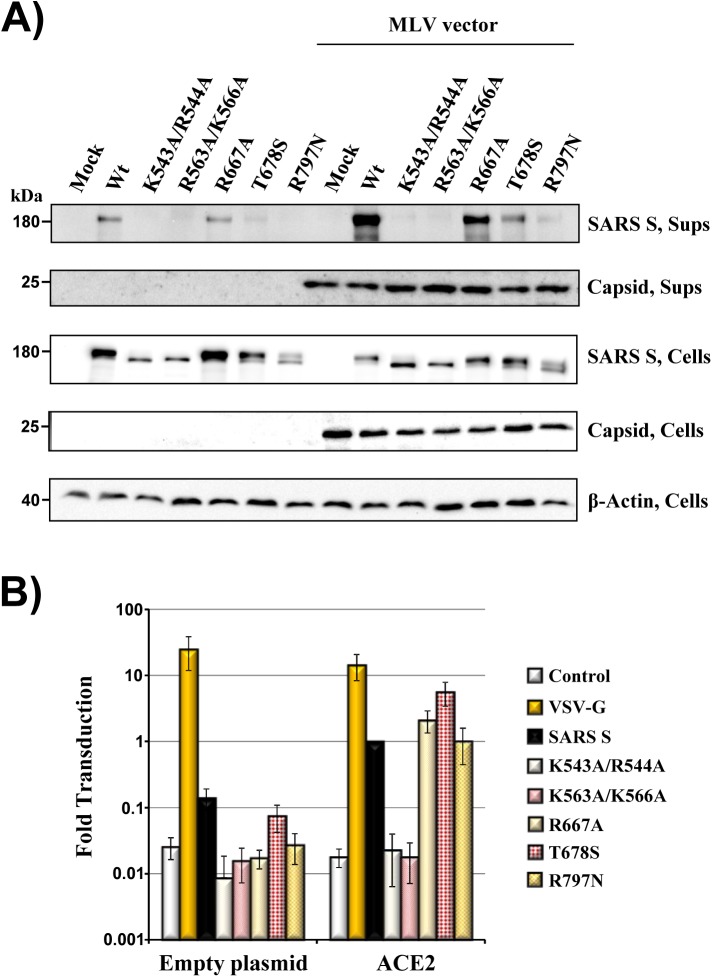
The spike (S) protein of severe acute respiratory syndrome coronavirus (SARS-CoV) mediates viral entry into target cells. Cleavage and activation of SARS S by a host cell protease is essential for infectious viral entry and the responsible enzymes are potential targets for antiviral intervention. The type II transmembrane serine protease TMPRSS2 cleaves and activates SARS S in cell culture and potentially also in the infected host. Here, we investigated which determinants in SARS S control cleavage and activation by TMPRSS2. We found that SARS S residue R667, a previously identified trypsin cleavage site, is also required for S protein cleavage by TMPRSS2. The cleavage fragments produced by trypsin and TMPRSS2 differed in their decoration with N-glycans, suggesting that these proteases cleave different SARS S glycoforms. Although R667 was required for SARS S cleavage by TMPRSS2, this residue was dispensable for TMPRSS2-mediated S protein activation. Conversely, residue R797, previously reported to be required for SARS S activation by trypsin, was dispensable for S protein cleavage but required for S protein activation by TMPRSS2. Collectively, these results show that different residues in SARS S control cleavage and activation by TMPRSS2, suggesting that these processes are more complex than initially appreciated.
严重急性呼吸综合征冠状病毒(SARS-CoV)的刺突(S)蛋白介导病毒进入靶细胞。宿主细胞蛋白酶对SARS S的切割和激活对于感染性病毒进入至关重要,而相关酶是抗病毒干预的潜在靶点。II型跨膜丝氨酸蛋白酶TMPRSS2在细胞培养中以及可能在受感染宿主中切割并激活SARS S。在此,我们研究了SARS S中哪些决定因素控制TMPRSS2的切割和激活。我们发现SARS S残基R667,一个先前确定的胰蛋白酶切割位点,也是TMPRSS2切割S蛋白所必需的。胰蛋白酶和TMPRSS2产生的切割片段在N-聚糖修饰上有所不同,这表明这些蛋白酶切割不同的SARS S糖型。尽管R667是TMPRSS2切割SARS S所必需的,但该残基对于TMPRSS2介导的S蛋白激活是可有可无的。相反,先前报道的胰蛋白酶激活SARS S所需的残基R797对于S蛋白切割是可有可无的,但对于TMPRSS2激活S蛋白是必需的。总体而言,这些结果表明SARS S中的不同残基控制TMPRSS2的切割和激活,这表明这些过程比最初认为的更为复杂。