Zabiegala Alexandria, Kim Yunjeong, Chang Kyeong-Ok
Department of Diagnostic Medicine and Pathobiology, College of Veterinary Medicine, Kansas State University, 1800 Denison Avenue, Manhattan, KS 66506 USA.
Anim Dis. 2023;3(1):12. doi: 10.1186/s44149-023-00075-x. Epub 2023 Apr 25.
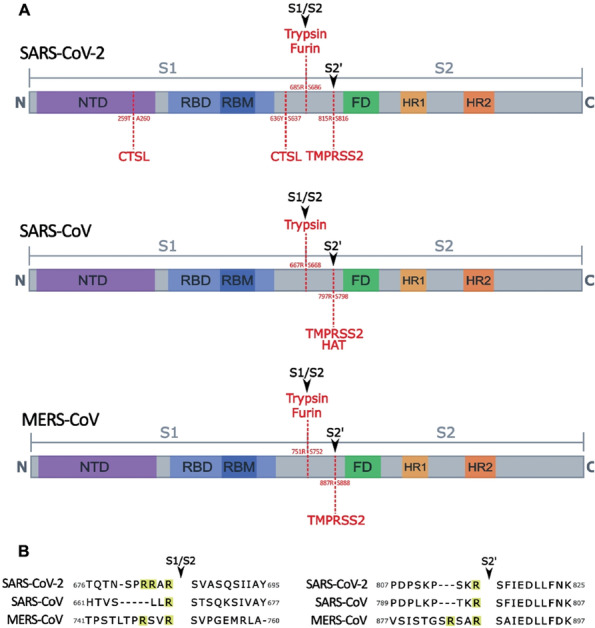
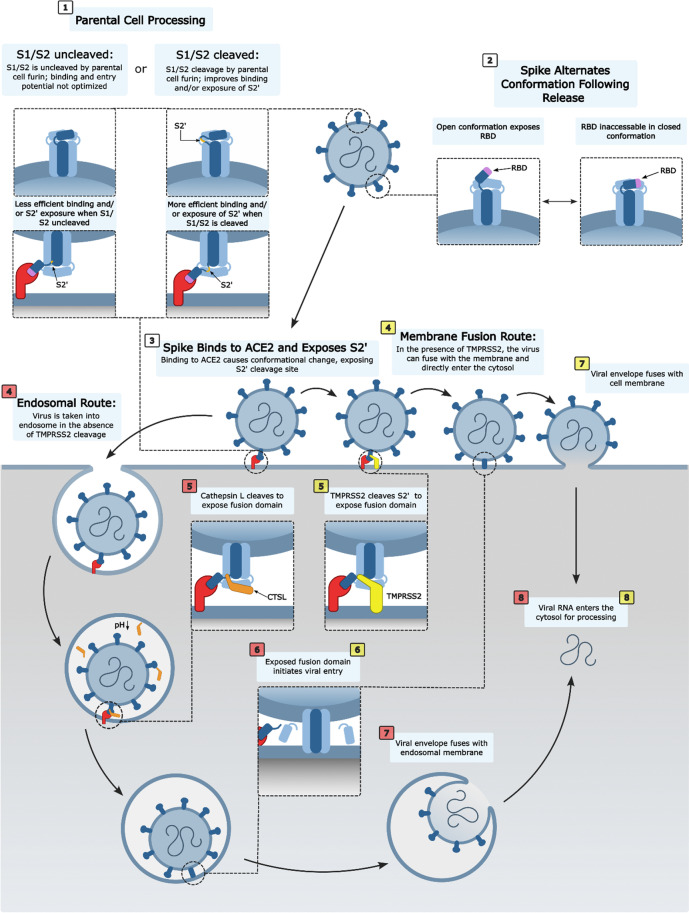
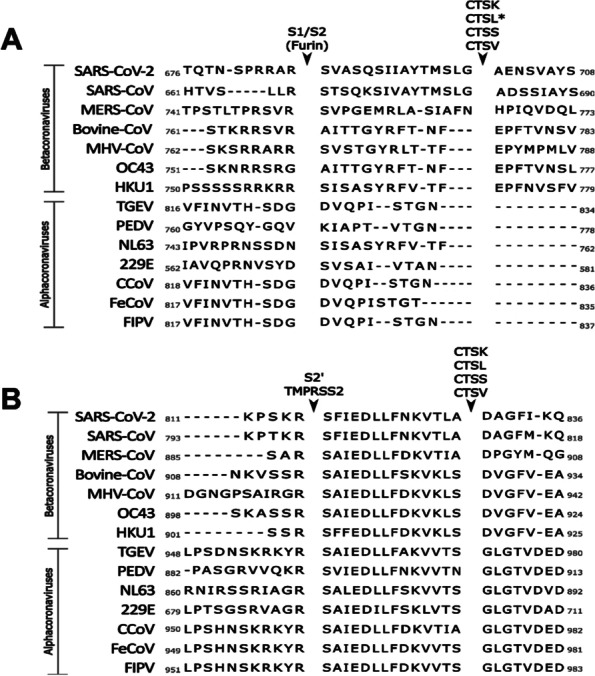
The spike protein (S) of SARS-CoV-2 is responsible for viral attachment and entry, thus a major factor for host susceptibility, tissue tropism, virulence and pathogenicity. The S is divided with S1 and S2 region, and the S1 contains the receptor-binding domain (RBD), while the S2 contains the hydrophobic fusion domain for the entry into the host cell. Numerous host proteases have been implicated in the activation of SARS-CoV-2 S through various cleavage sites. In this article, we review host proteases including furin, trypsin, transmembrane protease serine 2 (TMPRSS2) and cathepsins in the activation of SARS-CoV-2 S. Many betacoronaviruses including SARS-CoV-2 have polybasic residues at the S1/S2 site which is subjected to the cleavage by furin. The S1/S2 cleavage facilitates more assessable RBD to the receptor ACE2, and the binding triggers further conformational changes and exposure of the S2' site to proteases such as type II transmembrane serine proteases (TTPRs) including TMPRSS2. In the presence of TMPRSS2 on the target cells, SARS-CoV-2 can utilize a direct entry route by fusion of the viral envelope to the cellular membrane. In the absence of TMPRSS2, SARS-CoV-2 enter target cells endosomes where multiple cathepsins cleave the S for the successful entry. Additional host proteases involved in the cleavage of the S were discussed. This article also includes roles of 3C-like protease inhibitors which have inhibitory activity against cathepsin L in the entry of SARS-CoV-2, and discussed the dual roles of such inhibitors in virus replication.
严重急性呼吸综合征冠状病毒2(SARS-CoV-2)的刺突蛋白(S)负责病毒的附着和进入,因此是宿主易感性、组织嗜性、毒力和致病性的主要因素。S蛋白分为S1和S2区域,S1包含受体结合域(RBD),而S2包含用于进入宿主细胞的疏水融合域。许多宿主蛋白酶通过各种切割位点参与了SARS-CoV-2 S蛋白的激活。在本文中,我们综述了包括弗林蛋白酶、胰蛋白酶、跨膜蛋白酶丝氨酸2(TMPRSS2)和组织蛋白酶在内的宿主蛋白酶在SARS-CoV-2 S蛋白激活中的作用。包括SARS-CoV-2在内的许多β冠状病毒在S1/S2位点具有多碱性残基,可被弗林蛋白酶切割。S1/S2切割使RBD更容易与受体血管紧张素转换酶2(ACE2)结合,这种结合会触发进一步的构象变化,并使S2'位点暴露于包括TMPRSS2在内的II型跨膜丝氨酸蛋白酶(TTPPs)等蛋白酶。在靶细胞存在TMPRSS2的情况下,SARS-CoV-2可通过病毒包膜与细胞膜融合利用直接进入途径。在缺乏TMPRSS2的情况下,SARS-CoV-2进入靶细胞的内体,在那里多种组织蛋白酶切割S蛋白以实现成功进入。本文还讨论了参与S蛋白切割的其他宿主蛋白酶。本文还包括3C样蛋白酶抑制剂在SARS-CoV-2进入过程中对组织蛋白酶L的抑制活性的作用,并讨论了此类抑制剂在病毒复制中的双重作用。