Pan Hai, Bilinovich Stephanie M, Kaur Parminder, Riehn Robert, Wang Hong, Williams David C
Department of Physics, North Carolina State University, Raleigh, North Carolina, NC 27695, USA.
Department of Pathology and Laboratory Medicine, University of North Carolina at Chapel Hill, Chapel Hill, NC 27599, USA.
Nucleic Acids Res. 2017 Sep 6;45(15):9164-9177. doi: 10.1093/nar/gkx548.
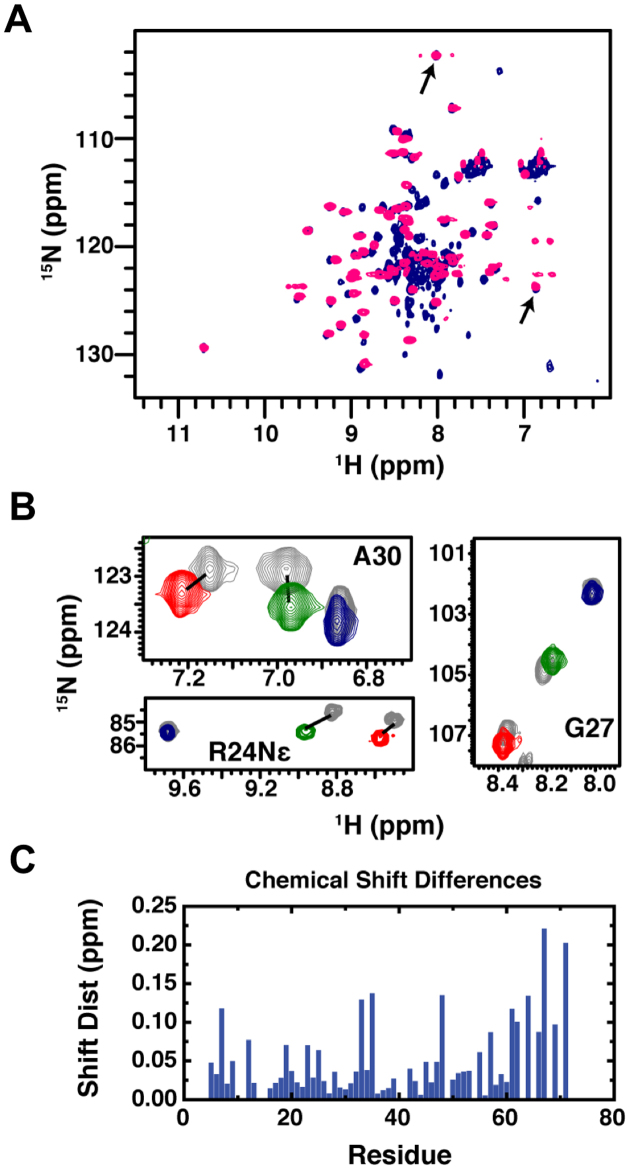
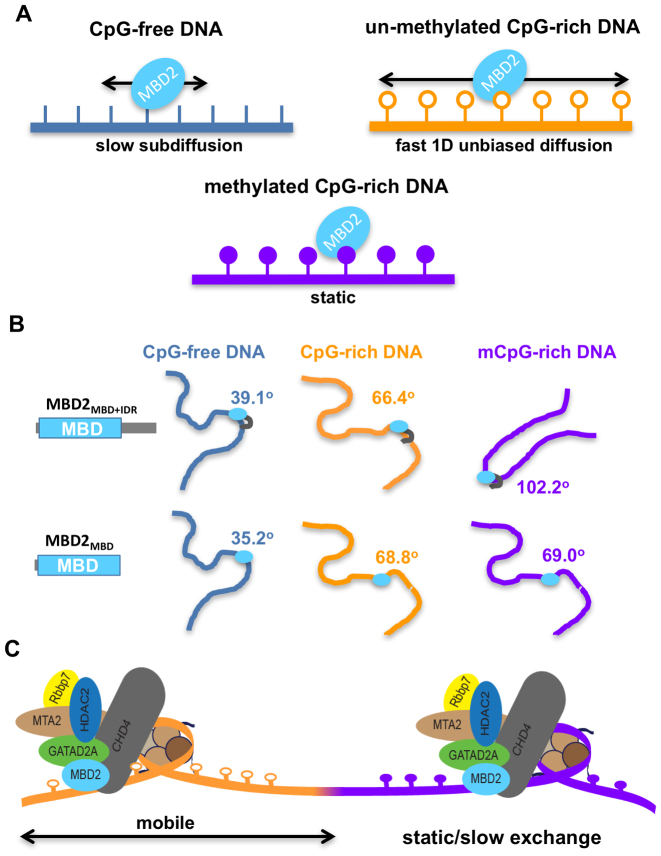
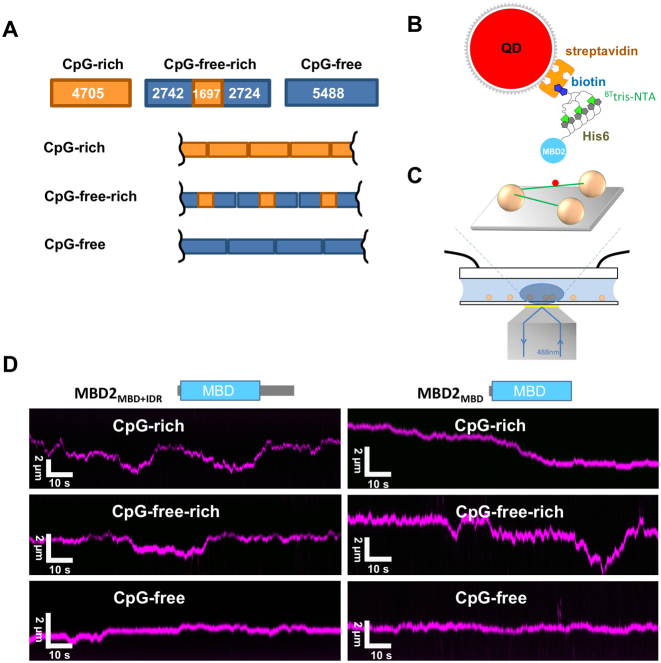
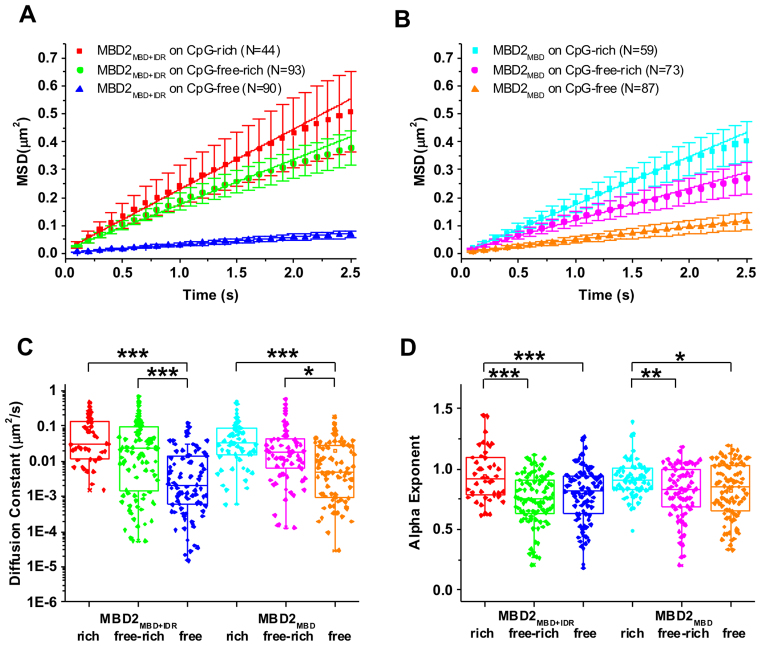
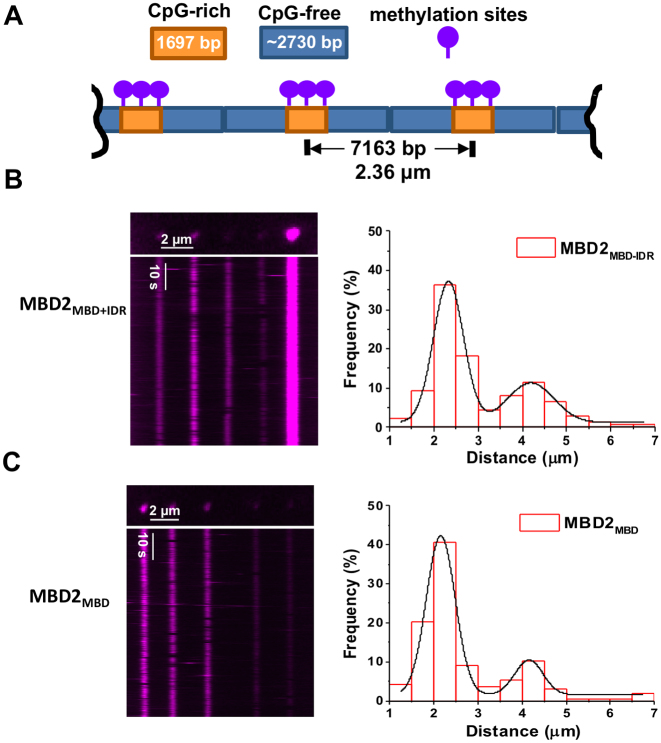
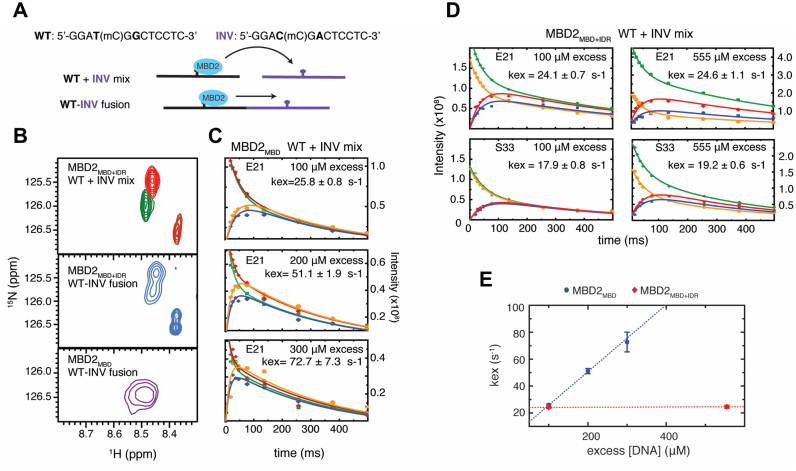
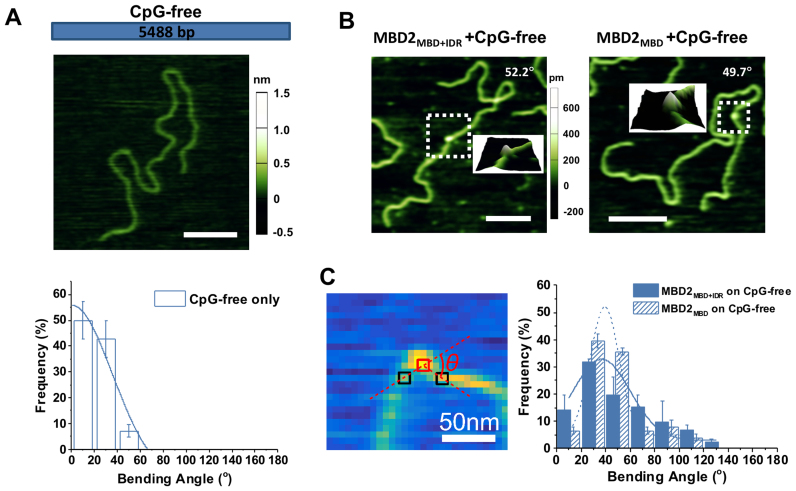
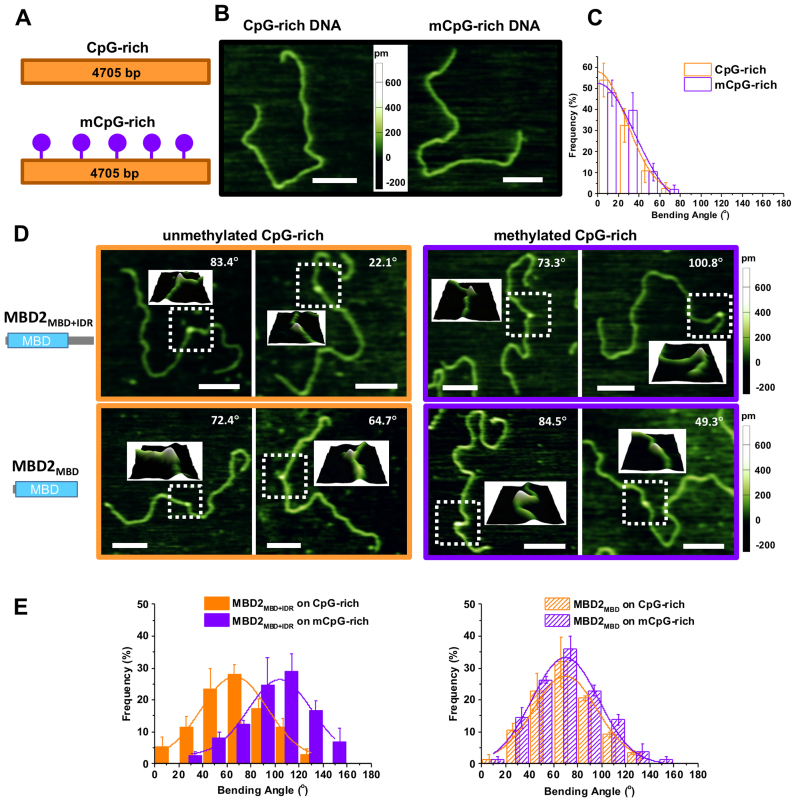
The methylcytosine-binding domain 2 (MBD2) protein recruits the nucleosome remodeling and deacetylase complex (NuRD) to methylated DNA to modify chromatin and regulate transcription. Importantly, MBD2 functions within CpG islands that contain 100s to 1000s of potential binding sites. Since NuRD physically rearranges nucleosomes, the dynamic mobility of this complex is directly related to function. In these studies, we use NMR and single-molecule atomic force microscopy and fluorescence imaging to study DNA binding dynamics of MBD2. Single-molecule fluorescence tracking on DNA tightropes containing regions with CpG-rich and CpG-free regions reveals that MBD2 carries out unbiased 1D diffusion on CpG-rich DNA but subdiffusion on CpG-free DNA. In contrast, the protein stably and statically binds to methylated CpG (mCpG) regions. The intrinsically disordered region (IDR) on MBD2 both reduces exchange between mCpG sites along the DNA as well as the dissociation from DNA, acting like an anchor that restricts the dynamic mobility of the MBD domain. Unexpectedly, MBD2 binding to methylated CpGs induces DNA bending that is augmented by the IDR region of the protein. These results suggest that MBD2 targets NuRD to unmethylated or methylated CpG islands where its distinct dynamic binding modes help maintain open or closed chromatin, respectively.
甲基胞嘧啶结合域2(MBD2)蛋白将核小体重塑和去乙酰化酶复合物(NuRD)募集到甲基化的DNA上,以修饰染色质并调节转录。重要的是,MBD2在含有数百到数千个潜在结合位点的CpG岛中发挥作用。由于NuRD会对核小体进行物理重排,因此该复合物的动态流动性与功能直接相关。在这些研究中,我们使用核磁共振、单分子原子力显微镜和荧光成像来研究MBD2的DNA结合动力学。在含有富含CpG区域和无CpG区域的DNA绳索上进行的单分子荧光追踪显示,MBD2在富含CpG的DNA上进行无偏的一维扩散,而在无CpG的DNA上进行次扩散。相比之下,该蛋白稳定且静态地结合于甲基化的CpG(mCpG)区域。MBD2上的内在无序区域(IDR)既能减少沿着DNA的mCpG位点之间的交换,也能减少与DNA的解离,其作用就像一个锚,限制了MBD结构域的动态流动性。出乎意料的是,MBD2与甲基化的CpG结合会诱导DNA弯曲,而该蛋白的IDR区域会增强这种弯曲。这些结果表明,MBD2将NuRD靶向未甲基化或甲基化的CpG岛,在那里其独特的动态结合模式分别有助于维持开放或封闭的染色质状态。