Gent Jonathan I, Wang Na, Dawe R Kelly
Department of Plant Biology, University of Georgia, Athens, USA.
Department of Genetics, University of Georgia, Athens, USA.
Genome Biol. 2017 Jun 21;18(1):121. doi: 10.1186/s13059-017-1249-4.
Paradoxically, centromeres are known both for their characteristic repeat sequences (satellite DNA) and for being epigenetically defined. Maize (Zea mays mays) is an attractive model for studying centromere positioning because many of its large (~2 Mb) centromeres are not dominated by satellite DNA. These centromeres, which we call complex centromeres, allow for both assembly into reference genomes and for mapping short reads from ChIP-seq with antibodies to centromeric histone H3 (cenH3).
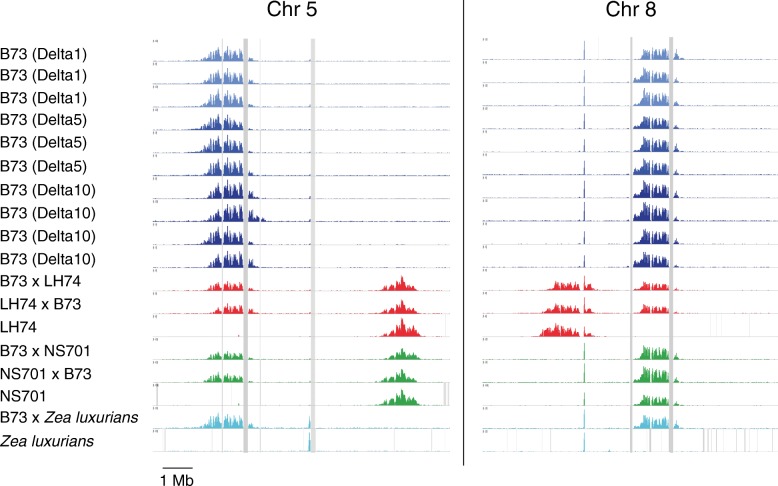
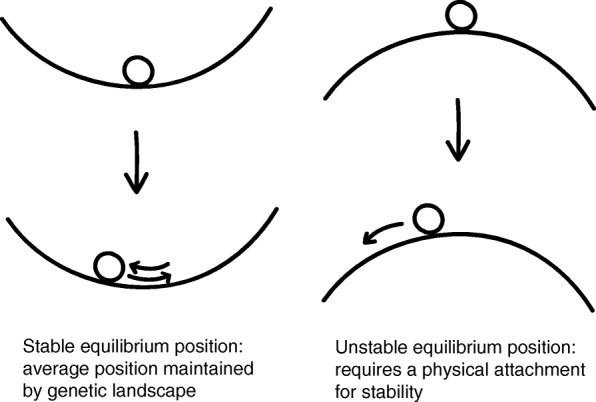
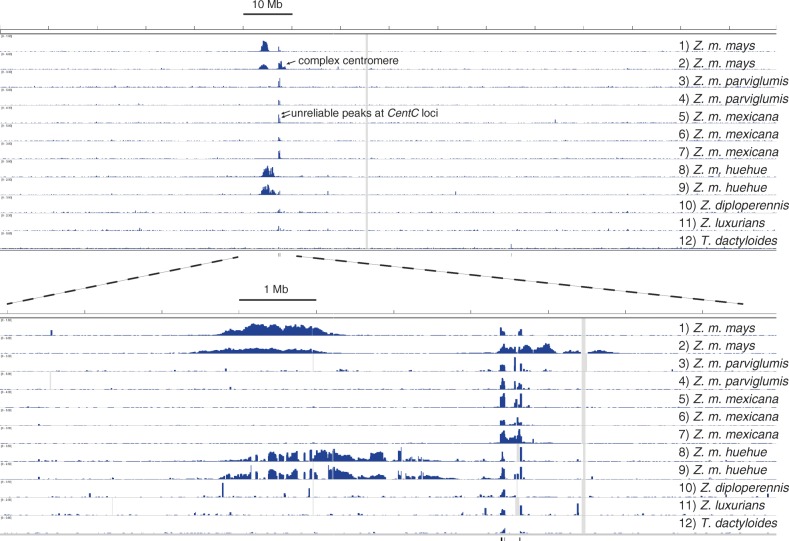
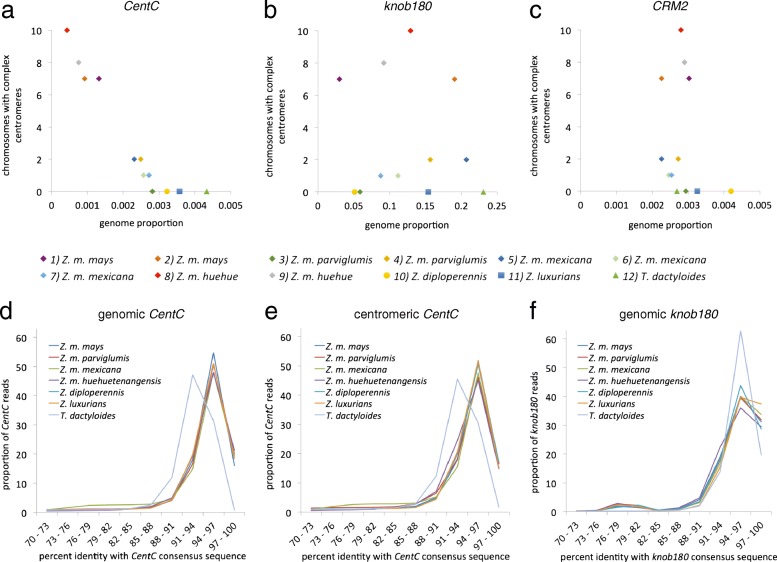
We found frequent complex centromeres in maize and its wild relatives Z. mays parviglumis, Z. mays mexicana, and particularly Z. mays huehuetenangensis. Analysis of individual plants reveals minor variation in the positions of complex centromeres among siblings. However, such positional shifts are stochastic and not heritable, consistent with prior findings that centromere positioning is stable at the population level. Centromeres are also stable in multiple F1 hybrid contexts. Analysis of repeats in Z. mays and other species (Zea diploperennis, Zea luxurians, and Tripsacum dactyloides) reveals tenfold differences in abundance of the major satellite CentC, but similar high levels of sequence polymorphism in individual CentC copies. Deviation from the CentC consensus has little or no effect on binding of cenH3.
These data indicate that complex centromeres are neither a peculiarity of cultivation nor inbreeding in Z. mays. While extensive arrays of CentC may be the norm for other Zea and Tripsacum species, these data also reveal that a wide diversity of DNA sequences and multiple types of genetic elements in and near centromeres support centromere function and constrain centromere positions.
矛盾的是,着丝粒既因其特征性重复序列(卫星DNA)而闻名,又因其表观遗传学定义而为人所知。玉米(Zea mays mays)是研究着丝粒定位的一个有吸引力的模型,因为它的许多大型(约2 Mb)着丝粒并不以卫星DNA为主导。我们将这些着丝粒称为复杂着丝粒,它们既可以组装到参考基因组中,也可以用针对着丝粒组蛋白H3(cenH3)的抗体将ChIP-seq的短读段进行定位。
我们在玉米及其野生近缘种小颖玉米(Z. mays parviglumis)、墨西哥玉米(Z. mays mexicana),特别是韦韦特南戈玉米(Z. mays huehuetenangensis)中发现了频繁出现的复杂着丝粒。对单株植物的分析表明,同胞个体之间复杂着丝粒的位置存在微小差异。然而,这种位置变化是随机的,不具有遗传性,这与之前关于着丝粒定位在群体水平上是稳定的研究结果一致。着丝粒在多个F1杂交背景下也是稳定的。对玉米和其他物种(二倍体多年生玉米(Zea diploperennis)、繁茂玉米(Zea luxurians)和摩擦禾(Tripsacum dactyloides))中的重复序列分析表明,主要卫星序列CentC的丰度存在10倍差异,但单个CentC拷贝中的序列多态性水平相似。与CentC共有序列的偏差对着丝粒组蛋白H3的结合几乎没有影响。
这些数据表明,复杂着丝粒既不是玉米栽培也不是近亲繁殖所特有的现象。虽然大量CentC阵列可能是其他玉米属和摩擦禾属物种的常态,但这些数据也表明,着丝粒及其附近广泛多样的DNA序列和多种类型的遗传元件支持着丝粒功能并限制着丝粒位置。