Vezzalini Marzia, Mafficini Andrea, Tomasello Luisa, Lorenzetto Erika, Moratti Elisabetta, Fiorini Zeno, Holyoake Tessa L, Pellicano Francesca, Krampera Mauro, Tecchio Cristina, Yassin Mohamed, Al-Dewik Nader, Ismail Mohamed A, Al Sayab Ali, Monne Maria, Sorio Claudio
Department of Medicine, University of Verona, Strada le Grazie 8, 37134, Verona, Italy.
ARC-Net Research Centre, University and Hospital Trust of Verona, 37134, Verona, Italy.
J Hematol Oncol. 2017 Jun 21;10(1):129. doi: 10.1186/s13045-017-0494-z.
Protein tyrosine phosphatase receptor gamma (PTPRG) is a ubiquitously expressed member of the protein tyrosine phosphatase family known to act as a tumor suppressor gene in many different neoplasms with mechanisms of inactivation including mutations and methylation of CpG islands in the promoter region. Although a critical role in human hematopoiesis and an oncosuppressor role in chronic myeloid leukemia (CML) have been reported, only one polyclonal antibody (named chPTPRG) has been described as capable of recognizing the native antigen of this phosphatase by flow cytometry. Protein biomarkers of CML have not yet found applications in the clinic, and in this study, we have analyzed a group of newly diagnosed CML patients before and after treatment. The aim of this work was to characterize and exploit a newly developed murine monoclonal antibody specific for the PTPRG extracellular domain (named TPγ B9-2) to better define PTPRG protein downregulation in CML patients.
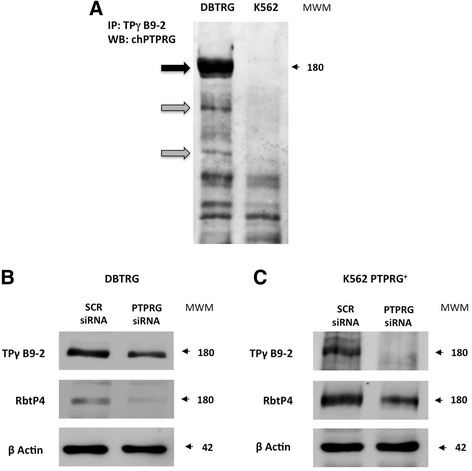
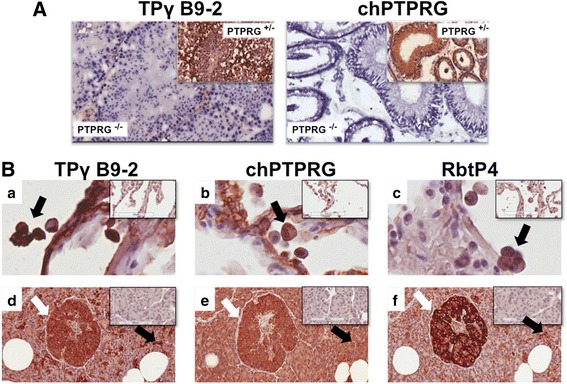
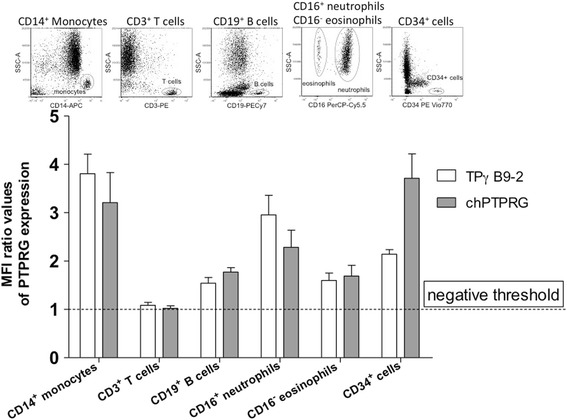
TPγ B9-2 specifically recognizes PTPRG (both human and murine) by flow cytometry, western blotting, immunoprecipitation, and immunohistochemistry.
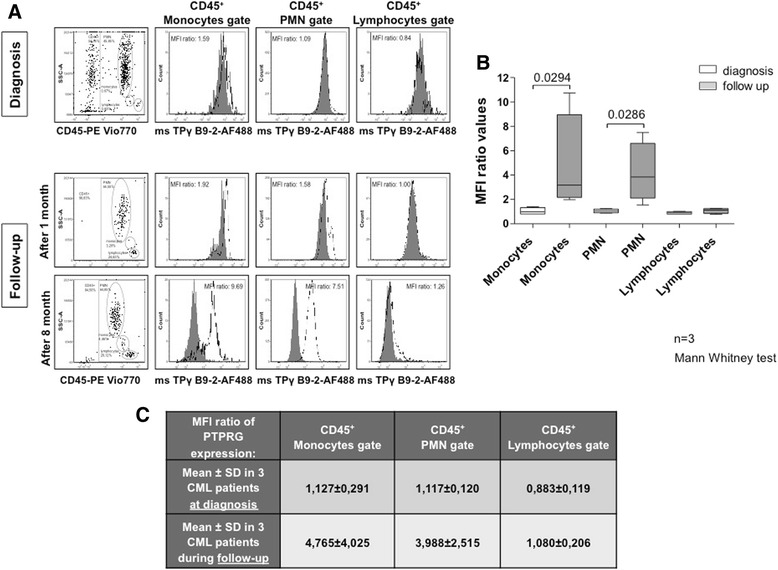
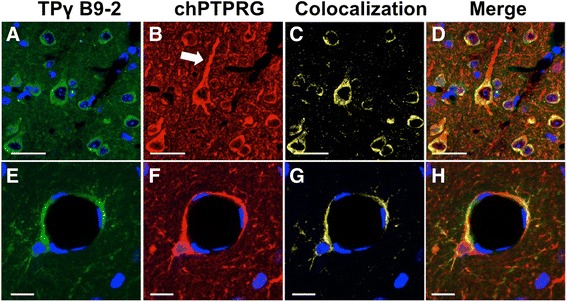
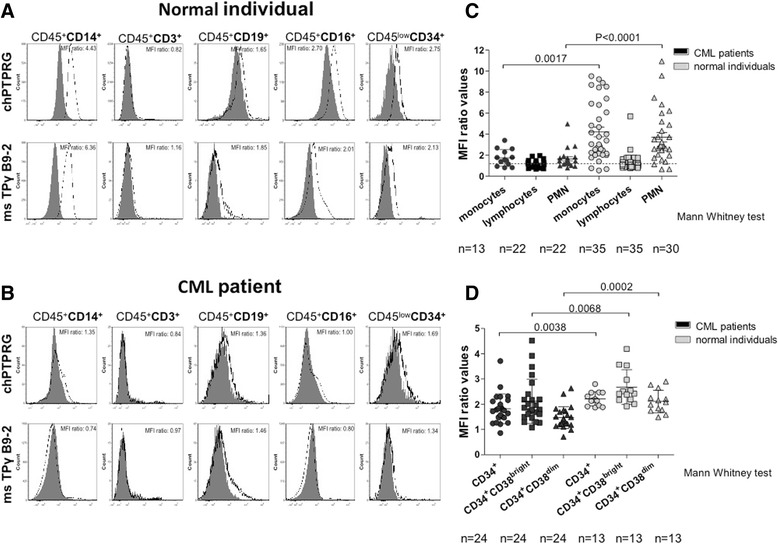
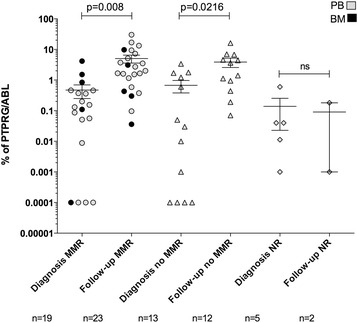
Co-localization experiments performed with both anti-PTPRG antibodies identified the presence of isoforms and confirmed protein downregulation at diagnosis in the Philadelphia-positive myeloid lineage (including CD34/CD38 cells). After effective tyrosine kinase inhibitor (TKI) treatment, its expression recovered in tandem with the return of Philadelphia-negative hematopoiesis. Of note, PTPRG mRNA levels remain unchanged in tyrosine kinase inhibitors (TKI) non-responder patients, confirming that downregulation selectively occurs in primary CML cells.
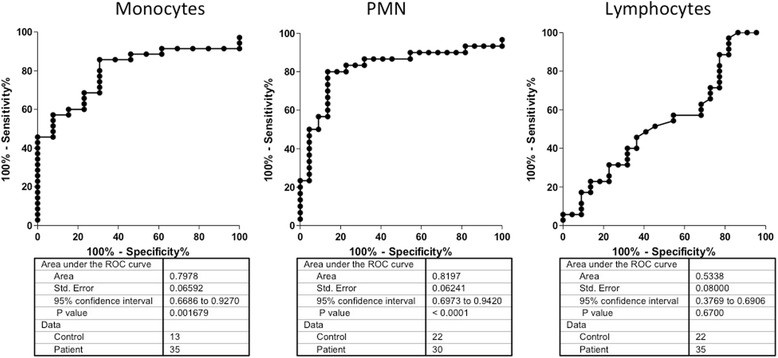
The availability of this unique antibody permits its evaluation for clinical application including the support for diagnosis and follow-up of these disorders. Evaluation of PTPRG as a potential therapeutic target is also facilitated by the availability of a specific reagent capable to specifically detect its target in various experimental conditions.
蛋白酪氨酸磷酸酶受体γ(PTPRG)是蛋白酪氨酸磷酸酶家族中广泛表达的成员,已知在许多不同肿瘤中作为肿瘤抑制基因发挥作用,其失活机制包括启动子区域CpG岛的突变和甲基化。尽管已有报道称其在人类造血过程中起关键作用,在慢性髓性白血病(CML)中起肿瘤抑制作用,但仅有一种多克隆抗体(名为chPTPRG)被描述为能够通过流式细胞术识别这种磷酸酶的天然抗原。CML的蛋白质生物标志物尚未在临床中得到应用,在本研究中,我们分析了一组新诊断的CML患者治疗前后的情况。这项工作的目的是鉴定和利用一种新开发的针对PTPRG细胞外结构域的鼠单克隆抗体(名为TPγ B9-2),以更好地确定CML患者中PTPRG蛋白的下调情况。
TPγ B9-2通过流式细胞术、蛋白质印迹法、免疫沉淀法和免疫组织化学法特异性识别PTPRG(包括人和鼠的)。
用两种抗PTPRG抗体进行的共定位实验确定了异构体的存在,并证实了在费城染色体阳性髓系谱系(包括CD34/CD38细胞)诊断时蛋白下调。在有效的酪氨酸激酶抑制剂(TKI)治疗后,其表达随着费城染色体阴性造血的恢复而恢复。值得注意的是,酪氨酸激酶抑制剂(TKI)无反应患者的PTPRG mRNA水平保持不变,证实下调选择性地发生在原发性CML细胞中。
这种独特抗体的可用性允许对其进行临床应用评估,包括支持这些疾病的诊断和随访。一种能够在各种实验条件下特异性检测其靶点的特异性试剂的可用性也有助于将PTPRG评估为潜在的治疗靶点。