Centre for Developmental Neurobiology, Kings College London, London, SE1 1UL, UK.
Institute of Clinical Anatomy and Cell Analysis, Department of Anatomy, University of Tübingen, Oesterbergstrasse 3, 72074, Tuebingen, Germany.
Neural Dev. 2017 Jun 21;12(1):11. doi: 10.1186/s13064-017-0088-z.
The cells of the mesencephalic trigeminal nucleus (MTN) are the proprioceptive sensory neurons that innervate the jaw closing muscles. These cells differentiate close to the two key signalling centres that influence the dorsal midbrain, the isthmus, which mediates its effects via FGF and WNT signalling and the roof plate, which is a major source of BMP signalling as well as WNT signalling.
In this study, we have set out to analyse the importance of FGF, WNT and BMP signalling for the development of the MTN. We have employed pharmacological inhibitors of these pathways in explant cultures as well as utilising the electroporation of inhibitory constructs in vivo in the chick embryo.
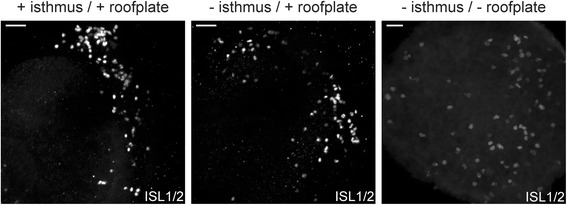
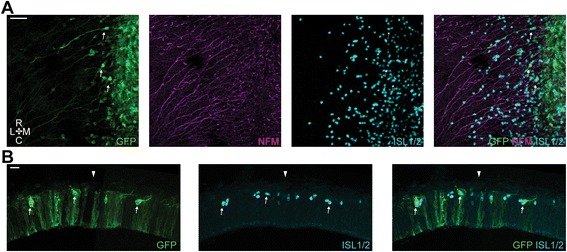
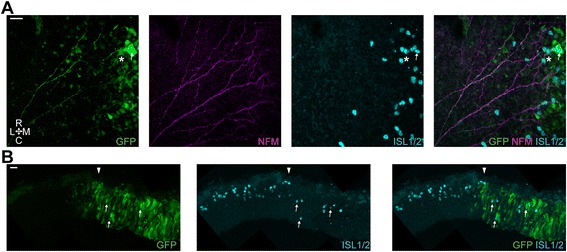
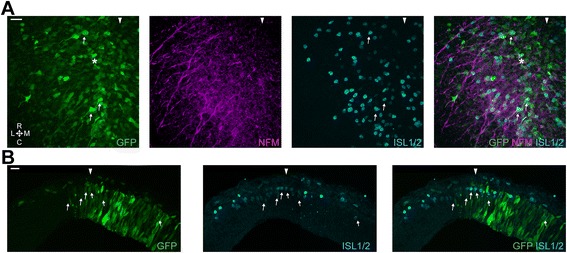
We find that interfering with either FGF or WNT signalling has pronounced effects on MTN development whilst abrogation of BMP signalling has no effect. We show that treatment of explants with either FGF or WNT antagonists results in the generation of fewer MTN neurons and affects MTN axon extension and that inhibition of both these pathways has an additive effect. To complement these studies, we have used in vivo electroporation to inhibit BMP, FGF and WNT signalling within dorsal midbrain cells prior to, and during, their differentiation as MTN neurons. Again, we find that inhibition of BMP signalling has no effect on the development of MTN neurons. We additionally find that cells electroporated with inhibitory constructs for either FGF or WNT signalling can differentiate as MTN neurons suggesting that these pathways are not required cell intrinsically for the emergence of these neurons. Indeed, we also show that explants of dorsal mesencephalon lacking both the isthmus and roof plate can generate MTN neurons. However, we did find that inhibiting FGF or WNT signalling had consequences for MTN differentiation.
Our results suggest that the emergence of MTN neurons is an intrinsic property of the dorsal mesencephalon of gnathostomes, and that this population undergoes expansion, and maturation, along with the rest of the dorsal midbrain under the influence of FGF and WNT signalling.
中脑三叉神经核(MTN)的细胞是支配下颌闭合肌肉的本体感觉神经元。这些细胞在靠近两个关键信号中心的地方分化,这两个信号中心影响背侧中脑,其中包括弓状核,通过 FGF 和 WNT 信号传递其影响,以及顶盖,它是 BMP 信号以及 WNT 信号的主要来源。
在这项研究中,我们旨在分析 FGF、WNT 和 BMP 信号对 MTN 发育的重要性。我们在体外培养物中使用这些途径的药理学抑制剂,并在鸡胚体内利用抑制性构建体的电穿孔来实现。
我们发现干扰 FGF 或 WNT 信号对 MTN 发育有显著影响,而 BMP 信号的阻断则没有影响。我们表明,用 FGF 或 WNT 拮抗剂处理外植体导致 MTN 神经元的生成减少,并影响 MTN 轴突延伸,而抑制这两条途径具有累加效应。为了补充这些研究,我们使用体内电穿孔在 MTN 神经元分化之前和期间抑制背侧中脑细胞中的 BMP、FGF 和 WNT 信号。同样,我们发现抑制 BMP 信号对 MTN 神经元的发育没有影响。我们还发现,电穿孔抑制 FGF 或 WNT 信号的细胞可以分化为 MTN 神经元,这表明这些途径对于这些神经元的出现不是内在必需的。事实上,我们还表明,缺失弓状核和顶盖的背侧中脑外植体可以产生 MTN 神经元。然而,我们确实发现抑制 FGF 或 WNT 信号对 MTN 分化有影响。
我们的结果表明,MTN 神经元的出现是颌脊椎动物背侧中脑的固有特性,并且在 FGF 和 WNT 信号的影响下,这个神经元群体与背侧中脑的其余部分一起经历扩张和成熟。