Cheng Henry S, Besla Rickvinder, Li Angela, Chen Zhiqi, Shikatani Eric A, Nazari-Jahantigh Maliheh, Hammoutène Adel, Nguyen My-Anh, Geoffrion Michele, Cai Lei, Khyzha Nadiya, Li Tong, MacParland Sonya A, Husain Mansoor, Cybulsky Myron I, Boulanger Chantal M, Temel Ryan E, Schober Andreas, Rayner Katey J, Robbins Clinton S, Fish Jason E
From the Toronto General Hospital Research Institute, University Health Network, Ontario, Canada (H.S.C, R.B., A.L., Z.C., E.A.S., N.K., S.A.M., M.H., M.I.C., C.S.R., J.E.F.); Department of Laboratory Medicine and Pathobiology, University of Toronto, Ontario, Canada (H.S.C, R.B., A.L., Z.C., E.A.S., N.K., S.A.M., M.H., M.I.C., C.S.R., J.E.F.); Heart and Stroke Richard Lewar Centre of Excellence in Cardiovascular Research, Toronto, Ontario, Canada (H.S.C, R.B., A.L., Z.C., E.A.S., N.K., M.H., M.I.C., C.S.R., J.E.F.); Institute for Cardiovascular Prevention, Ludwig-Maximilians-University Munich, Germany (M.N.-J., A.S.); INSERM, Unit 970, Paris Cardiovascular Research Center-PARCC, France (A.H., C.M.B.); University of Ottawa Heart Institute, Ontario, Canada (M.-A.N., M.G., K.J.R.); and Pharmacology and Nutritional Sciences, University of Kentucky, Lexington (L.C., T.L., R.E.T.).
Circ Res. 2017 Aug 4;121(4):354-367. doi: 10.1161/CIRCRESAHA.116.310529. Epub 2017 Jun 21.
Inflammation is a key contributor to atherosclerosis. MicroRNA-146a (miR-146a) has been identified as a critical brake on proinflammatory nuclear factor κ light chain enhancer of activated B cells signaling in several cell types, including endothelial cells and bone marrow (BM)-derived cells. Importantly, miR-146a expression is elevated in human atherosclerotic plaques, and polymorphisms in the precursor have been associated with risk of coronary artery disease.
To define the role of endogenous miR-146a during atherogenesis.
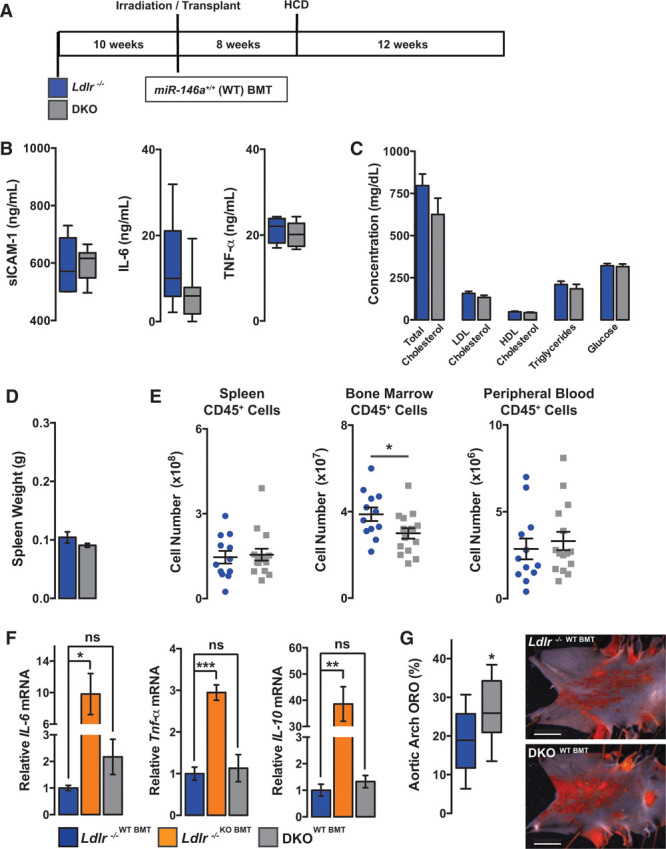
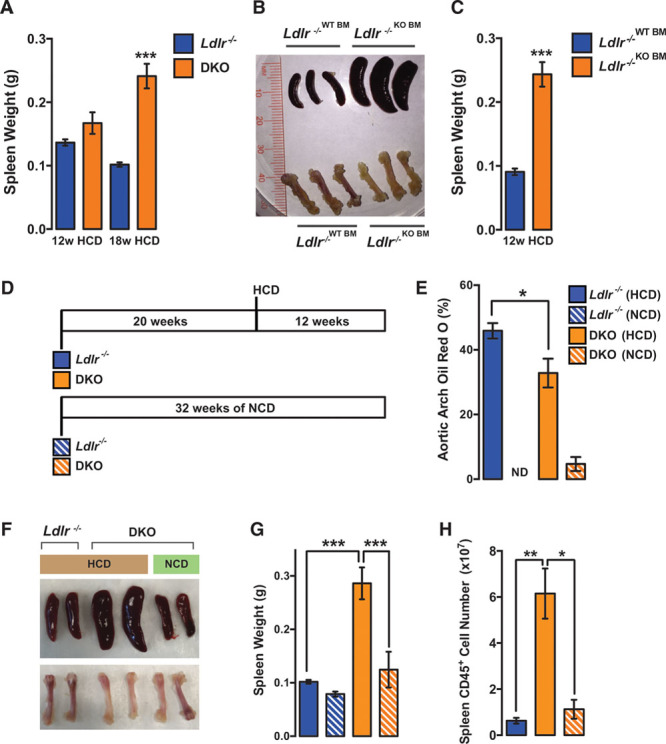
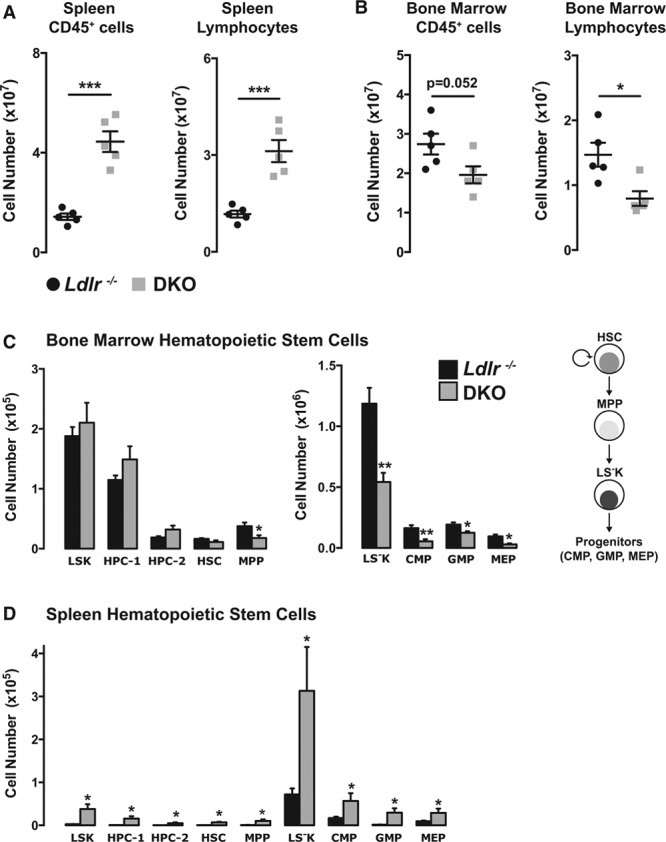
Paradoxically, (low-density lipoprotein receptor null) mice deficient in develop less atherosclerosis, despite having highly elevated levels of circulating proinflammatory cytokines. In contrast, cytokine levels are normalized in mice receiving wild-type BM transplantation, and these mice have enhanced endothelial cell activation and elevated atherosclerotic plaque burden compared with mice receiving wild-type BM, demonstrating the atheroprotective role of miR-146a in the endothelium. We find that deficiency of in BM-derived cells precipitates defects in hematopoietic stem cell function, contributing to extramedullary hematopoiesis, splenomegaly, BM failure, and decreased levels of circulating proatherogenic cells in mice fed an atherogenic diet. These hematopoietic phenotypes seem to be driven by unrestrained inflammatory signaling that leads to the expansion and eventual exhaustion of hematopoietic cells, and this occurs in the face of lower levels of circulating low-density lipoprotein cholesterol in mice lacking in BM-derived cells. Furthermore, we identify sortilin-1(), a known regulator of circulating low-density lipoprotein levels in humans, as a novel target of miR-146a.
Our study reveals that miR-146a regulates cholesterol metabolism and tempers chronic inflammatory responses to atherogenic diet by restraining proinflammatory signaling in endothelial cells and BM-derived cells.
炎症是动脉粥样硬化的关键促成因素。微小RNA - 146a(miR - 146a)已被确定为包括内皮细胞和骨髓(BM)来源细胞在内的多种细胞类型中促炎核因子κB轻链增强子激活B细胞信号传导的关键制动因子。重要的是,miR - 146a在人类动脉粥样硬化斑块中的表达升高,其前体中的多态性与冠状动脉疾病风险相关。
确定内源性miR - 146a在动脉粥样硬化发生过程中的作用。
矛盾的是,低密度脂蛋白受体缺失(Ldlr−/−)小鼠尽管循环促炎细胞因子水平大幅升高,但动脉粥样硬化程度较轻。相反,接受野生型BM移植的Ldlr−/−小鼠细胞因子水平恢复正常,与接受野生型BM的Ldlr−/−小鼠相比,这些小鼠内皮细胞活化增强,动脉粥样硬化斑块负担增加,证明了miR - 146a在内皮中的抗动脉粥样硬化作用。我们发现BM来源细胞中miR - 146a缺乏会导致造血干细胞功能缺陷,导致髓外造血、脾肿大、BM衰竭,并降低喂食致动脉粥样硬化饮食小鼠中循环促动脉粥样硬化细胞的水平。这些造血表型似乎是由不受抑制的炎症信号驱动的,导致造血细胞扩增并最终耗竭,而这发生在BM来源细胞中缺乏miR - 146a的小鼠循环低密度脂蛋白胆固醇水平较低的情况下。此外,我们确定sortilin - 1(Sort1),一种已知的人类循环低密度脂蛋白水平调节剂,为miR - 146a的新靶点。
我们的研究表明,miR - 146a通过抑制内皮细胞和BM来源细胞中的促炎信号来调节胆固醇代谢并缓和对致动脉粥样硬化饮食的慢性炎症反应。