Centro Nacional de Investigaciones Cardiovasculares Carlos III (CNIC), Madrid, Spain.
CIBER de Enfermedades Cardiovasculares (CIBER-CV), Murcia, Spain.
PLoS One. 2018 Jun 14;13(6):e0198932. doi: 10.1371/journal.pone.0198932. eCollection 2018.
Atherosclerosis involves activation of the IRAK1/TRAF6/NF-κB inflammatory cascade, which is negatively regulated by miR146a. Previous studies showed that the TT genotype of rs2431697, located near the miR-146a gene, drives lower miR-146a transcription and predicts adverse cardiovascular events in anticoagulated atrial fibrillation patients. Moreover, systemic miR-146a administration protects mice from atherosclerosis. Here we evaluated the ability of miR-146a expression in the hematopoietic component to regulate atherosclerosis in low-density lipoprotein receptor-null mice (Ldlr-/-).
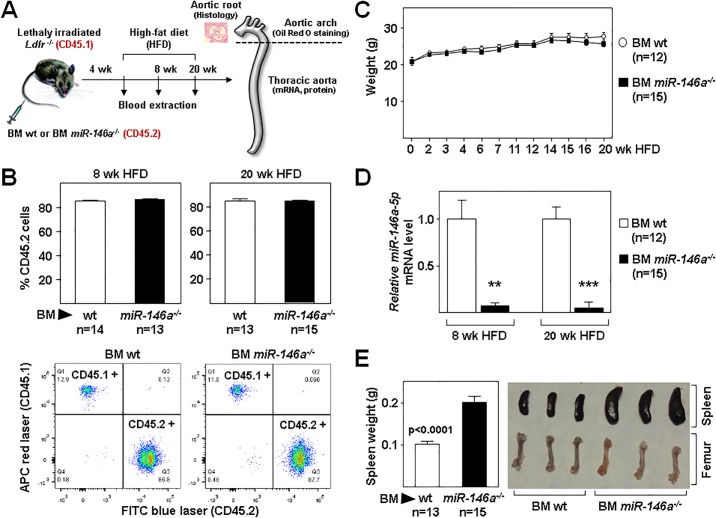
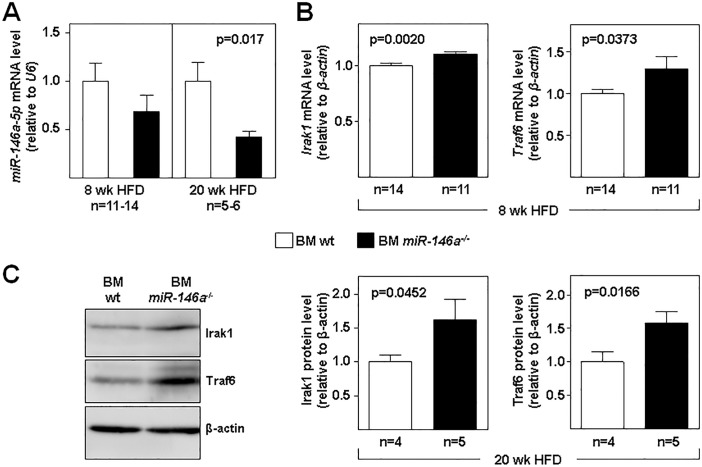
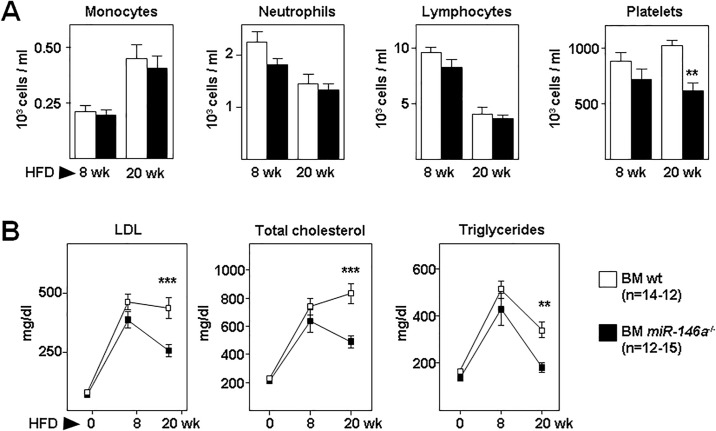
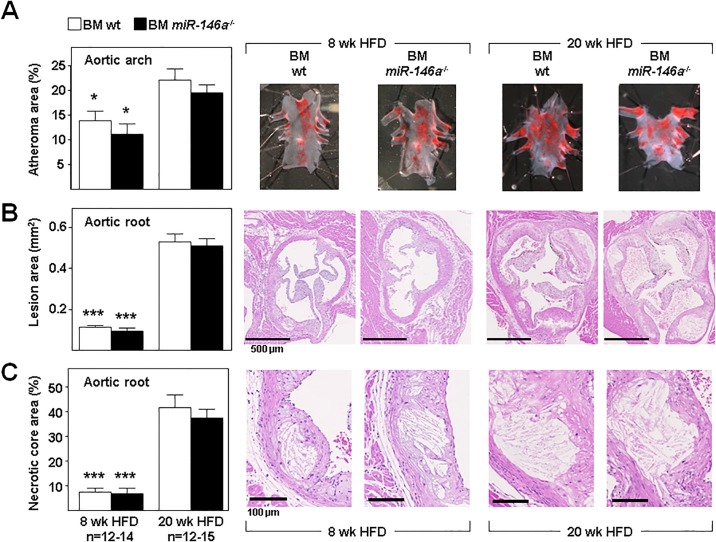
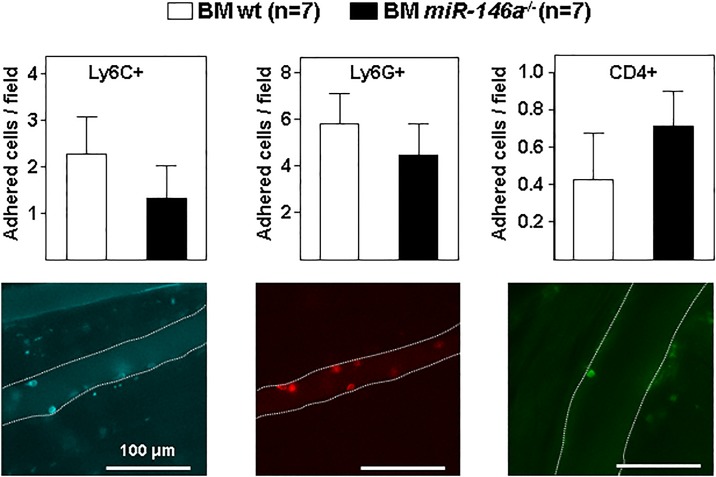
Lethally-irradiated Ldlr-/- mice transplanted with bone marrow from wild-type or miR-146a-null mice were fed an atherogenic diet for 8 and 20 weeks. Irak1, Traf6 and MIR146A expression were quantified in thoracic aorta by qRT-PCR and Western blot. Aortic plaque size and composition were characterized by Oil-Red staining and immunohistochemistry and leukocyte recruitment by intravital microscopy. Blood cell counts were similar in fat-fed Ldlr-/-mice with or without hematopoietic miR-146a expression. However, plasma cholesterol decreased in fat-fed Ldlr-/-mice transplanted with bone marrow deficient for miR-146a. Finally, aortic atherosclerosis burden and recruitment of leukocytes into the vessel wall were undistinguishable between the two groups, despite higher levels of Irak1 and Traf6 mRNA and protein in the aorta of fat-fed mice lacking hematopoietic miR-146a expression.
miR-146a deficiency exclusively in hematopoietic cells modulates cholesterol levels in plasma and the expression of its targets in the artery wall of fat-fed Ldlr-/- mice, but does not accelerate atherosclerosis. Atheroprotection upon systemic miR-146a administration may therefore be caused by specific effects on vascular cells.
动脉粥样硬化涉及 IRAK1/TRAF6/NF-κB 炎症级联的激活,该级联受 miR146a 的负调控。先前的研究表明,位于 miR-146a 基因附近的 rs2431697 的 TT 基因型可降低 miR-146a 的转录,并预测抗凝性心房颤动患者的不良心血管事件。此外,全身性 miR-146a 给药可保护小鼠免受动脉粥样硬化的侵害。在这里,我们评估了造血成分中 miR-146a 表达的能力,以调节低密度脂蛋白受体缺失小鼠(Ldlr-/-)中的动脉粥样硬化。
用致死剂量辐照的 Ldlr-/- 小鼠移植野生型或 miR-146a 缺陷型小鼠的骨髓,然后用致动脉粥样硬化饮食喂养 8 周和 20 周。通过 qRT-PCR 和 Western blot 定量胸主动脉中的 Irak1、Traf6 和 MIR146A 表达。通过油红染色和免疫组织化学检测主动脉斑块大小和组成,并通过活体显微镜检测白细胞募集。高脂肪喂养的 Ldlr-/- 小鼠中,无论骨髓中是否存在 miR-146a 表达,其血细胞计数均相似。然而,在缺乏骨髓 miR-146a 表达的高脂肪喂养 Ldlr-/- 小鼠中,血浆胆固醇降低。最后,尽管在缺乏造血 miR-146a 表达的高脂肪喂养小鼠的主动脉中 Irak1 和 Traf6 mRNA 和蛋白水平较高,但两组主动脉粥样硬化负担和白细胞向血管壁的募集无差异。
仅在造血细胞中缺乏 miR-146a 可调节高脂肪喂养的 Ldlr-/- 小鼠血浆中的胆固醇水平及其在动脉壁中的靶基因表达,但不会加速动脉粥样硬化。全身性 miR-146a 给药的抗动脉粥样硬化作用可能是由于其对血管细胞的特异性作用所致。