University of Campinas, Institute of Geosciences, Campinas, 13083-970, Brazil.
University of Concepción, Institute of Applied Economic Geology, Concepción, Casilla 160-C, Chile.
Sci Rep. 2017 Jun 21;7(1):4008. doi: 10.1038/s41598-017-04161-2.
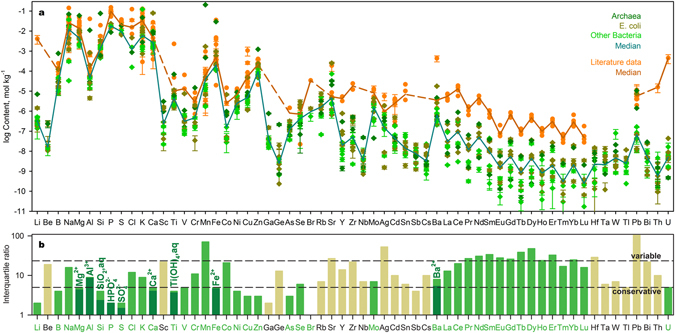
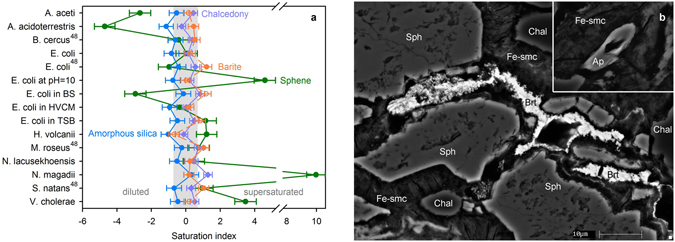
The environmental conditions on the Earth before 4 billion years ago are highly uncertain, largely because of the lack of a substantial rock record from this period. During this time interval, known as the Hadean, the young planet transformed from an uninhabited world to the one capable of supporting, and inhabited by the first living cells. These cells formed in a fluid environment they could not at first control, with homeostatic mechanisms developing only later. It is therefore possible that present-day organisms retain some record of the primordial fluid in which the first cells formed. Here we present new data on the elemental compositions and mineral fingerprints of both Bacteria and Archaea, using these data to constrain the environment in which life formed. The cradle solution that produced this elemental signature was saturated in barite, sphene, chalcedony, apatite, and clay minerals. The presence of these minerals, as well as other chemical features, suggests that the cradle environment of life may have been a weathering fluid interacting with dry-land silicate rocks. The specific mineral assemblage provides evidence for a moderate Hadean climate with dry and wet seasons and a lower atmospheric abundance of CO than is present today.
40 亿年前地球的环境条件极不确定,主要是因为这一时期缺乏大量的岩石记录。在这段被称为冥古宙的时间里,年轻的行星从一个无人居住的世界转变为能够支持并居住着最初的生命细胞的世界。这些细胞最初是在它们无法控制的流体环境中形成的,只有在后来才发展出了体内平衡机制。因此,现代生物可能保留了一些最初形成细胞的原始流体的记录。在这里,我们使用这些数据提供了关于细菌和古菌的元素组成和矿物指纹的新数据,以限制生命形成的环境。产生这种元素特征的摇篮溶液中含有重晶石、榍石、玉髓、磷灰石和粘土矿物。这些矿物的存在以及其他化学特征表明,生命的摇篮环境可能是一种风化流体,与干燥陆地硅酸盐岩石相互作用。特定的矿物组合为冥古宙气候提供了证据,具有干湿季节和比现今大气中更少的二氧化碳含量。