Ke Hung-Lung, Li Wei-Ming, Lin Hui-Hui, Hsu Wei-Chi, Hsu Ya-Ling, Chang Lin-Li, Huang Chun-Nung, Li Ching-Chia, Chang Hsin-Ping, Yeh Hsin-Chih, Li Chien-Feng, Wu Wen-Jeng
Graduate Institute of Medicine, College of Medicine, Kaohsiung Medical University, Kaohsiung, Taiwan.
Department of Urology, School of Medicine, College of Medicine, Kaohsiung Medical University, Kaohsiung, Taiwan.
Int J Med Sci. 2017 May 11;14(6):578-584. doi: 10.7150/ijms.15699. eCollection 2017.
Hypoxia has been shown to facilitate tumor progression. Hypoxia-regulated microRNA-210 (miR-210) may play an important role in carcinogenesis and tumor progression. In this study, we evaluated the clinical significance of miR-210 expression in upper tract urothelial carcinoma (UTUC).
Eighty-three UTUC patients participated in this study. All of them provided cancer tissue samples and 50 of them provided non-cancerous urothelium samples. Clinicopathologic data were collected by reviewing medical records. The expression of miR-210 and hypoxia-inducible factor-1α (HIF-1α) was determined by quantitative real-time polymerase chain reaction. The relationship between clinicopathologic variables and the expression of miR-210 and HIF-1α was analyzed statistically.
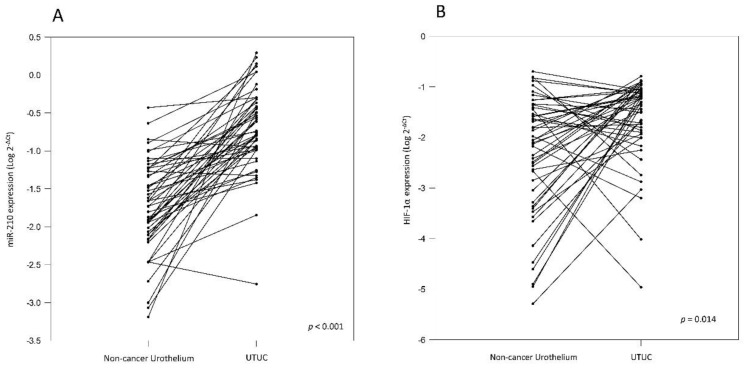
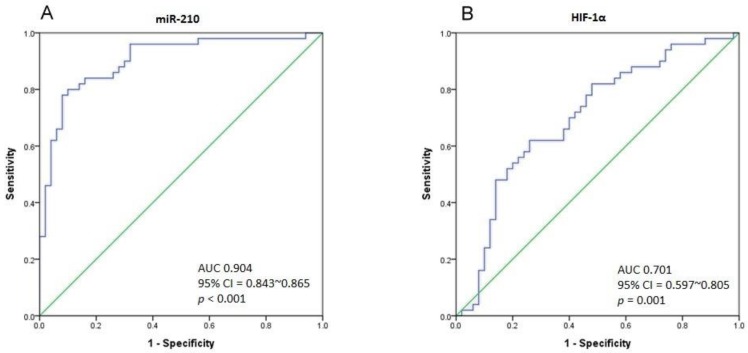
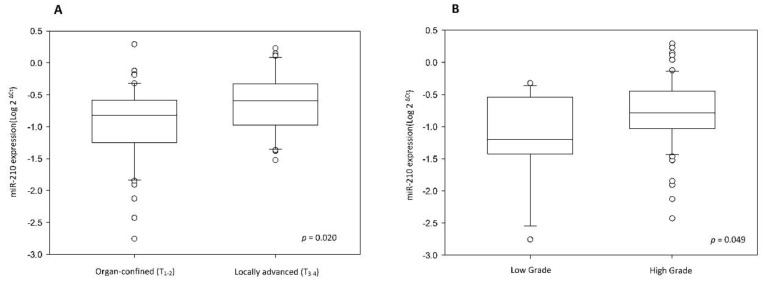
MiR-210 is overexpressed in UTUC compared to non-cancerous urothelium ( < 0.001); it is also upregulated in high-stage and high-grade tumors ( = 0.020 and 0.049, respectively). HIF-1α is overexpressed in UTUC and correlates positively with miR-210 expression ( = 0.442, = 0.001).
Both miR-210 and HIF-1α are involved in promoting UTUC carcinogenesis. MiR-210 is also correlated with tumor progression. Further studies are needed to clarify the underlying mechanism.
缺氧已被证明可促进肿瘤进展。缺氧调节的微小RNA-210(miR-210)可能在致癌作用和肿瘤进展中发挥重要作用。在本研究中,我们评估了miR-210表达在上尿路尿路上皮癌(UTUC)中的临床意义。
83例UTUC患者参与了本研究。他们均提供了癌组织样本,其中50例还提供了非癌性尿路上皮样本。通过查阅病历收集临床病理数据。采用定量实时聚合酶链反应测定miR-210和缺氧诱导因子-1α(HIF-1α)的表达。对临床病理变量与miR-210和HIF-1α表达之间的关系进行统计学分析。
与非癌性尿路上皮相比,miR-210在UTUC中过表达(<0.001);在高分期和高分级肿瘤中也上调(分别为=0.020和0.049)。HIF-1α在UTUC中过表达,且与miR-210表达呈正相关(=0.442,=0.001)。
miR-210和HIF-1α均参与促进UTUC的致癌作用。miR-210也与肿瘤进展相关。需要进一步研究以阐明其潜在机制。