Messer Lauren F, Brown Mark V, Furnas Miles J, Carney Richard L, McKinnon A D, Seymour Justin R
Climate Change Cluster, School of Life Sciences, University of Technology Sydney, SydneyNSW, Australia.
School of Biotechnology and Biomolecular Sciences, University of New South Wales, SydneyNSW, Australia.
Front Microbiol. 2017 Jun 7;8:967. doi: 10.3389/fmicb.2017.00967. eCollection 2017.
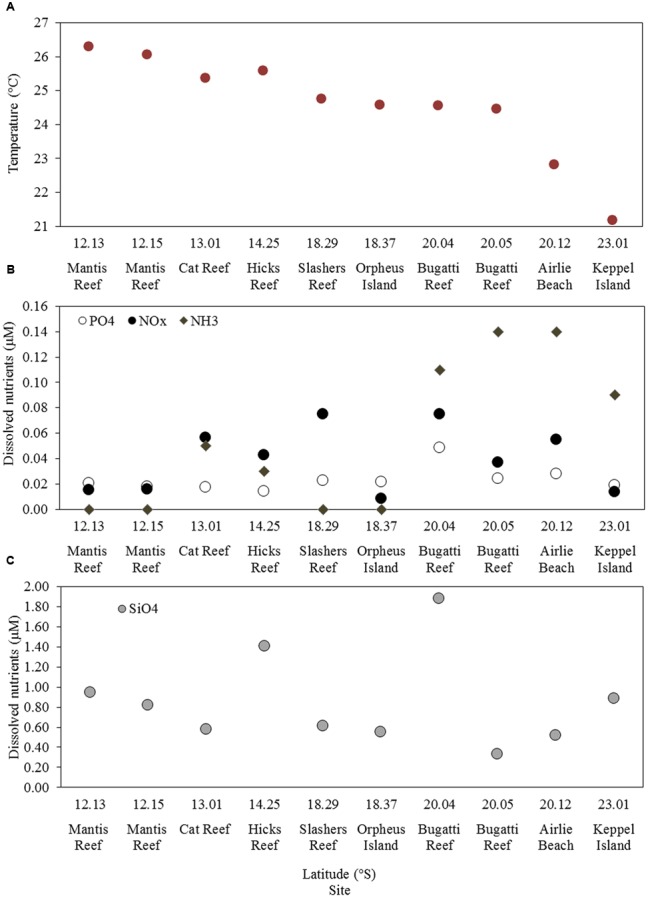
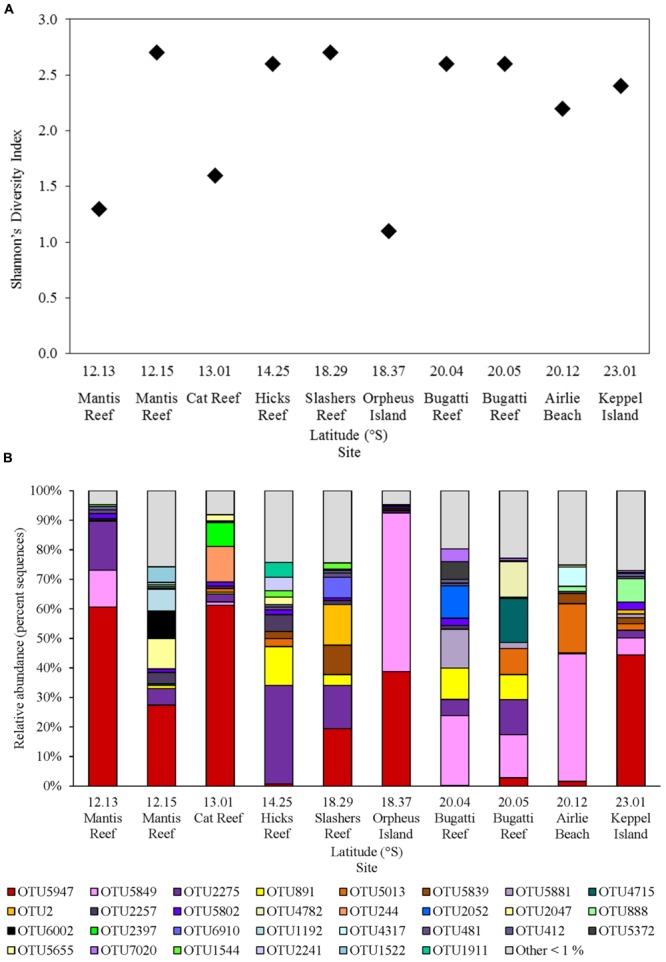
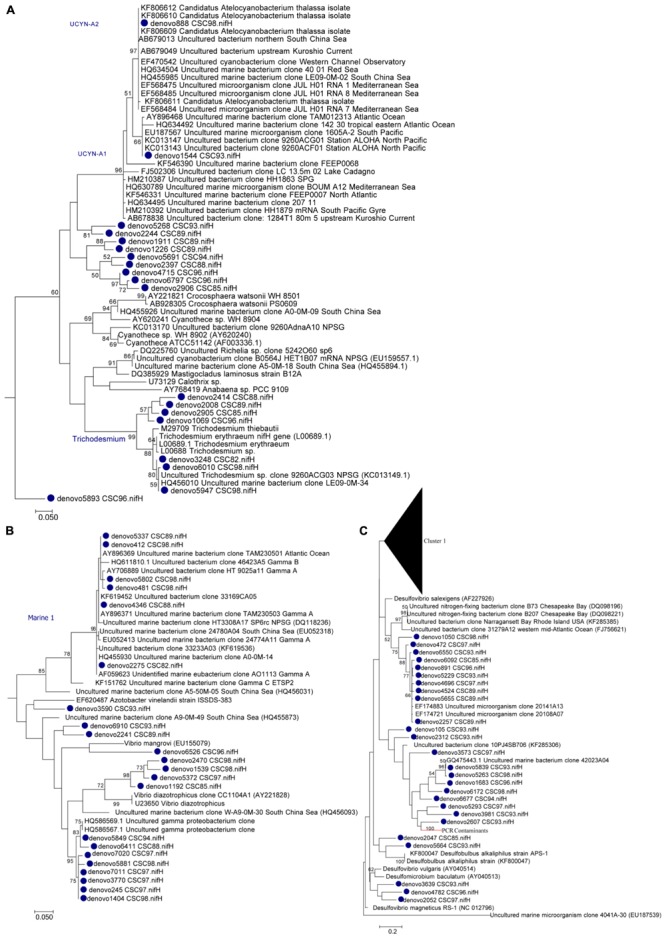
Discrepancies between bioavailable nitrogen (N) concentrations and phytoplankton growth rates in the oligotrophic waters of the Great Barrier Reef (GBR) suggest that undetermined N sources must play a significant role in supporting primary productivity. One such source could be biological dinitrogen (N) fixation through the activity of "diazotrophic" bacterioplankton. Here, we investigated N fixation and diazotroph community composition over 10° S of latitude within GBR surface waters. Qualitative N fixation rates were found to be variable across the GBR but were relatively high in coastal, inner and outer GBR waters, reaching 68 nmol L d. Diazotroph assemblages, identified by amplicon sequencing of the gene, were dominated by the cyanobacterium , γ-proteobacteria from the Gamma A clade, and δ-proteobacterial phylotypes related to sulfate-reducing genera. However, diazotroph communities exhibited significant spatial heterogeneity, correlated with shifts in dissolved inorganic nutrient concentrations. Specifically, heterotrophic diazotrophs generally increased in relative abundance with increasing concentrations of phosphate and N, while was proportionally more abundant when concentrations of these nutrients were low. This study provides the first in-depth characterization of diazotroph community composition and N fixation dynamics within the oligotrophic, N-limited surface waters of the GBR. Our observations highlight the need to re-evaluate N cycling dynamics within oligotrophic coral reef systems, to include diverse N fixing assemblages as a potentially significant source of dissolved N within the water column.
大堡礁(GBR)贫营养水域中生物可利用氮(N)浓度与浮游植物生长速率之间的差异表明,未确定的氮源在支持初级生产力方面必定起着重要作用。其中一个这样的来源可能是通过“固氮”浮游细菌的活动进行的生物固氮。在此,我们调查了大堡礁表层水域南纬10°范围内的固氮作用和固氮微生物群落组成。发现定性固氮率在大堡礁各地有所不同,但在大堡礁的沿海、内区和外区水域相对较高,达到68 nmol L d。通过对 基因的扩增子测序鉴定的固氮微生物组合,以蓝细菌、来自伽马A分支的γ-变形菌以及与硫酸盐还原属相关的δ-变形菌系统型为主。然而,固氮微生物群落表现出显著的空间异质性,与溶解无机养分浓度的变化相关。具体而言,随着磷酸盐和氮浓度的增加,异养固氮微生物的相对丰度通常会增加,而当这些养分浓度较低时, 的比例更为丰富。本研究首次深入描述了大堡礁贫营养、氮受限表层水域中固氮微生物群落组成和固氮动力学。我们的观察结果强调有必要重新评估贫营养珊瑚礁系统内的氮循环动态,将多样的固氮组合视为水柱中溶解氮的潜在重要来源。