Salama Amr, Alweis Richard
Department of Medicine, Unity Hospital, Rochester, NY, USA.
Department of Medicine, Sidney Kimmel Medical College at Thomas Jefferson University, Philadelphia, PA, USA.
J Community Hosp Intern Med Perspect. 2017 Jun 6;7(2):136-137. doi: 10.1080/20009666.2017.1328967. eCollection 2017 Mar.
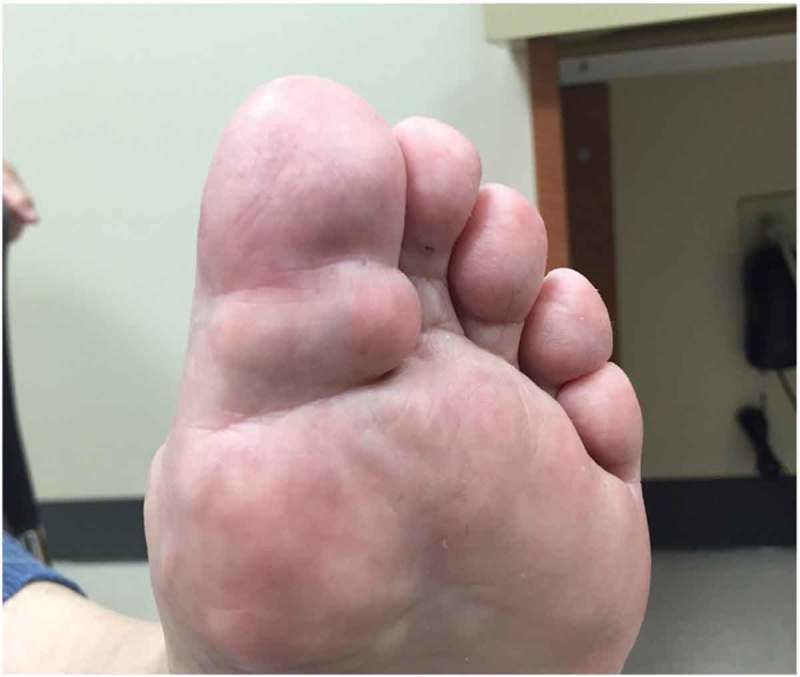
Tophi (plural of tophus, Latin for "stone") are stone-like deposits of monosodium urate in the soft tissues, synovial tissues, or in bones near the joints. They are pathognomonic for gout, the most common inflammatory arthritis in the United States, with an estimated lifetime prevalence of 4%. It is usually the end result of loss of the balance between uric acid production and excretion. It can be found anywhere in the body especially in areas of friction or trauma. It is usually painless and rarely to present as the initial manifestation of gout. It is diagnosed mainly clinically. Imaging is mainly used to assess the complication like bony erosions. The American College of Rheumatology (ACR) guidelines currently indicate that urate-lowering therapy should be initiated in patients with the presence of tophi visible on examination or imaging (ACR Evidence A). First-line therapy for urate lowering remains the xanthine oxidase inhibitor allopurinol. The ACR currently recommends colchicine, 0.6 mg (or 0.5 mg) once or twice daily, or low dose NSAIDs should be continued to reduce gout flare incidence for six months after resolution of the tophus. Daily prednisone ≤10 mg has been endorsed as an acceptable second-line prophylactic agent. ACR: American College of Rheumatology; NSAID: non-steroidal anti-inflammatory drug.
痛风石(tophus的复数形式,拉丁文意为“石头”)是软组织、滑膜组织或关节附近骨骼中尿酸钠的石状沉积物。它们是痛风的特征性表现,痛风是美国最常见的炎症性关节炎,估计终生患病率为4%。它通常是尿酸生成与排泄失衡的最终结果。它可在身体的任何部位出现,尤其是在摩擦或创伤部位。它通常无痛,很少作为痛风的初始表现出现。主要通过临床诊断。影像学主要用于评估诸如骨质侵蚀等并发症。美国风湿病学会(ACR)指南目前指出,对于在体格检查或影像学检查中可见痛风石的患者,应开始降尿酸治疗(ACR证据A)。降尿酸的一线治疗仍然是黄嘌呤氧化酶抑制剂别嘌醇。ACR目前建议,在痛风石消退后,应持续使用秋水仙碱,0.6毫克(或0.5毫克),每日一次或两次,或低剂量非甾体抗炎药,以降低痛风发作的发生率,持续六个月。每日服用≤10毫克泼尼松已被认可为可接受的二线预防药物。ACR:美国风湿病学会;NSAID:非甾体抗炎药