IRIS Team, Physiopathologie de la Vision et Motricité Binoculaire FR3636 Neurosciences CNRS, University Paris Descartes Paris France.
Brain Behav. 2017 May 1;7(6):e00658. doi: 10.1002/brb3.658. eCollection 2017 Jun.
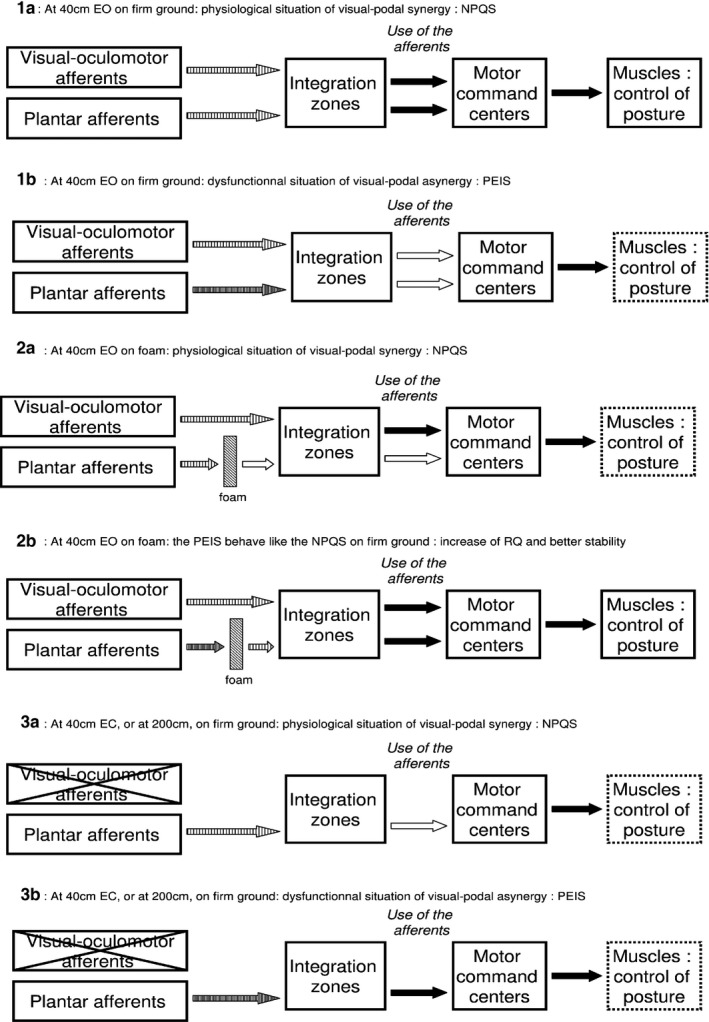
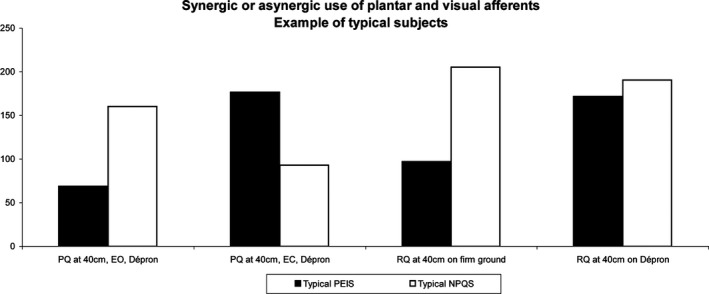
Some subjects have difficulty to integrate both visual and plantar inputs, showing at the same time a "postural blindness" and a Plantar Exteroceptive Inefficiency (PEI). The former corresponds to a better stability eyes closed (EC) than eyes open (EO), while the latter is defined as a better stability on foam than on firm ground. Clinical studies reported that a manipulation of either plantar or visual input could affect the weight of both cues in postural control, suggesting interdependence in their use. The purpose of the experiment is to characterize the PEI phenomenon better and see if such synergy can be objectified.
We recruited 48 subjects (25 ± 3.3 years) and assessed their balance with a force platform, EO, EC, at 40 or 200 cm, on firm ground, Dépron foam, Dynachoc foam, or on a 3 mm-thick Anterior Bar AB. We assessed their sensorial preferences through their PQ and RQ.
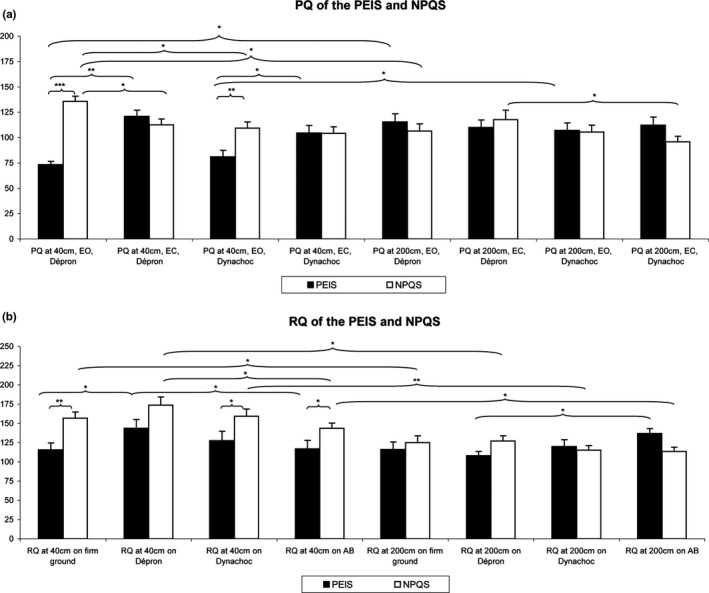
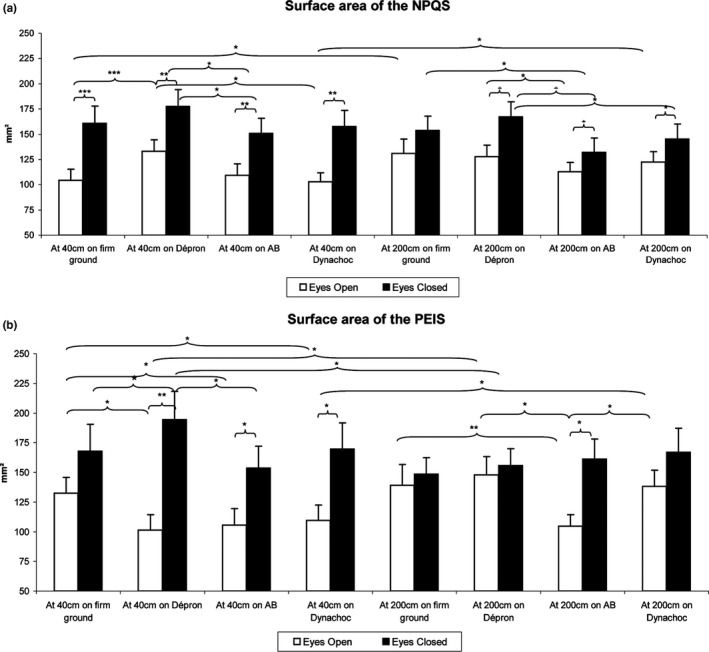
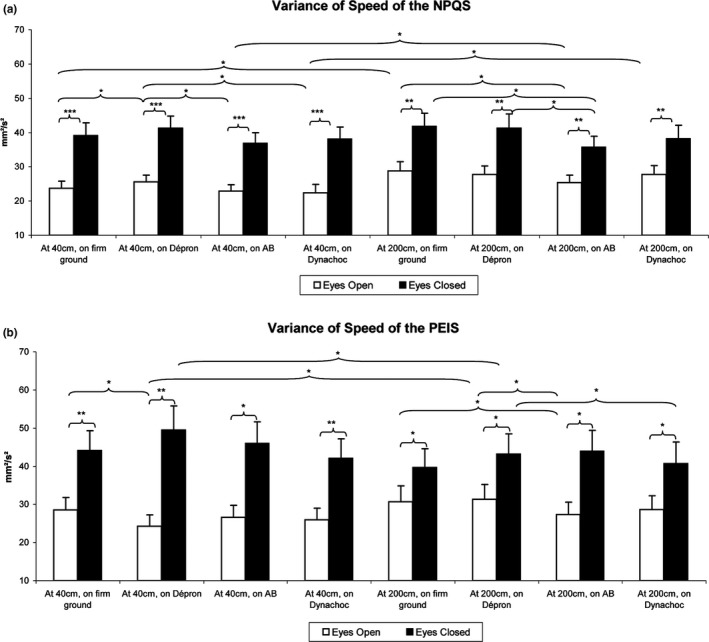
The main results are that there normally exists a synergy in the use of plantar and visual afferents, but only at 40 cm and in the absence of PEI.
Plantar Exteroceptive Inefficiency interferes with the role of vision in postural control, its effects are distance specific, are better revealed by Dépron foam and the AB improves posture but does not solve visual-podal asynergy. These results also have clinical interests as they indicate the best way in terms of distance and choice of foam to diagnostic PEI. Finally, they suggest restricting the use of the AB, commonly employed. These findings can be useful for clinicians concerned with foot, eye, and posture.
有些受试者难以整合视觉和足底输入,同时表现出“姿势盲”和足底外感受效率低下(PEI)。前者对应于闭眼(EC)时更好的稳定性,而后者则定义为在泡沫上比在坚固地面上更好的稳定性。临床研究报告说,对足底或视觉输入的操纵都可以影响姿势控制中两个线索的权重,这表明它们的使用存在相互依赖性。实验的目的是更好地描述 PEI 现象,并观察这种协同作用是否可以客观化。
我们招募了 48 名受试者(25±3.3 岁),并使用力平台评估他们在坚固地面、Dépron 泡沫、Dynachoc 泡沫或 3 毫米厚的前条 AB 上睁眼(EO)、闭眼(EC)、40 或 200cm 时的平衡。我们通过 PQ 和 RQ 评估他们的感觉偏好。
主要结果是,在使用足底和视觉传入时通常存在协同作用,但仅在 40cm 且不存在 PEI 时存在协同作用。
足底外感受效率低下会干扰视觉在姿势控制中的作用,其影响具有距离特异性,在 Dépron 泡沫和 AB 上更好地揭示,改善姿势但不能解决视觉-足底协同作用。这些结果在临床上也有意义,因为它们表明了在距离和泡沫选择方面诊断 PEI 的最佳方法。最后,他们建议限制 AB 的使用,通常被采用。这些发现对关注足部、眼睛和姿势的临床医生有用。