NeoGenomics Laboratories, 31 Columbia, Aliso Viejo, CA, 92656, USA.
Mol Diagn Ther. 2017 Oct;21(5):571-579. doi: 10.1007/s40291-017-0290-z.
We compared mutations detected in EGFR, KRAS, and BRAF genes using next-generation sequencing (NGS) and confirmed by Sanger sequencing with mutations that could be detected by FDA-cleared testing kits.
Paraffin-embedded tissue from 822 patients was tested for mutations in EGFR, KRAS, and BRAF by NGS. Sanger sequencing of hot spots was used with locked nucleic acid to increase sensitivity for specific hot-spot mutations. This included 442 (54%) lung cancers, 168 (20%) colorectal cancers, 29 (4%) brain tumors, 33 (4%) melanomas, 14 (2%) thyroid cancers, and 16% others (pancreas, head and neck, and cancer of unknown origin). Results were compared with the approved list of detectable mutations in FDA kits for EGFR, KRAS, and BRAF.
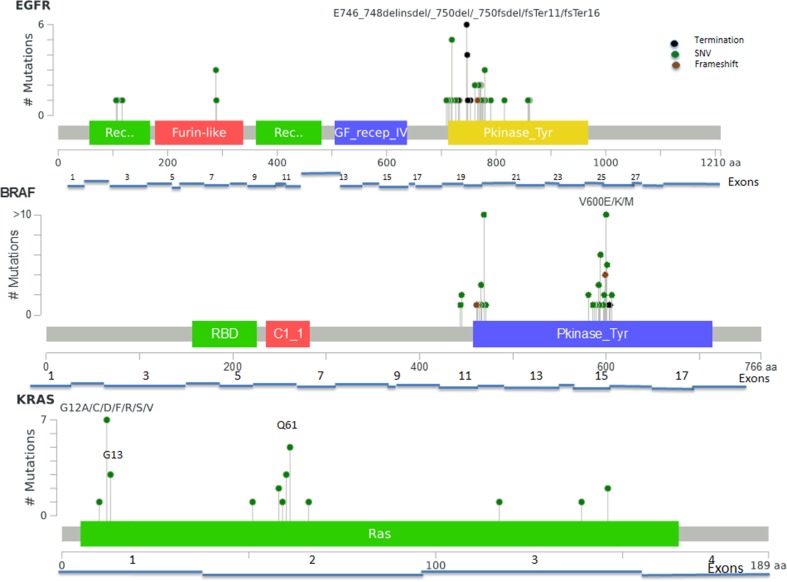
Of the 101 patients with EGFR abnormalities as detected by NGS, only 58 (57%) were detectable by cobas v2 and only 35 (35%) by therascreen. Therefore, 42 and 65%, respectively, more mutations were detected by NGS, including two patients with EGFR amplification. Of the 117 patients with BRAF mutation detected by NGS, 62 (53%) mutations were within codon 600, detectable by commercial kits, but 55 (47%) of the mutations were outside codon V600, detected by NGS only. Of the 321 patients with mutations in KRAS detected by NGS, 284 (88.5%) had mutations detectable by therascreen and 300 (93.5%) had mutations detectable by cobas. Therefore, 11.5 and 6.5% additional KRAS mutations were detected by NGS, respectively.
NGS provides significantly more comprehensive testing for mutations as compared with FDA-cleared kits currently available commercially.
我们比较了使用下一代测序(NGS)检测到的 EGFR、KRAS 和 BRAF 基因突变,并通过 Sanger 测序进行了确认,该测序方法可检测到 FDA 批准的检测试剂盒所能检测到的突变。
822 例患者的石蜡包埋组织通过 NGS 检测 EGFR、KRAS 和 BRAF 基因突变。使用带有锁核酸的热点 Sanger 测序来提高特定热点突变的检测灵敏度。这包括 442 例(54%)肺癌、168 例(20%)结直肠癌、29 例(4%)脑肿瘤、33 例(4%)黑色素瘤、14 例(2%)甲状腺癌和 16%其他(胰腺癌、头颈部和来源不明的癌症)。结果与 FDA 试剂盒批准的 EGFR、KRAS 和 BRAF 可检测突变列表进行了比较。
在通过 NGS 检测到 EGFR 异常的 101 例患者中,只有 58 例(57%)可通过 cobas v2 检测到,只有 35 例(35%)可通过 therascreen 检测到。因此,分别有 42%和 65%的患者通过 NGS 检测到更多的突变,包括两名患者存在 EGFR 扩增。在通过 NGS 检测到的 117 例 BRAF 突变患者中,62 例(53%)突变位于 600 密码子内,可通过商业试剂盒检测到,但 55 例(47%)突变位于 V600 密码子外,仅可通过 NGS 检测到。在通过 NGS 检测到的 321 例 KRAS 突变患者中,284 例(88.5%)有 therascreen 可检测到的突变,300 例(93.5%)有 cobas 可检测到的突变。因此,分别有 11.5%和 6.5%的 KRAS 突变通过 NGS 检测到。
与目前市售的 FDA 批准试剂盒相比,NGS 可显著提供更全面的基因突变检测。