Mitchell Caroline M, Srinivasan Sujatha, Zhan Xiang, Wu Michael C, Reed Susan D, Guthrie Katherine A, LaCroix Andrea Z, Fiedler Tina, Munch Matthew, Liu Congzhou, Hoffman Noah G, Blair Ian A, Newton Katherine, Freeman Ellen W, Joffe Hadine, Cohen Lee, Fredricks David N
1Vincent Center for Reproductive Biology, Massachusetts General Hospital, Boston, MA 2Fred Hutchinson Cancer Research Center, Seattle, WA 3Department of Obstetrics & Gynecology, University of Washington, Seattle, WA 4Department of Family Medicine and Public Health, University of California at San Diego, La Jolla, CA 5Department of Laboratory Medicine, University of Washington, Seattle, WA 6Department of Pharmacology, University of Pennsylvania, Philadelphia, PA 7Group Health Research Institute, Seattle, WA 8Department of Obstetrics & Gynecology and Psychiatry, University of Pennsylvania, Philadelphia, PA 9Brigham and Women's Hospital and Dana Farber Cancer Center, Boston, MA 10Department of Psychiatry, Massachusetts General Hospital, Boston, MA.
Menopause. 2017 Oct;24(10):1160-1166. doi: 10.1097/GME.0000000000000904.
To examine associations between the composition of the vaginal microbiota and genitourinary menopausal symptoms, serum estrogen, and vaginal glycogen.
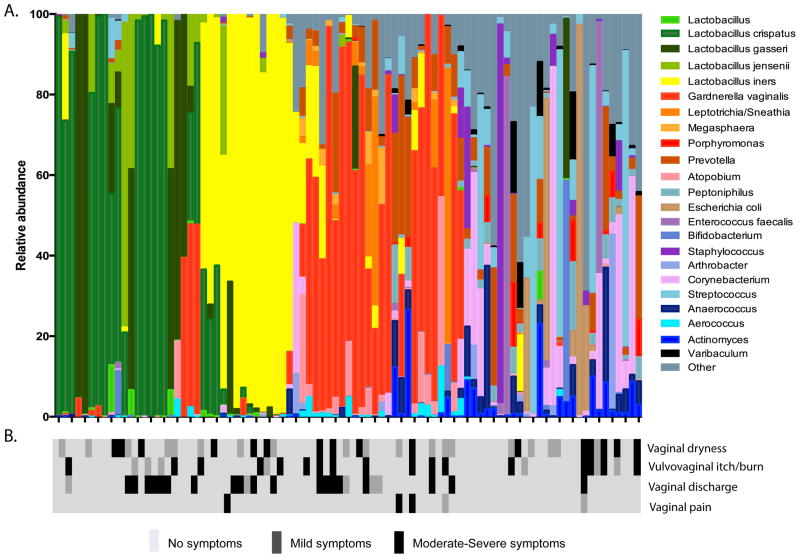
For this cross-sectional study, 88 women aged 40 to 62 years, enrolled in a hot flash treatment trial, provided vaginal swabs and a blood sample at enrollment. Bacterial communities were characterized using 16S rRNA PCR and deep sequencing targeting the V3-V4 region. Quantities of Lactobacillus crispatus and Lactobacillus iners were measured using qPCR. Self-reported genitourinary symptoms included: presence and severity of individual symptoms and identification of most bothersome symptom. Glycogen was measured fluorometrically in swab eluate. Serum estradiol (E2) and estrone (E1) were measured by liquid chromatography/mass spectrometry. Associations between bacteria, symptoms, glycogen, and serum estrogens were tested by linear regression or Wilcoxon signed-rank test, adjusted for multiple comparisons. Comparisons between groups used Kruskall-Wallis or Fisher's exact test.
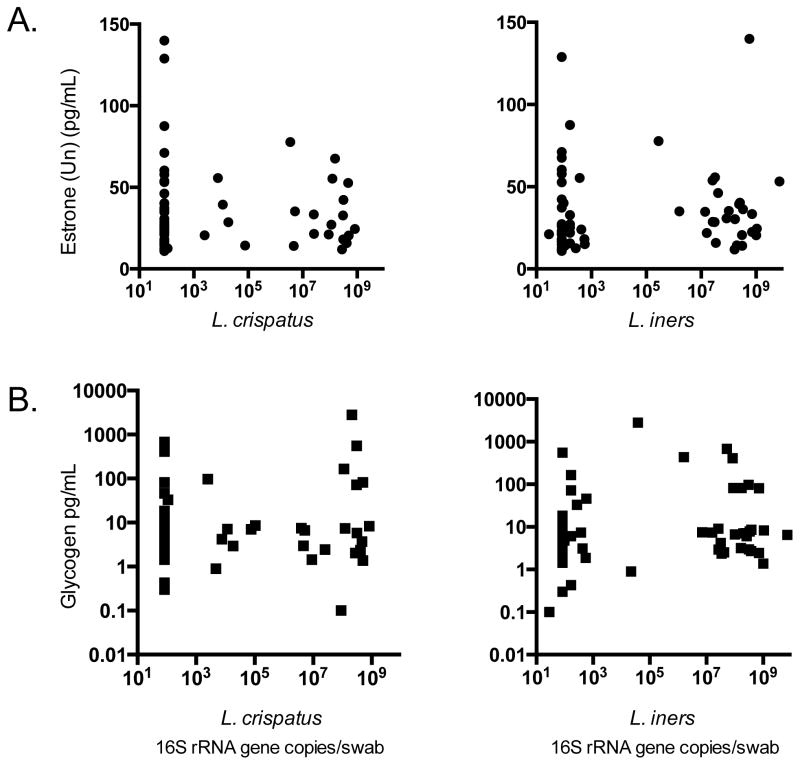
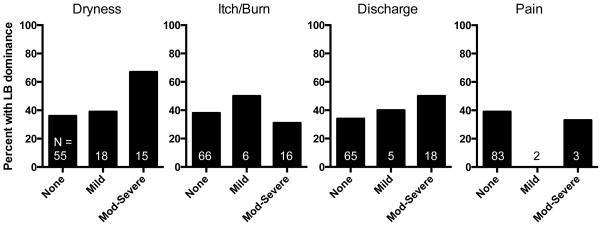
Of the 88 women, 33 (38%) had a majority of Lactobacillus species, whereas 58 (66%) had any Lactobacillus detected. Over half (53%) reported at least one vulvovaginal symptom (most commonly dryness), but symptoms were not associated with the presence of Lactobacillus species. Women with Lactobacillus-dominant communities had higher unconjugated serum estrone, but no difference in vaginal glycogen levels, compared with those with non-Lactobacillus-dominant communities. Higher serum E2 and E1 were not associated with either higher vaginal glycogen or detection of individual genera.
Presence of Lactobacillus-dominant vaginal microbiota was not associated with fewer vulvovaginal symptoms. Serum estrone was higher in women with Lactobacillus dominance, but vaginal-free glycogen was not associated with composition of the vaginal microbiota.
研究阴道微生物群组成与泌尿生殖系统更年期症状、血清雌激素及阴道糖原之间的关联。
在这项横断面研究中,88名年龄在40至62岁之间、参加潮热治疗试验的女性在入组时提供了阴道拭子和血液样本。使用针对V3 - V4区域的16S rRNA PCR和深度测序对细菌群落进行表征。采用qPCR测定卷曲乳杆菌和惰性乳杆菌的数量。自我报告的泌尿生殖系统症状包括:个体症状的存在及严重程度,以及最困扰症状的识别。用荧光法测定拭子洗脱液中的糖原。通过液相色谱/质谱法测定血清雌二醇(E2)和雌酮(E1)。通过线性回归或Wilcoxon符号秩检验来检验细菌、症状、糖原和血清雌激素之间的关联,并对多重比较进行校正。组间比较采用Kruskal - Wallis检验或Fisher精确检验。
在88名女性中,33名(38%)以乳酸杆菌属为主,而58名(66%)检测到有任何乳酸杆菌。超过一半(53%)的女性报告至少有一种外阴阴道症状(最常见的是干燥),但症状与乳酸杆菌属的存在无关。与非乳酸杆菌属占优势的女性相比,乳酸杆菌属占优势群落的女性血清未结合雌酮水平较高,但阴道糖原水平无差异。较高的血清E2和E1与较高的阴道糖原或单个菌属的检测均无关联。
乳酸杆菌属占优势的阴道微生物群的存在与较少的外阴阴道症状无关。乳酸杆菌属占优势的女性血清雌酮较高,但阴道游离糖原与阴道微生物群的组成无关。